Last verified July 2026. Every module below was tested on a paid TrendTrack account (Agency trial), not a demo.
Short version: TrendTrack is one of the strongest ad-spy and store-research tools we have tested, and the Brandtracker is the reason. The catch is that the plan most people click first cannot spy on ads at all.
So this is a hands-on review, not a feature list rewritten from a landing page. We ran the Shops database, the Ads library, the Brandtracker, Advertisers, Emails and the API on a live account across July 2026. Here is what earns the price, what is gated, and who should skip it.
Disclosure: some links on this page are affiliate links. If you subscribe through them we may earn a commission at no extra cost to you. We tested every TrendTrack feature mentioned here on a paid account.
Verdict: 4.5/5. A deep, well-built spy suite let down only by aggressive gating on its cheapest plan.
Best for: operators who spy on ads and scout products weekly. From $59/mo (or $42/mo billed annually), but ad spy starts on Pro ($89/mo).
Pros
- Four databases at real scale: 1.87M stores, 337M ads, 2.49M advertisers, 6.08M emails
- The Brandtracker follows a whole store: Meta, TikTok ads and organic, Google, emails
- Three ad platforms in one tab, with Ad Rank to surface likely winners
- Public API with an MCP server, plus a free unlimited Chrome extension
Cons
- Ad spy is gated: Starter cannot open the Ads or Advertisers modules
- Est. Revenue and competitor spend are estimates, not audited numbers
- The Trends module is still labeled Soon
- Not a supplier or fulfillment tool, and extra seats cost +€20/mo each
What TrendTrack actually is
TrendTrack is an e-commerce intelligence platform built around Shopify. You point it at a store, a niche or an ad, and it tells you what is scaling and how. Think of it as the tab you keep open next to your own store. If you want the two-minute version first, we cover how the platform works separately.
The official home is TrendTrack, and its Trustpilot score sits at 4.8. The pitch is scale plus depth, so start with the scale.
Database sizes shown in-app, checked July 13, 2026.
Scale alone does not sell a spy tool, though. Plenty of databases are big and useless. What matters is whether you can turn all that into a decision, and that is where the modules come in.
The modules, tested one by one
We opened every module on a paid account. Here is the honest read on each, starting with the one that actually sets TrendTrack apart.
Brandtracker: the differentiator
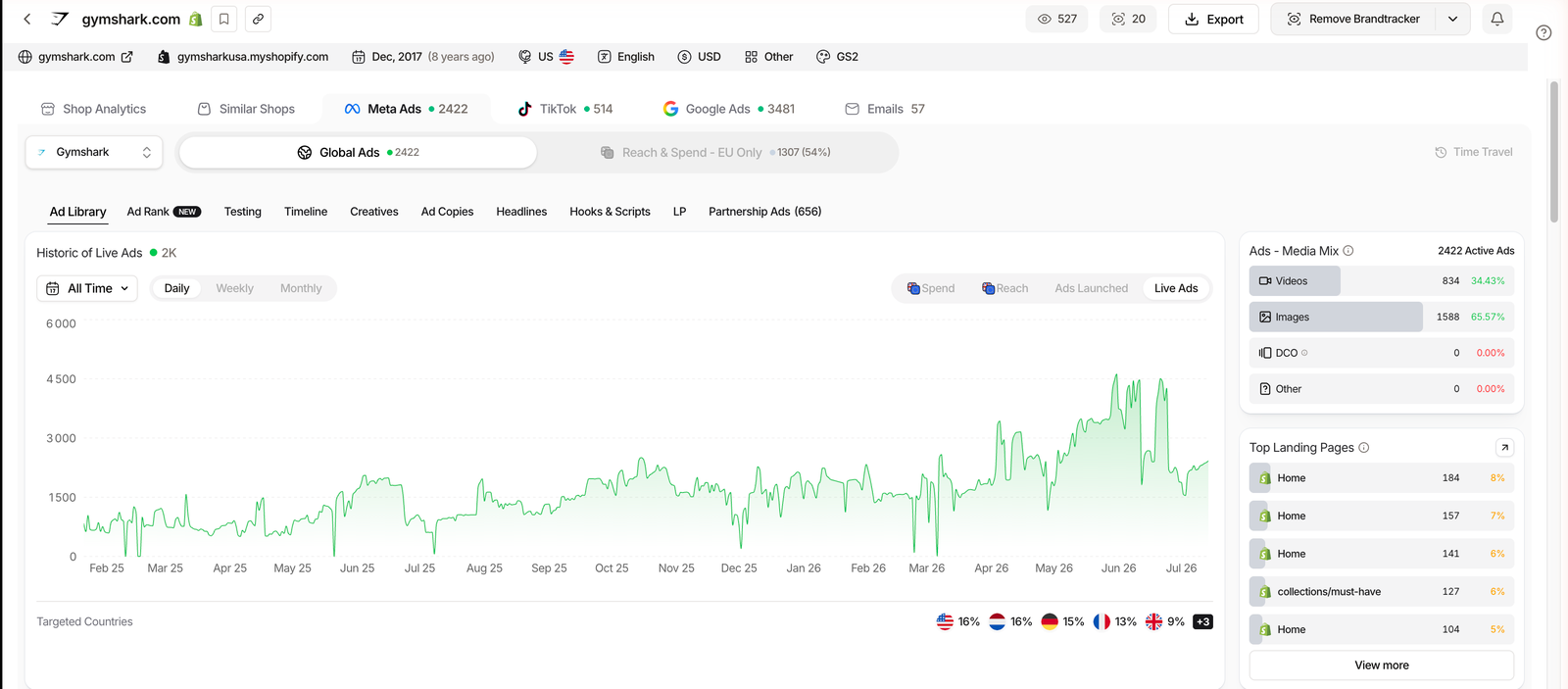
The Brandtracker is why TrendTrack is worth a review at all. You add one store and it tracks the whole brand: every Meta page, its TikTok ads and organic content, its Google ads, and its emails, in a single dashboard.
Since May 27, 2026, one slot covers a store’s entire footprint, not a single Facebook page. Inside a tracked brand you get ten Meta sub-tabs, including a day-by-day Testing timeline, a Gantt of every ad’s lifespan, bulk creative export, and a Hooks & Scripts tab that transcribes competitor video ads.
The TikTok view is the part most rivals miss. It splits a brand’s content into ads and organic, roughly 56% ads, 44% organic on the store we tracked, plus link-in-bio, top hashtags and best-performing videos. Tracking organic, not just paid, is genuinely rare. Our walkthrough on reading a brand’s TikTok ads goes through that view tab by tab.
Mini-verdict: the strongest module on the platform and the reason to buy it. If competitor funnels are your job, nothing else here compares.
Related guide
Brandtracker Tutorial: Track a Store’s Ads, Tests, Emails & LPs
A full walkthrough of every sub-tab, screen by screen.
The Shops database and Est. Revenue
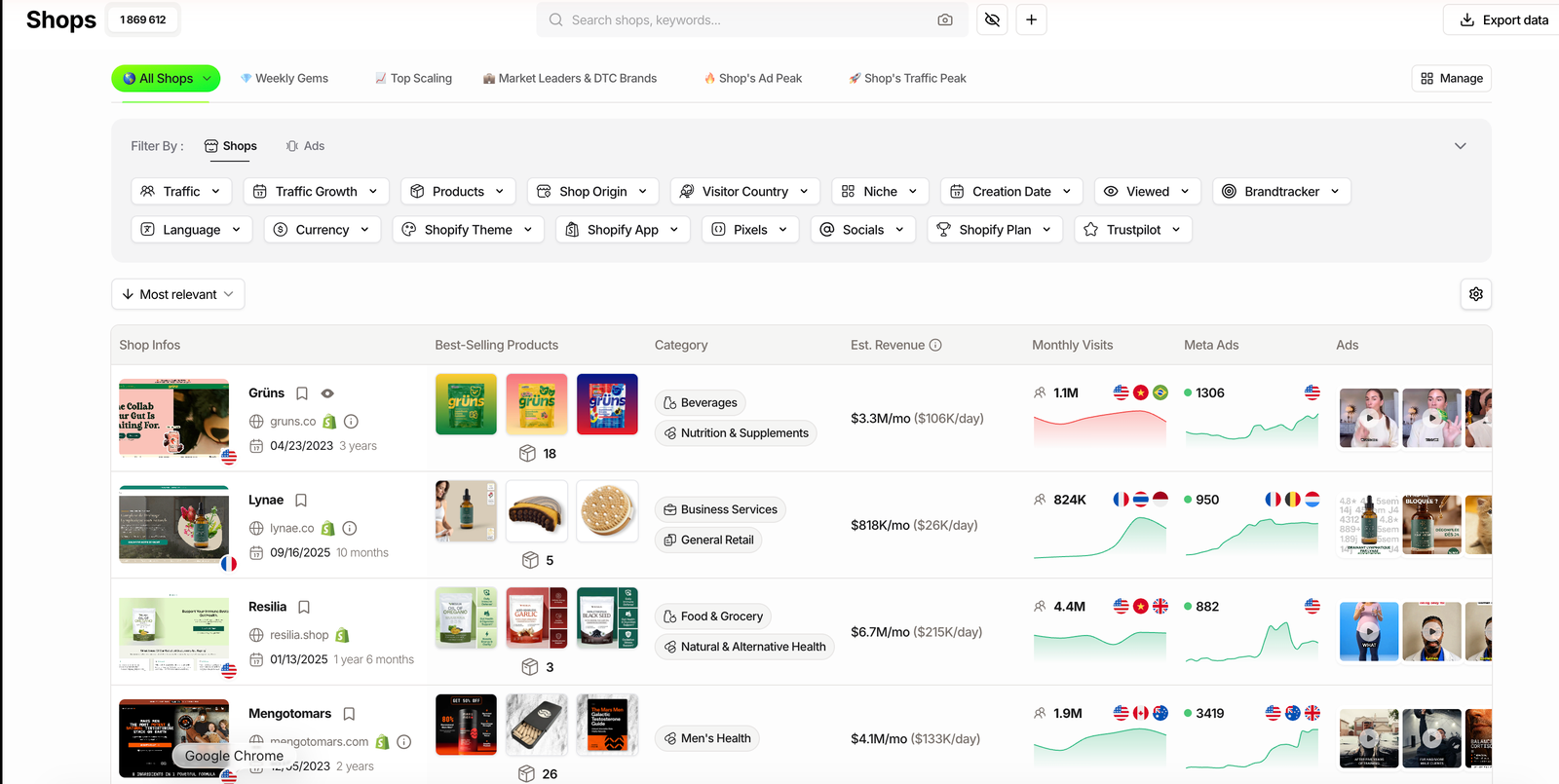
The Shops module holds 1.87M Shopify stores with 17 filters, from niche and visitor country to theme, apps, pixels and Trustpilot score. You can screen the entire index down to a shortlist of candidates in a couple of clicks.
The column people come for is Est. Revenue, hidden by default. It puts a monthly and daily figure on any store, for example a health brand estimated at around $3.3M/mo and $106K/day. Keep in mind that is an estimate read from the outside, not audited revenue, so treat it as directional. We explain how to read store revenue, and how to cross-check it, in the revenue checker guide.
There is also an AI Image Search, live since March 7, 2026, that finds the stores selling a product from a screenshot. Mini-verdict: the best store-discovery database we have used, as long as you read the revenue figure as an estimate.
Ad spy: Ads, Ad Rank and real EU spend
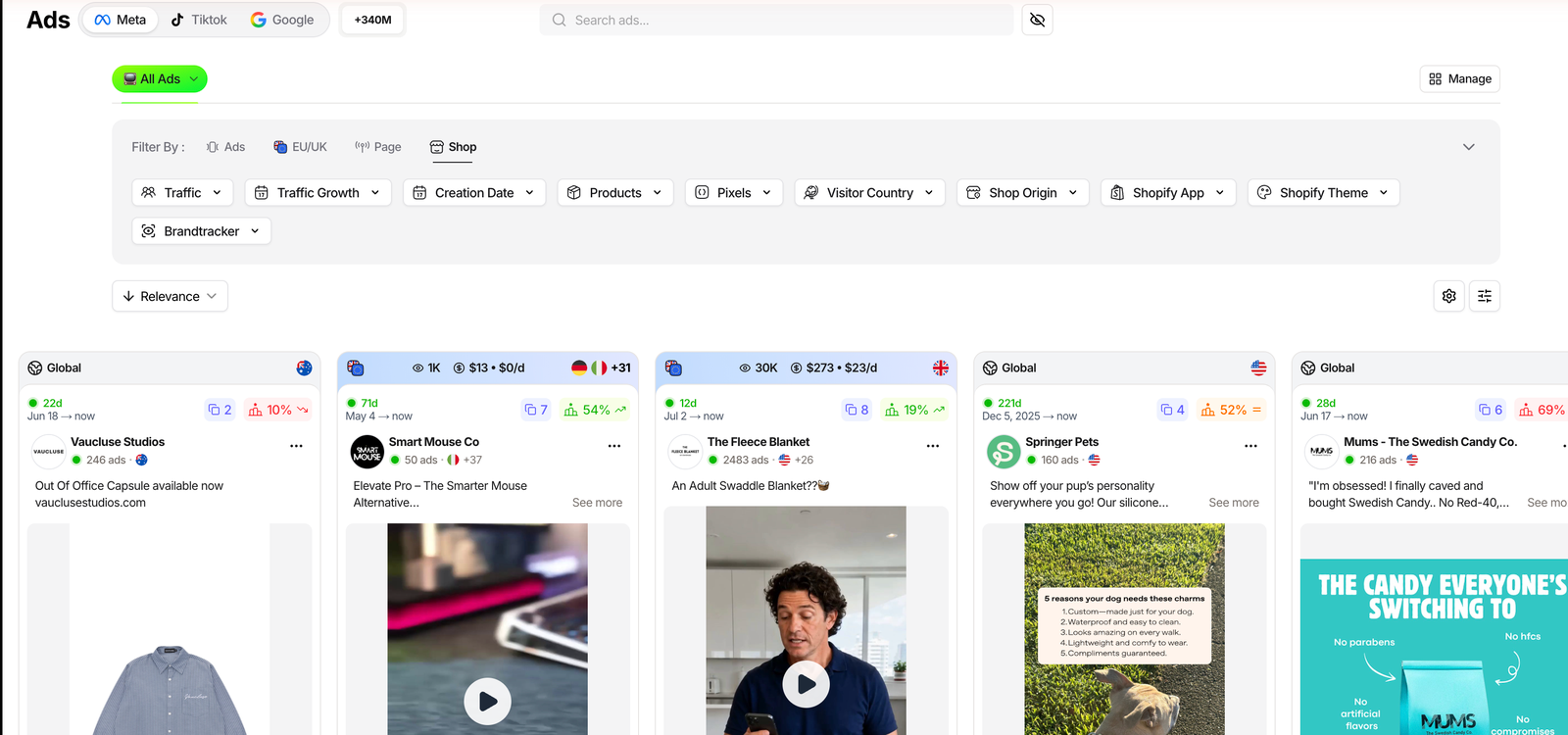
The Ads module spans 337M ads across three platforms, Meta, TikTok and Google, the last of which landed on July 1, 2026. You filter by media type, CTA, days running, the tech behind the store, and more. The Google tab behaves differently enough that we cover spying on Google search ads on its own.
Two features lift it above a raw ad dump. Ad Rank, live since January 29, 2026, ranks the ads most likely to be winning even without EU impression data. And by reading EU and UK transparency rules, TrendTrack turns a competitor’s reach into an estimated daily spend. If you want the mechanics, we cover them in the full Ads library walkthrough.
This is also where free tools stop and a paid database begins. A free source like the Google Ads Transparency Center shows you a brand’s live ads, but not which one is winning, for how long, or who else runs the same play. Mini-verdict: the ad spy is deep and cross-platform, and the winner ranking is what you actually pay for.
Advertisers, Emails, the extension and the API
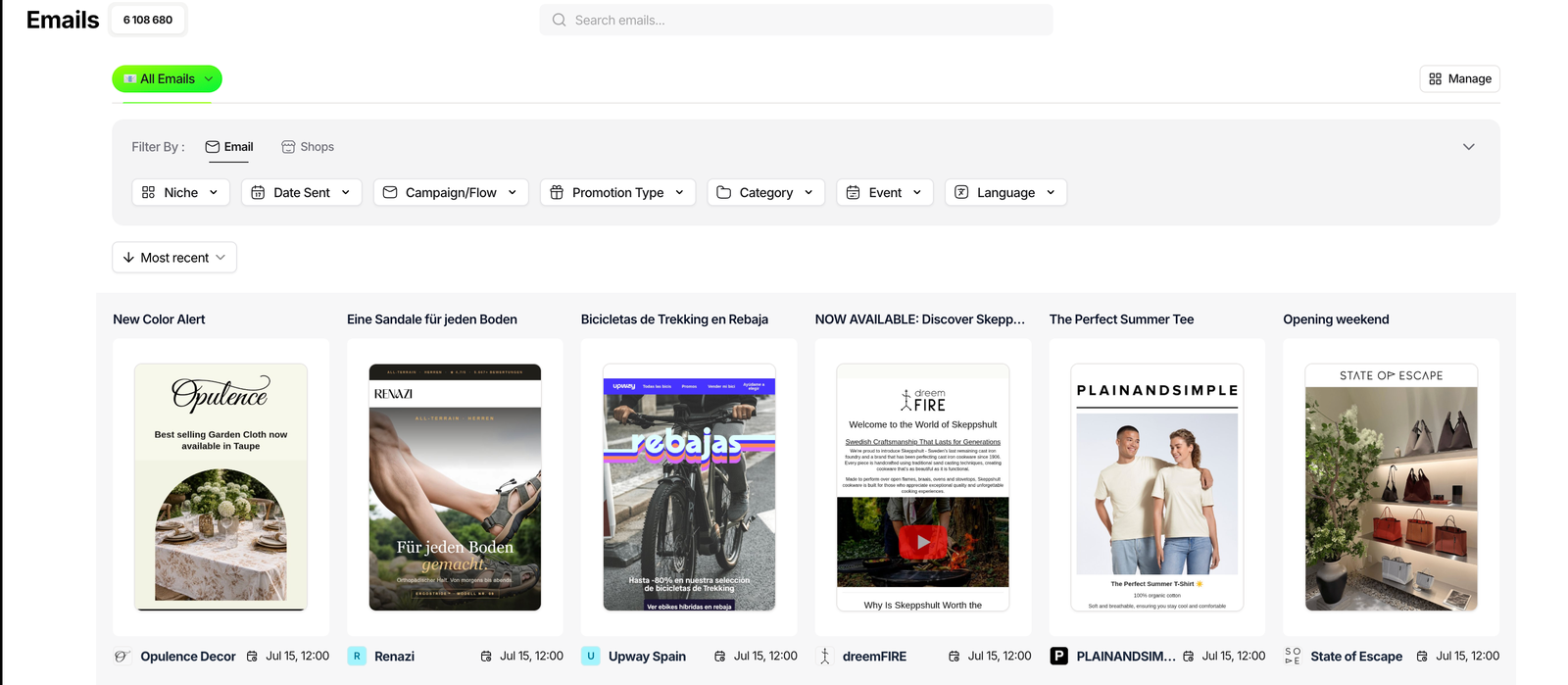
The Advertisers module ranks 2.49M ad pages by activity, surfacing lines like “48,188 ads launched in the last 14 days” so you can catch a brand ramping up. Emails is a 6.08M swipe file you can filter by flow, with 513,810 Welcome and 1,117,339 Abandoned Cart emails to model.
Two extras round it out. The free Chrome extension, rebuilt on March 13, 2026 with no usage limits, x-rays any store’s tech, ads and products. And since April 28, 2026 there is a public API with an MCP server and 11 tools that plug straight into Claude or n8n, with 10,000 API credits included on every plan. We show how to connect TrendTrack to AI end to end.
Mini-verdict: strong supporting cast. The API in particular is a real differentiator for anyone who automates their research.
See the modules on a free account
Pricing, and the one gotcha
TrendTrack has three public plans plus a hidden fourth. The full detail lives in the full pricing breakdown, but here is the shape of it.
| Plan | Starter | Pro | Business | Agency |
|---|---|---|---|---|
| Monthly | $59 | $89 | $149 | $200 |
| Annual (-30%) | $42 | $63 | $105 | – |
| Brandtrackers | 2 | 30 | Unlimited | Unlimited |
| Ads module | No | Yes | Yes | Yes |
| Advertisers | No | 1,000 | Unlimited | Unlimited |
| API credits | 10,000 | 10,000 | 10,000 | 10,000 |
Plan check: ad spy starts on Pro ($89/mo, or $63/mo annually). Starter covers the Shops database, 2 Brandtrackers, 30 mail credits and the extension, but not the Ads or Advertisers modules. If ad spy is why you are here, budget for Pro.
Billing runs monthly, quarterly at -15%, or yearly at -30%, so the annual prices above are the real floor. Two costs are easy to miss: extra seats are +€20/mo each, and the hidden Agency plan at $200/mo is aimed at multi-workspace teams and is not listed publicly. If you are about to subscribe, check the coupon page first.
Who should buy it, who should skip it
A tool this deep is not right for everyone. The honest split comes down to what your week actually looks like.
Buy it if
- You spy on competitor ads every week
- You scout products and stores to model
- You run Meta, TikTok or Google ads and want the winners
Skip it if
- You only need a supplier or fulfillment app
- You will never open the ad spy on Pro
- You want audited revenue, not estimates
For a beginner still choosing a first product, Starter is a fair entry: unlimited Shops access and two Brandtrackers for $42/mo annually is enough to learn the landscape. Just know you are not spying on ads yet.
For a scaler running paid traffic, Pro is the real plan, and the ad spy module pays for itself the first time you catch a competitor’s winning creative early. For an agency juggling several clients, Business or the Agency tier buys the seats and unlimited trackers.
TrendTrack vs the alternatives
Most sellers weigh TrendTrack against tools like Minea, PiPiAds, AdSpy or Kalodata. We compare each head-to-head in dedicated guides, but the shape of the difference is consistent.
| What you want | TrendTrack | Typical single-platform tool |
|---|---|---|
| Meta, TikTok and Google ads | Yes | Often one |
| TikTok organic, not just ads | Yes | Rare |
| Whole-store tracking and Est. Revenue | Yes | Varies |
| Public API with an MCP server | Yes | Rare |
The head-to-heads
- TrendTrack vs Minea
- TrendTrack vs PiPiAds
- TrendTrack vs AdSpy
- TrendTrack vs Kalodata
- TrendTrack vs Dropship.io
- TrendTrack vs Winning Hunter
The pattern: many rivals go deep on one surface, while TrendTrack goes wide across a store’s whole funnel. Where a competitor wins on a single dimension, the dedicated comparison spells it out. Read the full head-to-heads before you decide, because the right answer really does change by use case. If you would rather see the whole field at once, we list what else is on the market.
How we tested TrendTrack
This review is based on hands-on use, not a press kit. We ran TrendTrack on a paid account, an Agency trial, across July 2026, and opened every module discussed above.
We built a live Brandtracker on a real brand to document the Meta, TikTok, Google and email views, ran filters across the Shops and Ads databases, checked feature release dates against the in-app What’s New changelog, and confirmed pricing on the in-app billing page. Every figure here traces back to the app or its changelog.
Where a number is an estimate, we say so. Est. Revenue, competitor spend and monthly visits are modeled figures, useful as direction, not as audited accounts. We do not claim any revenue result of our own, because a spy tool is judged on its data, not on a success story.
FAQ
Is TrendTrack legit?
Yes. It is a real company with a Trustpilot score of 4.8, and we tested it on a paid account in July 2026. It indexes 1.87M Shopify stores and 337M ads across Meta, TikTok and Google. Its estimated figures, like revenue and competitor spend, are estimates rather than audited numbers.
How much does TrendTrack cost?
There are three public plans: Starter $59/mo, Pro $89/mo and Business $149/mo, or $42, $63 and $105 billed annually at -30%. A hidden Agency plan runs $200/mo. Ad spy, meaning the Ads and Advertisers modules, starts on Pro, not Starter.
Is TrendTrack worth it?
It depends on your job. For operators who spy on ads and scout products weekly, the Brandtracker, Est. Revenue and three-platform ad spy make it a strong pick. If you only need supplier or fulfillment tools, it is not the right buy.
Does the Starter plan include ad spy?
No. Starter at $59/mo covers the Shops database, 2 Brandtrackers, 30 mail credits and the free Chrome extension, but not the Ads or Advertisers modules. Full ad spy starts on Pro at $89/mo.
What makes TrendTrack different from other ad spy tools?
The Brandtracker follows a competitor’s whole funnel: Meta, TikTok ads and organic, Google, and emails. It transcribes video hooks, reads estimated EU and UK spend, and adds an Est. Revenue estimate, a public API with an MCP server, and a free unlimited Chrome extension.
Does TrendTrack have a free trial or free tools?
There is no fixed-length, self-serve free trial. What is free is the Chrome extension, with no usage limits since its March 2026 rebuild, plus a free account that opens an interactive demo on real data. The extension x-rays a store’s tech, ads and products without a paid plan, and paid plans cancel anytime with no lock-in, so a single month acts as your trial. For the whole picture, see how to try it without paying.
The verdict, scored
TrendTrack earns its 4.5 on depth. The Brandtracker, the three-platform ad spy with Ad Rank, and the Est. Revenue estimates are a genuinely strong package for anyone whose week involves watching competitors. Here is how it breaks down by axis.
| Axis | Score | Why |
|---|---|---|
| Data depth | 4.8 | Four databases at real scale, refreshed and filterable |
| Ad spy | 4.7 | Three platforms, Ad Rank, estimated EU spend, video transcripts |
| Product research | 4.3 | Strong discovery, but Est. Revenue is an estimate and there is no sourcing |
| Price and value | 4.2 | Fair for Pro, but Starter cannot spy on ads and seats cost extra |
| Support and extras | 4.4 | Trustpilot 4.8, API and MCP, free extension, but Trends still Soon |
The bottom line: if you spy on ads and scout products, this is one of the best tools on the market, and the Brandtracker alone can justify the subscription cost. If ad spy is the goal, do not stop on Starter, because the module you came for lives on Pro.
See it on your own competitors first
Open a free account, track one rival store, and watch the whole funnel light up. Ad spy starts on Pro ($89/mo, or $63/mo billed annually). Starter ($59) covers Shops and the free Chrome extension.