Last verified July 15, 2026. Modules, filters and gating were checked live on a paid TrendTrack account; ad counts were read from the app the same day.
You spend two weeks and real money on a clean studio ad. Then a competitor posts a shaky phone clip of someone unboxing the same product on their kitchen counter, and it quietly outspends you for a month.
That clip is a UGC ad. It looks like a normal creator post, so people watch it instead of scrolling past. This guide breaks down what actually makes UGC convert, then shows you exactly where to find the ones your competitors are already running.
UGC ads (user-generated content ads) are paid ads built from content that looks like a real creator post: a real person, filmed on a phone, talking to camera or demoing a product. You find competitor UGC for free in Meta’s Ad Library and TikTok’s Creative Center, or at scale by filtering an ad-spy index like TrendTrack for video creatives.
Disclosure: some links on this page are affiliate links. If you subscribe through them we may earn a commission at no extra cost to you. We tested every TrendTrack feature mentioned here on a paid account.
What UGC ads actually are
UGC stands for user-generated content. In practice, a UGC ad is any paid creative that mimics the look of an organic post instead of a branded campaign.
No agency lighting, no voiceover, no logo sting. Just a person and a product, shot the way a friend would film it. The point is to blend into the feed so the viewer lowers their guard.
The “user” is loose. The person on camera can be a hired creator, the founder, or an actual customer. What matters is the style, not who literally pressed record.
Source: TrendTrack app headers and the Gymshark Brandtracker, read July 15, 2026. Counts grow over time.
Why does the format matter so much? Because the feed rewards it. A clip that reads as content earns longer watch-through, and longer watch-through tends to pull cheaper CPMs and stronger click-through than an obvious ad.
That is the whole trade. You give up polish and gain attention.
What makes a UGC ad actually work
Here is the part most guides get wrong: it is not the camera. A UGC ad wins on structure, not production value.
The hook does most of the heavy lifting. If the first three seconds fail, the other three parts never get watched, no matter how good the product is.
The common winning angles are simple. Problem-solution opens on a pain point, then shows the fix. Unboxing rides curiosity. A testimonial leans on a real voice, and a before-and-after sells the transformation in one cut.
Authenticity beats polish almost every time. A clip that feels staged breaks the illusion, and the moment it reads as an ad, watch-through drops and CPMs climb. So when you study competitor UGC, read the structure, not the resolution.
Where to find UGC ads for free
Two free libraries cover most of what you need. Start with Meta.
Meta’s Ad Library shows every active Facebook and Instagram ad for any page. Search a competitor, filter to their video ads, and you are looking at their live UGC. Our full walkthrough of the Facebook Ad Library covers the search operators in depth.
For short-form, use TikTok’s Creative Center. It surfaces top-performing TikTok ads by market and objective, which is the closest free view of what UGC is winning on that platform. This all sits inside the wider job of how to spy on competitors’ ads, so treat it as one input, not the whole picture.
Related guide
TikTok Creative Center: How to Use It
The free way to browse top-performing TikTok UGC by market and objective.
Both libraries are great for a first look. But here is the catch: each one is single-platform, neither ranks ads by winner, neither shows how long an ad has run, and neither transcribes the video for you.
So you see the creative without the context. You cannot tell the test from the winner.
Where to find competitor UGC at scale
This is where a dedicated ad-spy index changes the job. Instead of browsing one page at a time, you filter the whole market at once.
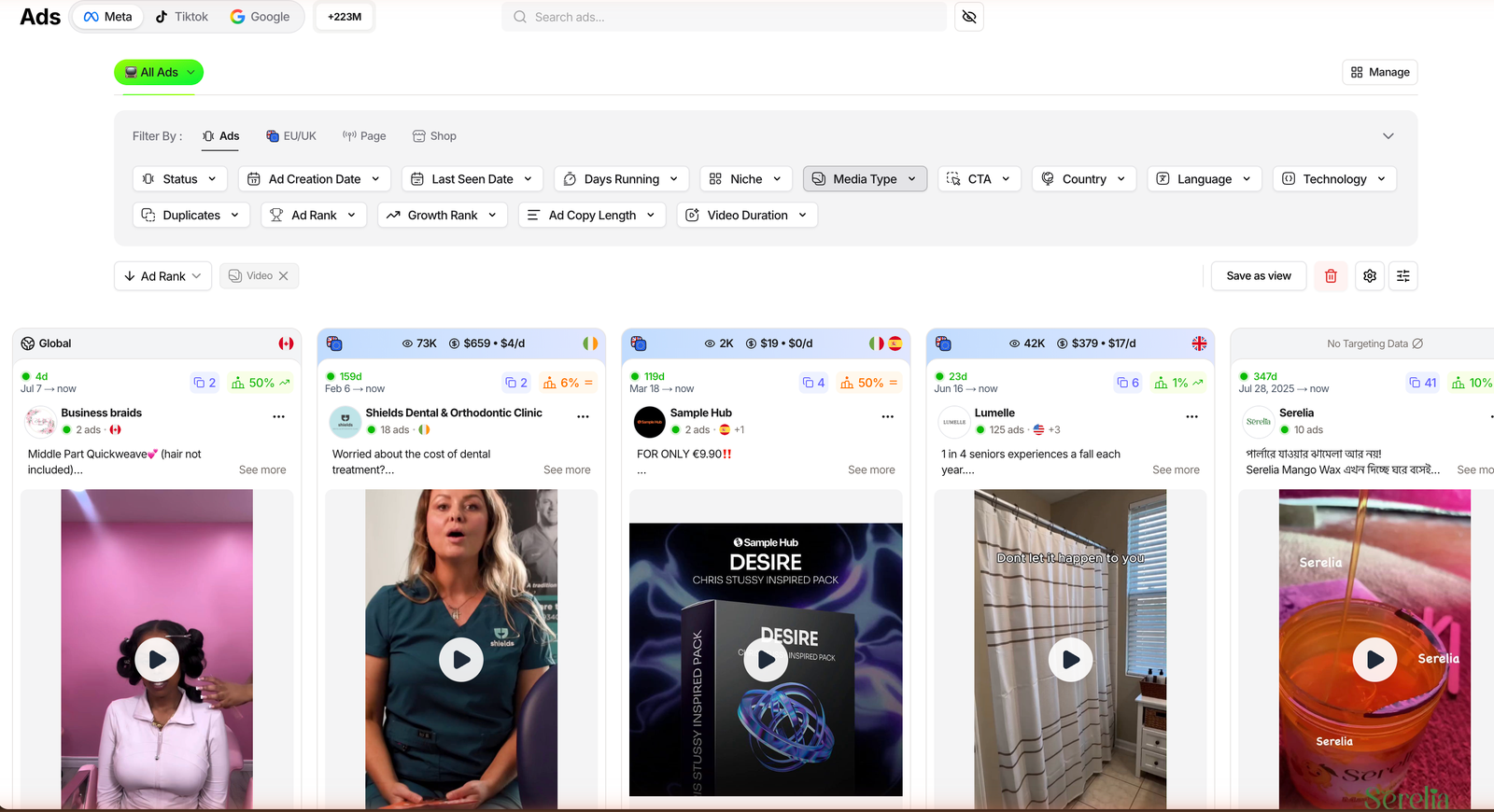
In TrendTrack’s Ads module, set Media Type to Video and sort by Longest Active or Ad Rank. Duration is the cheapest winner signal you have: an ad that has run for weeks is usually paying for itself.
The next layer is whitelisting. A lot of a brand’s best UGC never runs from the brand page at all.
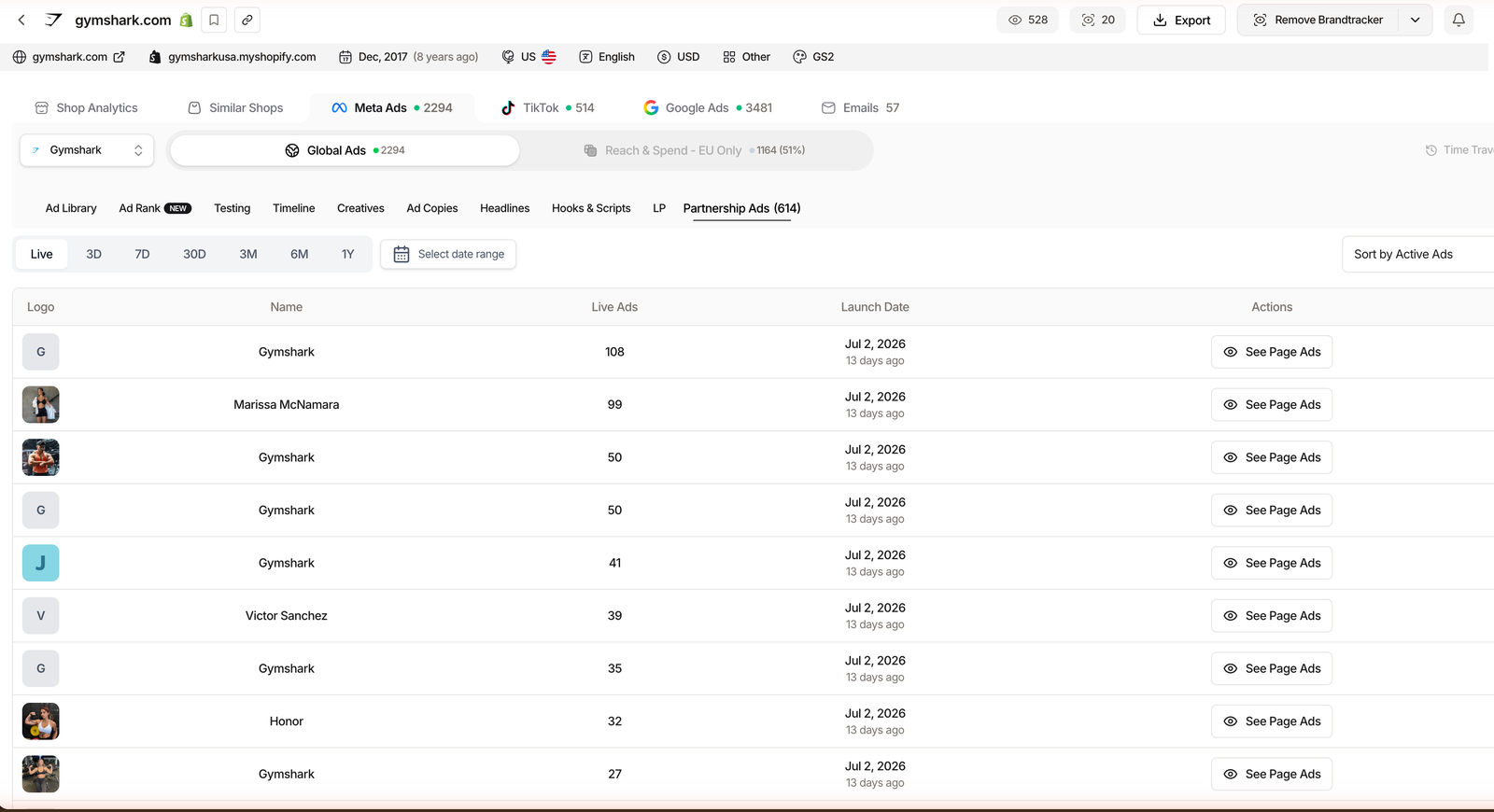
The Partnership Ads tab lists every creator whose handle a tracked store is running ads through. That is where the whitelisted, creator-native UGC lives, the stuff that looks fully organic in the feed.
Then read the script. TrendTrack’s Brandtracker transcribes competitor video ads, so you can study the opening line without replaying the clip twenty times.
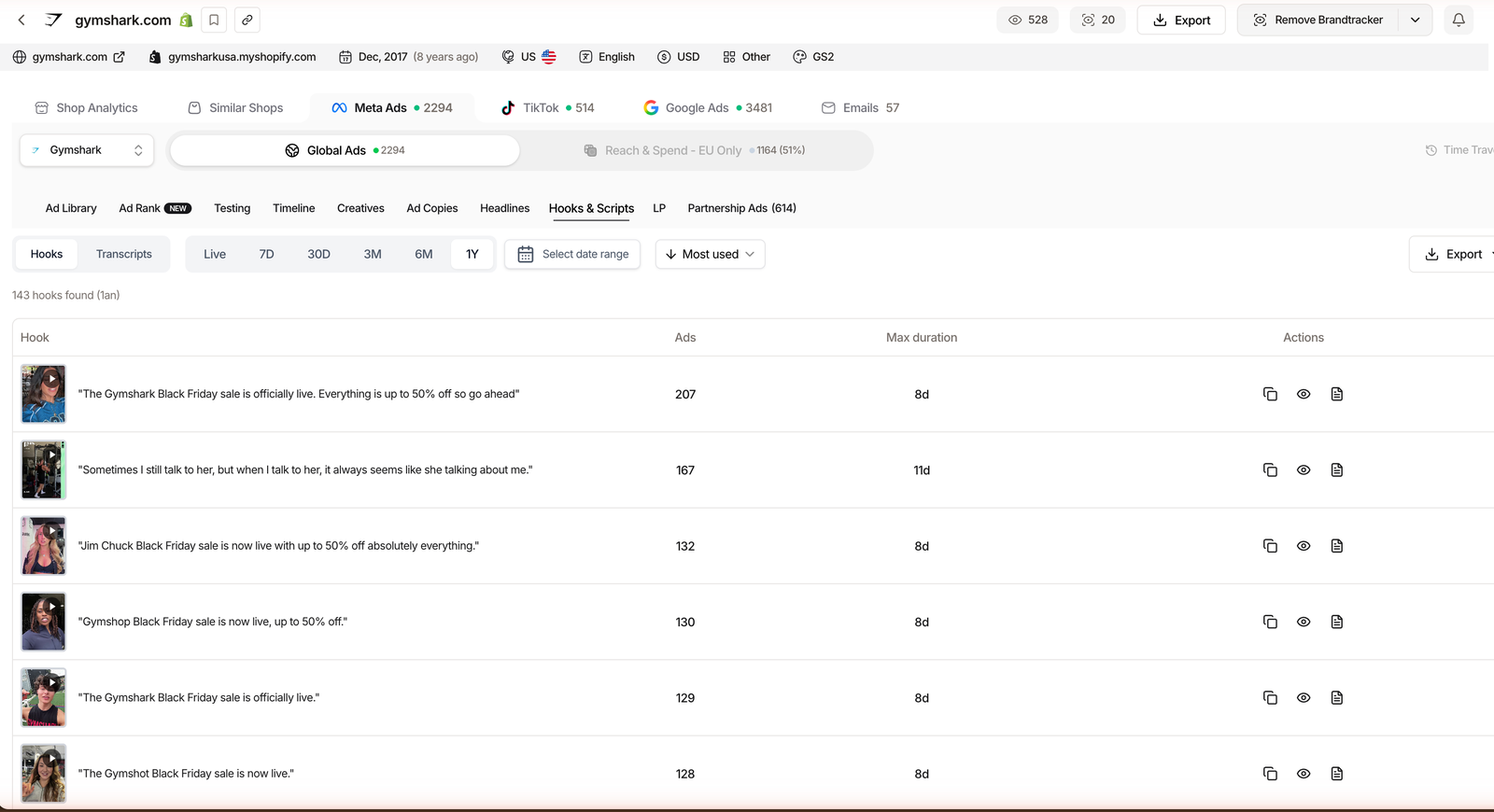
The Hooks & Scripts tab ranks hooks by how many ads reuse them and gives you the full transcript. TikTok organic tracking shipped June 8, 2026, so you can also see which non-paid creator clips a brand is leaning on.
One more read worth taking: the media mix. A tracked store’s Ad Library view breaks its live creatives into videos versus images, so you can tell at a glance whether a competitor is betting on UGC video or static at any given time.
Plan check: the Ads module and Partnership Ads start on Pro ($89/mo, or $62/mo billed annually). Starter ($59) covers Shops, two Brandtrackers and the free Chrome extension, but not ad spy.
Start with the free extension to x-ray a single store, then move up to Pro when you want to filter the whole index by video and days running.
Related guide
TrendTrack Ads Library
Filter 337M ads by media type, days running and Ad Rank to isolate winning UGC.
Turn what you found into your own UGC brief
Spotting a winner is only half the work. The point is to turn it into a brief a creator can shoot.
Take the four parts you studied and write them down for your own product: the hook you will open on, the format (talking head, demo, unboxing), the proof you will show, and the soft CTA to close. That is a creator brief.
Worked example: a competitor’s longest-running video opens with “I was skeptical too.” That is a skeptic hook. You do not copy the line, you keep the shape: open on the objection your own buyers have, then answer it.
Do the same for the other three parts. Match the format to your product, plan a proof shot that fits what you sell, and end on a CTA no harder than theirs.
One guardrail: borrow the angle, never the clip. Copying a competitor’s exact creative is both a legal risk and a bad idea, because the same video rarely wins twice. Rebuild the structure with your own product and your own person.
Your UGC research workflow
Put it together and the whole process is three phases: spot the winners, read them, then brief your own.
Phase 1: Spot
- Open Meta’s Ad Library or the Ads module and filter to video only.
- Sort by Longest Active or Ad Rank to push winners to the top.
- Save the five video ads that have run longest in your niche.
Phase 2: Read
- Note the hook in the first three seconds of each one.
- Tag the format: talking head, demo, unboxing or before-and-after.
- Read the transcript and mark the proof moment and the CTA.
Phase 3: Brief
- Pick the one angle that fits your product best.
- Write a one-page brief: hook line, format, proof shot, soft CTA.
- Send it to a creator and test two hook variants against each other.
| For UGC research | Free libraries | TrendTrack |
|---|---|---|
| Browse UGC by platform | Yes | Yes |
| Filter to video creatives only | Limited | Yes |
| See days running (winner signal) | No | Yes |
| Read the hook and transcript | No | Yes |
| Find whitelisted creators | No | Yes |
| Track a store over time | No | Yes |
| Price | Free | From $59/mo, ad spy on Pro $89 |
FAQ
What are UGC ads?
UGC ads (user-generated content ads) are paid ads built from content that looks like a normal creator post: a real person, filmed on a phone, talking to camera or demoing a product. They trade production polish for authenticity, which usually earns cheaper watch-through on Meta and TikTok feeds. Brands run them from their own page or from a creator’s handle (whitelisting).
Why do UGC ads work better than studio ads?
They blend into the feed. A shaky phone testimonial reads as content, not an interruption, so people watch longer before scrolling. That watch-through and the built-in social proof tend to lift click-through and lower CPMs. It is not a rule: plenty of polished ads win too. The real driver is the hook in the first three seconds, not the camera.
Where can I find UGC ads from competitors for free?
Two free libraries cover most of it. Meta’s Ad Library shows every active Facebook and Instagram ad for any page, and TikTok’s Creative Center surfaces top-performing TikTok ads by market and objective. Both let you browse, but neither sorts by winner, shows how long an ad has run, or transcribes the video, so you see the creative without the context.
How do I know which UGC ad is actually winning?
Duration is the cheapest signal: an ad that has run for weeks is usually paying for itself. Free libraries hint at start dates but do not rank ads. A dedicated tool like TrendTrack sorts 337M ads by Longest Active and Ad Rank, so you can spot the video creatives a competitor keeps live and copy the angle, not the guess.
What is a whitelisted or partnership UGC ad?
Whitelisting is when a brand runs ads from a creator’s own handle instead of the brand page. The ad shows the creator’s name and following, which makes it feel like an organic post rather than a brand campaign. TrendTrack’s Partnership Ads tab lists every creator a tracked store is running ads through, which is where a lot of a brand’s best UGC actually lives.
The bottom line
UGC ads win because they look like content, not ads. What makes them convert is structure, the hook, format, proof and soft CTA, far more than the camera.
Finding them is the easy part once you know where to look. Free libraries give you a first pass; a dedicated index gives you the winners, the days running, the transcripts and the creators behind them.
If you research UGC weekly, that context is worth the Pro tier. If you only check occasionally, start with the free tools and start a TrendTrack account when browsing stops being enough.