Last verified July 15, 2026. Each platform’s free tool and the TrendTrack Ads module were checked hands-on on a paid account.
Three platforms hold almost every ad your competitors are running right now. None of them shows you the same thing, and none of them talks to the others.
Meta has the widest public library. Google quietly indexes ads you never see in your feed. TikTok is the only place where the organic post and the paid ad sit side by side.
This maps all three as spy surfaces: what each one reveals, where each one goes dark, and how to stop hopping between tabs to piece the picture together.
There is no single best ad spy platform. Meta’s Ad Library is the deepest public archive, Google’s Transparency Center covers Search, Display and YouTube, and TikTok’s Top Ads adds the organic signal. Pick by goal, or search all three from one database.
Disclosure: some links on this page are affiliate links. If you subscribe through them we may earn a commission at no extra cost to you. We tested every TrendTrack feature mentioned here on a paid account.
The three ad spy surfaces at a glance
Every serious ad spy workflow starts with the free, first-party tools each platform publishes. They exist because of ad-transparency law, so they are honest about what is running, but stingy about everything else.
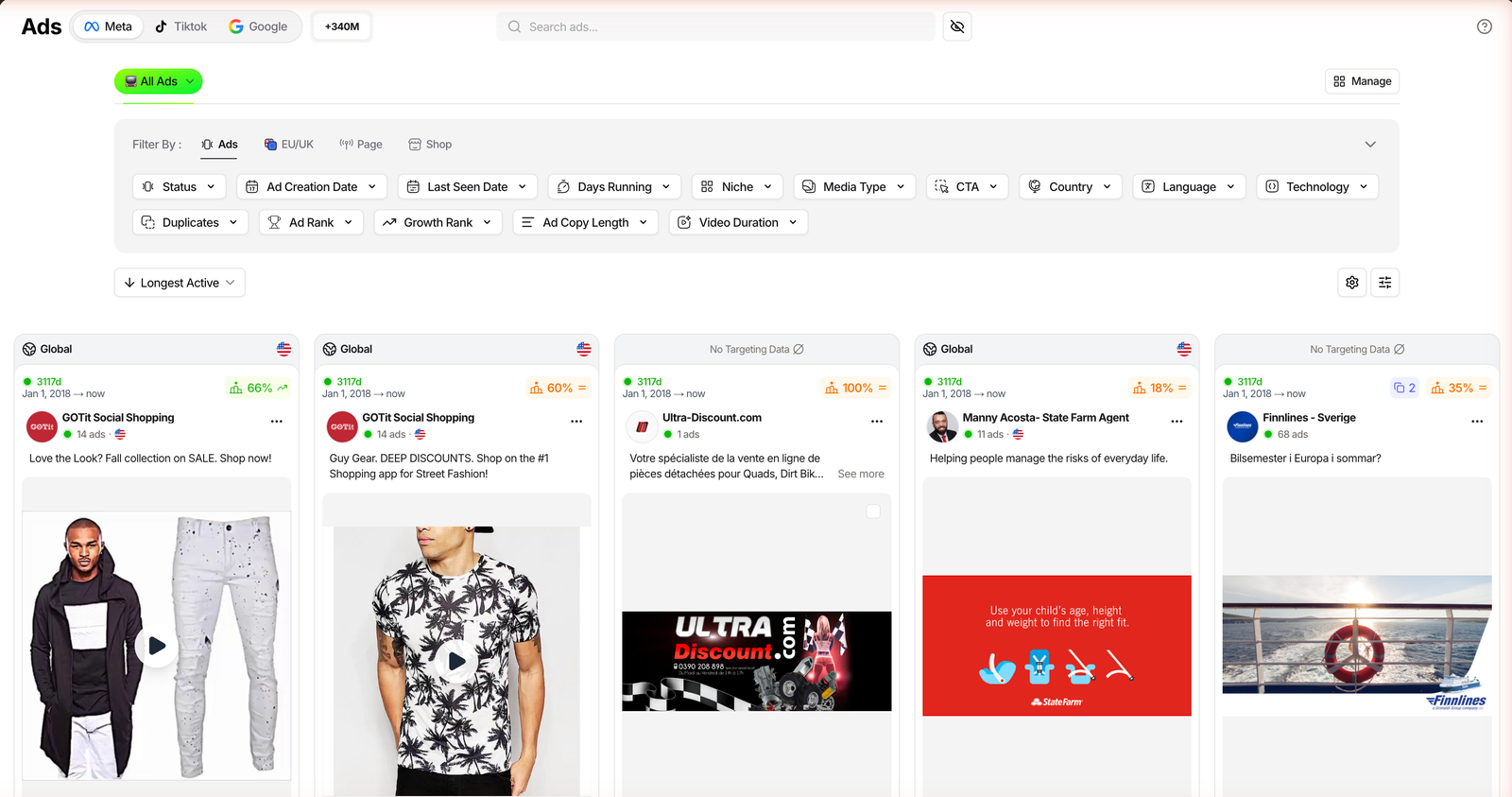
Before comparing them, it helps to see how much of this lives in one place once you index it. Aggregators pull the three feeds together and add the layer the native tools refuse to: history, ranking, and estimated spend.
TrendTrack in-app headers, checked July 13, 2026. The counter grows daily.
The native tools split cleanly along a few lines: coverage, whether they hint at spend, and whether you can search across brands. This is where they stand today.
| Native tool | Facebook Ad Library | TikTok Top Ads | Google Transparency Center |
|---|---|---|---|
| Every active ad shown | Yes | Limited | Yes |
| Estimated reach or spend | Limited (EU/UK only) | No | No |
| Days-running history | Limited | No | Limited |
| Search across all brands | Yes | Limited | No |
| Organic content shown | No | Limited | No |
| Sort by performance | No | Yes | No |
Read across the rows and the pattern is clear. Each native tool is strong on exactly one thing and blank on the rest. The rest of this guide takes them one at a time.
Meta: the deepest public library
If you only ever open one free tool, open Meta’s Ad Library. It lists every ad currently running across Facebook and Instagram, no login required. You can toggle between searching by advertiser name and by any keyword in the ad copy, then narrow by country and platform.
For advertisers running in the EU or UK, Meta goes further and discloses a reach range plus the gender and age of who saw the ad. Convert that reach and you get an estimated spend, which is the closest thing to a public budget number anywhere in ad spy.
Plan check: the free Ad Library is enough to browse. If you want history, ranking and estimated EU spend on top, TrendTrack’s Ads and Advertisers modules start on Pro ($89/mo, or $62/mo billed annually). The Starter plan does not include them.
Where Meta goes dark is time and ranking. It shows what is live, not how long each ad has run or which creative is actually winning. Outside political ads, the history is thin, so a creative that has printed money for six months looks identical to one launched yesterday.
The one tell it does hand you is duplication. When a brand runs the same creative fifteen or twenty times over, that repetition is usually a winner soaking up budget, and it is the closest the free library gets to a performance signal.
Related guide
Facebook Ad Library: The Complete Guide
Every filter in Meta’s free library, step by step.
So Meta is your widest net and your best budget estimate, as long as you accept it will never tell you what is working. That gap is exactly what paid tools close with an ad-rank layer.
TikTok: ads plus the organic signal
TikTok’s free window is TikTok’s Top Ads dashboard inside the Creative Center. It is a curated feed of high-performing ads you can filter by region, industry and objective, and it is genuinely useful for format ideas.
The catch is that it is a highlight reel, not a library. You cannot pull a specific brand’s full ad history the way you can on Meta, and there is no spend or reach attached to anything. It shows you what TikTok wants to promote, not everything that is running.
Operator note: TikTok is the one platform where the organic post and the paid ad share a format. Track only the ads and you miss the unpaid videos that test a hook first, which is where a product usually breaks before any budget appears.
For a full walkthrough of the free surface, see our guide to TikTok’s Creative Center. It covers the filters that matter and the ones that waste your time.
The real TikTok edge sits one layer up. Tools that track a brand’s TikTok show the ads-versus-organic split directly, plus its Link in Bio and top hashtags, which is often how a product spreads before a cent goes behind it. On one store we tracked, the breakdown was roughly 56% ads and 44% organic, so nearly half the signal is invisible to any ads-only tool.
Google: the blind spot most sellers skip
Most dropshippers never open Google’s Ads Transparency Center, which is exactly why it is worth opening. It shows a given advertiser’s ads across Search, Display and YouTube, with a date range and the format of each one.
That coverage matters because a DTC brand’s Google and YouTube ads often reveal a completely different angle from its Facebook feed. YouTube is the clearest example: a brand can run pre-roll video that never touches your feed, and this is the only public place it surfaces.
Related guide
Google Ads Transparency Center: The Complete Guide
How to read a brand’s Google ads across Search, Display and YouTube.
What the native tool withholds is everything quantitative. There is no spend, no sorting, no performance signal, and no way to search across all advertisers at once. You look up one brand at a time, and you read raw creatives with almost no metadata around them.
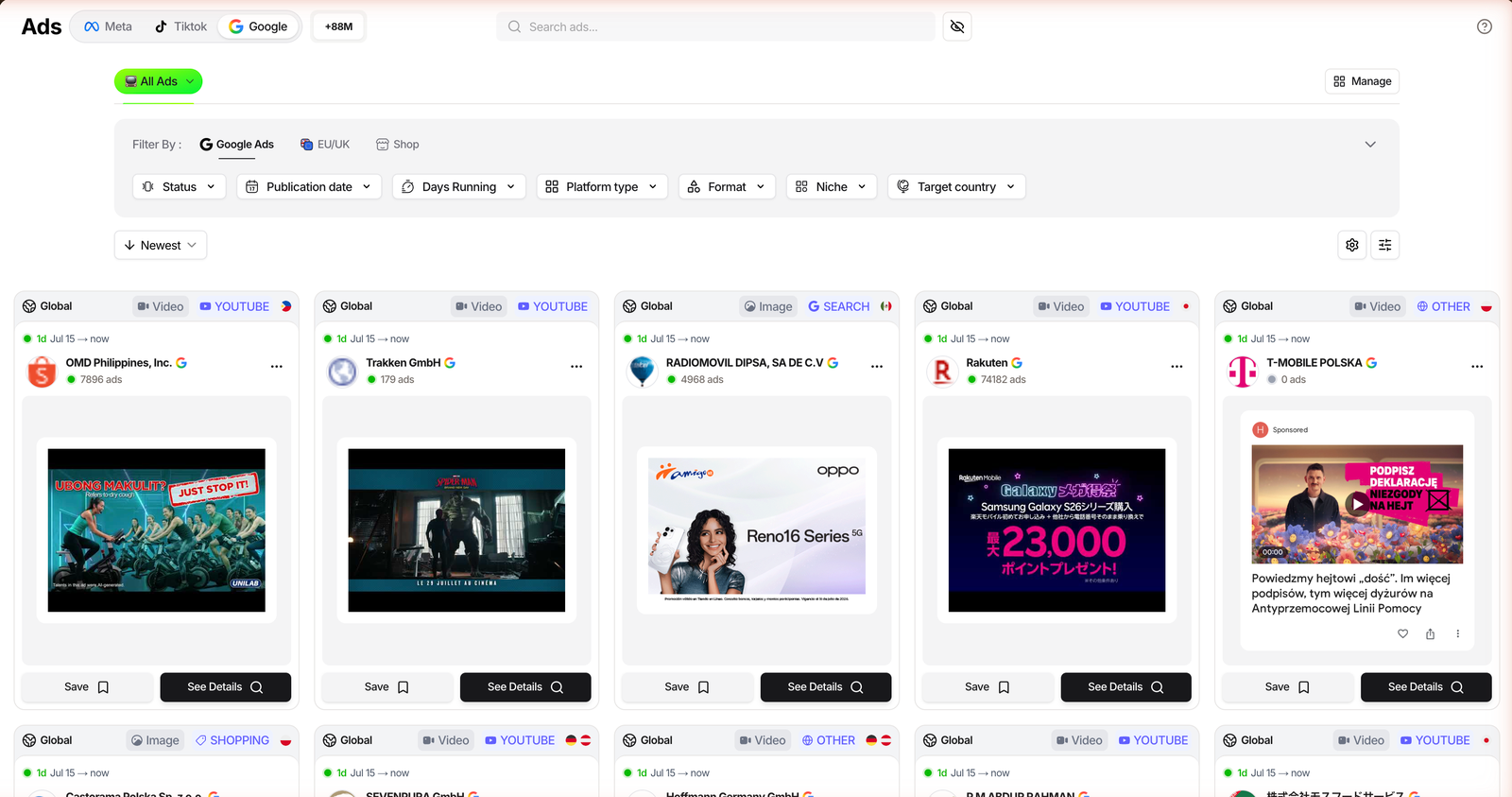
Google only became searchable at scale in ad spy tools recently. TrendTrack added its Google tab on July 1, 2026, which turns that one-brand-at-a-time lookup into full-text search across the whole index.
So where should you actually spy?
The honest answer is that the platform is the wrong question. Your goal picks the surface, and most real workflows touch all three within a single research session. If you want the full method, our guide on spying on competitors’ ads walks the whole loop.
Read a brand’s full history
Start on Meta. The widest active-ad coverage and the only estimated EU spend.
Catch a rising hook early
Go to TikTok. The organic post usually moves before the paid ad does.
See Search and YouTube angles
Open Google. The intent-side offer a brand hides from its feed.
Compare a whole niche
Use all three in one index, or you will miss half the players.
A beginner hunting a first winning product should live in Meta, because coverage beats depth when you do not yet know who to watch. A scaler defending a niche needs Google and TikTok too, because that is where challengers open a second front.
A real session chains all three in order, one competitor at a time.
The one workflow that fails is picking a single platform and calling it done. Your competitor is not loyal to one channel, so your spying cannot be either.
What none of them will show you
Before you obsess over which platform to open, know what all three withhold in exactly the same way. Free ad transparency was built to show that an ad exists, not to hand you a competitor’s P&L.
Blind for every platform
- Confirmed spend anywhere outside the EU and UK reach estimates.
- Whether the advertiser is actually profitable, or just burning cash.
- The landing page and funnel the ad drives to, and how often it changes.
- Which creative is winning, since none of them ranks by performance.
That is the ceiling of free ad spy. You see the creative, never the outcome, so you infer winners from proxies like longevity and duplication. Closing that gap is the entire job of a paid layer on top.
One search box across all three
The friction is obvious once you have done it a few times. Three tabs, three logins-free-but-clumsy tools, three formats, and no shared history between them. You spend the session copying creatives into a doc instead of reading patterns.
That is the case for one index. TrendTrack pulls Meta, TikTok (added June 8, 2026) and Google (added July 1, 2026) into a single Ads module, then layers on what the native tools skip: days-running history, an Ad Rank score, and estimated EU reach and spend from a configurable CPM. It is one ad database across Meta, TikTok and Google instead of three windows you reconcile by hand.
It is not a replacement for the free libraries, and you should still open them. It is the shortcut for the day you are tired of tab-hopping and want the three feeds ranked and searchable in one place.
Tired of spying across three tabs?
Search Meta, TikTok and Google ads in one index, with history, Ad Rank and estimated EU spend the free tools hide. The Ads module starts on Pro ($89/mo, or $62/mo annually), and the Chrome extension is free with a plan you can cancel anytime.
FAQ
Which platform is best for ad spying in 2026?
None wins outright. Meta’s Ad Library is the deepest public archive, Google’s Transparency Center covers Search, Display and YouTube, and TikTok’s Top Ads adds the organic signal. Pick the surface by your goal, or search all three at once from a single database so you do not miss a channel.
Are Meta, TikTok and Google ad libraries free?
Yes. Meta’s Ad Library, TikTok’s Top Ads dashboard and Google’s Ads Transparency Center are all free and need no account. They differ in coverage, history and search, which is exactly where paid aggregators add value on top of the free feeds.
Can you see how much a competitor spends on ads?
Only estimates, and only in the EU or UK, where Meta discloses reach ranges you can convert into an estimated spend. TikTok and Google native tools show no spend at all. Treat every spend figure as an estimate, never a confirmed budget.
Does TrendTrack cover all three platforms?
Yes. The Ads module has Meta, TikTok (added June 8, 2026) and Google (added July 1, 2026) tabs in one database, and the Brandtracker also follows TikTok organic content. The Ads module starts on the Pro plan at $89 a month, or $62 a month billed annually.
Where should a beginner start spying?
Start free on Meta’s Ad Library for the widest coverage, add Google’s Transparency Center for the specific brand you are copying, and check TikTok Top Ads for format ideas. Move to one searchable database once hopping between tabs starts slowing your research down.