Last verified July 15, 2026. Niche counts pulled from TrendTrack’s Shops index on a paid account, checked July 13, 2026.
Ask ten sellers for the best dropshipping niche and you get ten answers, because they are answering different questions.
Some want repeat buyers. Some want a passionate community that shares their ads for free. Some just want a seasonal spike they can ride and exit before it cools.
The right niche depends on which of those you are actually building. This guide maps the categories that hold up in 2026, then shows how to validate one in real store data before you commit.
The most durable dropshipping niches in 2026 are the ones with repeat buyers and healthy margins: Health & Supplements, Beauty & Care, Pet Supplies and Home & Garden lead by depth across TrendTrack’s index of 1.87M Shopify stores. The category matters less than your angle, so validate live demand before you build.
Disclosure: some links on this page are affiliate links. If you subscribe through them we may earn a commission at no extra cost to you. We tested every TrendTrack feature mentioned here on a paid account.
What actually makes a niche worth selling
A niche is not good or bad on its own. It is good or bad relative to five things you can check before you spend a dollar on ads.
- Repeat purchase and LTV: does one happy customer buy again, or is every sale a first sale?
- Margin: is there room between landed cost and a price the market accepts?
- Ad-testability: can you show the product working in three seconds of video?
- Demand shape: is it steady all year, or concentrated in a few weeks?
- Competition depth: how many stores already fight for the same buyer?
That last one is where data beats vibes. A large category means proven demand and plenty of examples to study, but also crowded ad auctions.
Source: TrendTrack Shops index, niche filter counts checked July 13, 2026.
Demand shape is the other split most lists skip. Some niches sell every month of the year, others live and die by a calendar window, and the two need very different plans.
Evergreen niches
- Steady demand every month
- Email and content compound over time
- Easier to plan stock and cash flow
- Peaks are slower to arrive
Seasonal niches
- Sharp, fast revenue spikes
- Demand crammed into short windows
- Timing and inventory get risky
- Quiet stretches between peaks
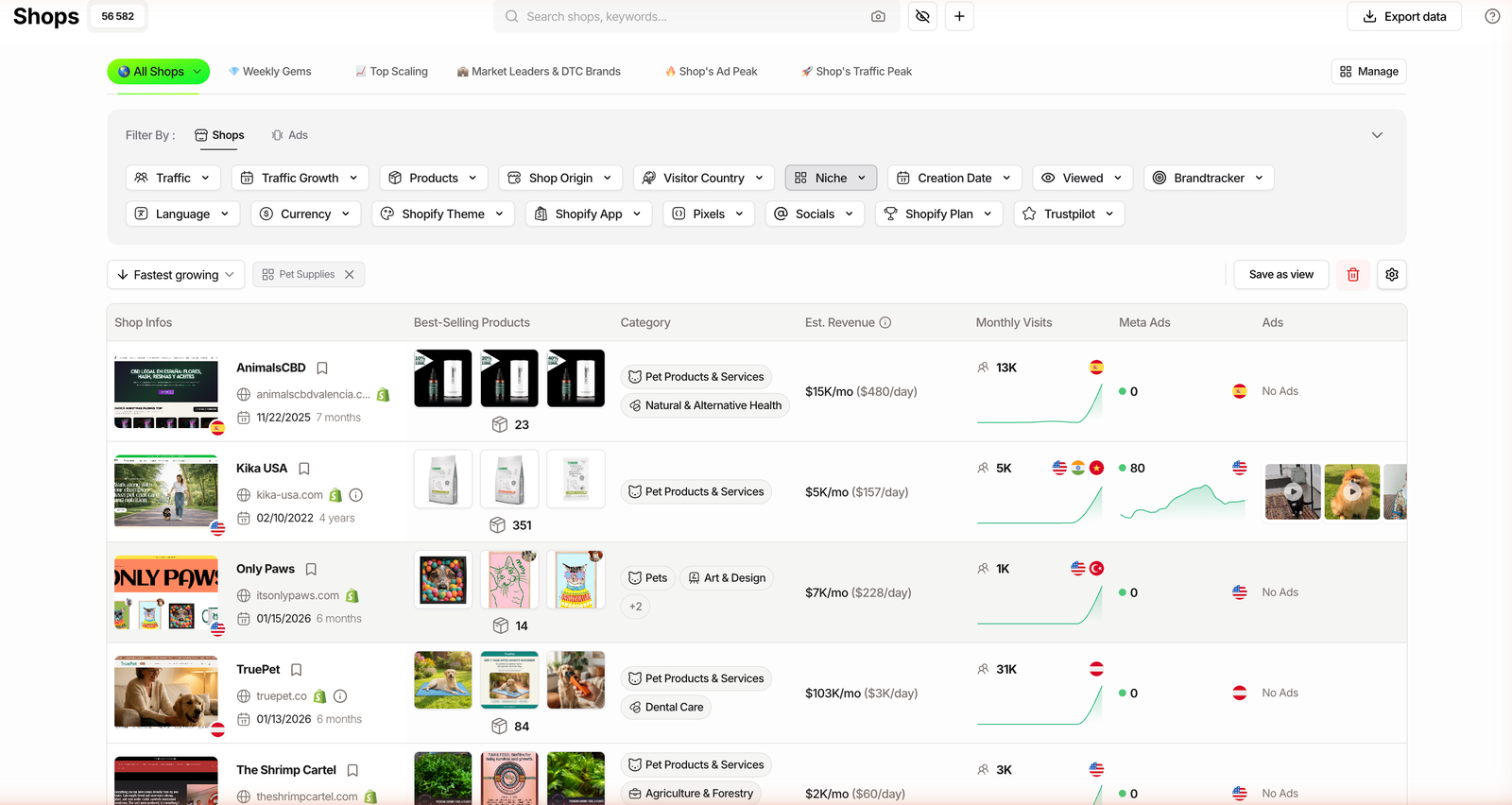
Neither is better. If you want a niche that is already gaining traffic right now, you can spot the fastest-growing stores and read which categories they sit in before you pick a lane.
The best dropshipping niches at a glance
Read the table as a map, not a ranking. The store count shows how much demand and competition a category carries in TrendTrack’s index, not how much any single store earns.
| Niche | Stores indexed | Repeat buys | Best for | Watch-out |
|---|---|---|---|---|
| Home & Garden | 1,772,575 | Limited | Problem-solving angles | Bulky shipping |
| Beauty & Care | 1,731,966 | Yes | Repeat-purchase brands | Claims compliance |
| Health & Supplements | 1,098,316 | Yes | Subscription and LTV | Ad-policy limits |
| Pet Supplies | 375,273 | Yes | Passion communities | Shipping weight |
| Sports & Outdoors | 678,081 | Limited | Seasonal hobby gear | Sizing and returns |
| Electronics & Tech | 750,903 | Limited | Impulse gadgets | Thin margins, warranty |
| Fashion & Apparel | 2,279,874 | Yes | Narrow-aesthetic stores | Most saturated |
| Gifts & Events | 617,487 | Limited | Seasonal peaks | Narrow demand windows |
Niche counts add up to more than the total index because a single store can carry several tags. Treat them as relative weight, not headcount.
The 8 niches, and how to play each one
Home & Garden
With 1,772,575 indexed stores, Home & Garden is one of the deepest categories in the index. It rewards problem-solving products: the organizer that fixes a mess, the tool that saves an afternoon, the upgrade that makes a room feel new.
Play it with sharp before-and-after video and a narrow room or job. Bulky or fragile items eat margin in shipping, so favor compact products that still solve something obvious.
Beauty & Care
Beauty & Care sits at 1,731,966 stores and is built for repeat purchase, which is what makes the customer economics work. A serum, a tool, a routine, people who like the first order come back for the second.
The catch is compliance: skin and body claims are policed hard on Meta, so keep copy honest and let the demo do the selling. Build for a specific skin type or concern rather than a generic beauty store.
Health & Supplements
Health & Supplements holds 1,098,316 stores and has the strongest lifetime-value case of the group, because consumables run out and get reordered. That is the whole reason subscription models thrive here.
It is also the most regulated. Ad accounts get restricted for aggressive claims, so a compliant offer and a trustworthy brand matter more than a clever hook. Start with one format and one clear benefit.
Pet Supplies
At 375,273 stores, Pet Supplies is leaner than the giants but punches above its size on loyalty. Pet owners buy emotionally, share content freely, and reorder food, treats and gear on a schedule.
Play the community angle: content that celebrates the pet sells better than spec sheets. Watch shipping weight on beds and crates, and lean toward lighter accessories for your first tests.
Sports & Outdoors
Sports & Outdoors covers 678,081 stores and mixes evergreen hobby demand with seasonal spikes around each activity. Hikers, cyclists and home-gym buyers are motivated and specific.
Sub-niche by activity rather than selling everything. Sizing and returns can bite on apparel and footwear, so accessories and gear are a cleaner starting point.
Electronics & Tech
Electronics & Tech spans 750,903 stores and thrives on the impulse gadget, the accessory that makes a phone or desk better for a small price. Demos travel well on short video.
Margins are thin and buyers expect things to just work, so warranty and support questions come fast. Pick one accessory line you can stand behind rather than a general electronics shop.
Fashion & Apparel
Fashion is the single largest category in the index at 2,279,874 stores, which cuts both ways. Demand is enormous, and so is competition, so a generic clothing store competes with everyone.
The stores that scale pick one aesthetic, one body type or one occasion and own it. Saturation is proof that people buy, not a reason to stay out, but you need a point of view to cut through.
Gifts & Events
Gifts & Events holds 617,487 stores and lives on the calendar. Personalized and occasion products convert well because the buyer has a deadline and an emotional reason to purchase.
The trade-off is concentration: much of the year’s revenue lands in a few windows. Plan inventory and ad spend around those dates, and use quieter months to build for the next peak.
Evergreen vs seasonal: timing your niche
Once you have a category, the next decision is timing. An evergreen niche lets you build slowly and compound, while a seasonal one asks you to be ready before the window opens and disciplined about exiting.
You can pressure-test the season with free tools like Google Trends to see when interest rises. Inside TrendTrack, the Shops filter goes further: the Creation Date filter has a Seasonal events preset, so you can see how many stores launch around a specific holiday and when.
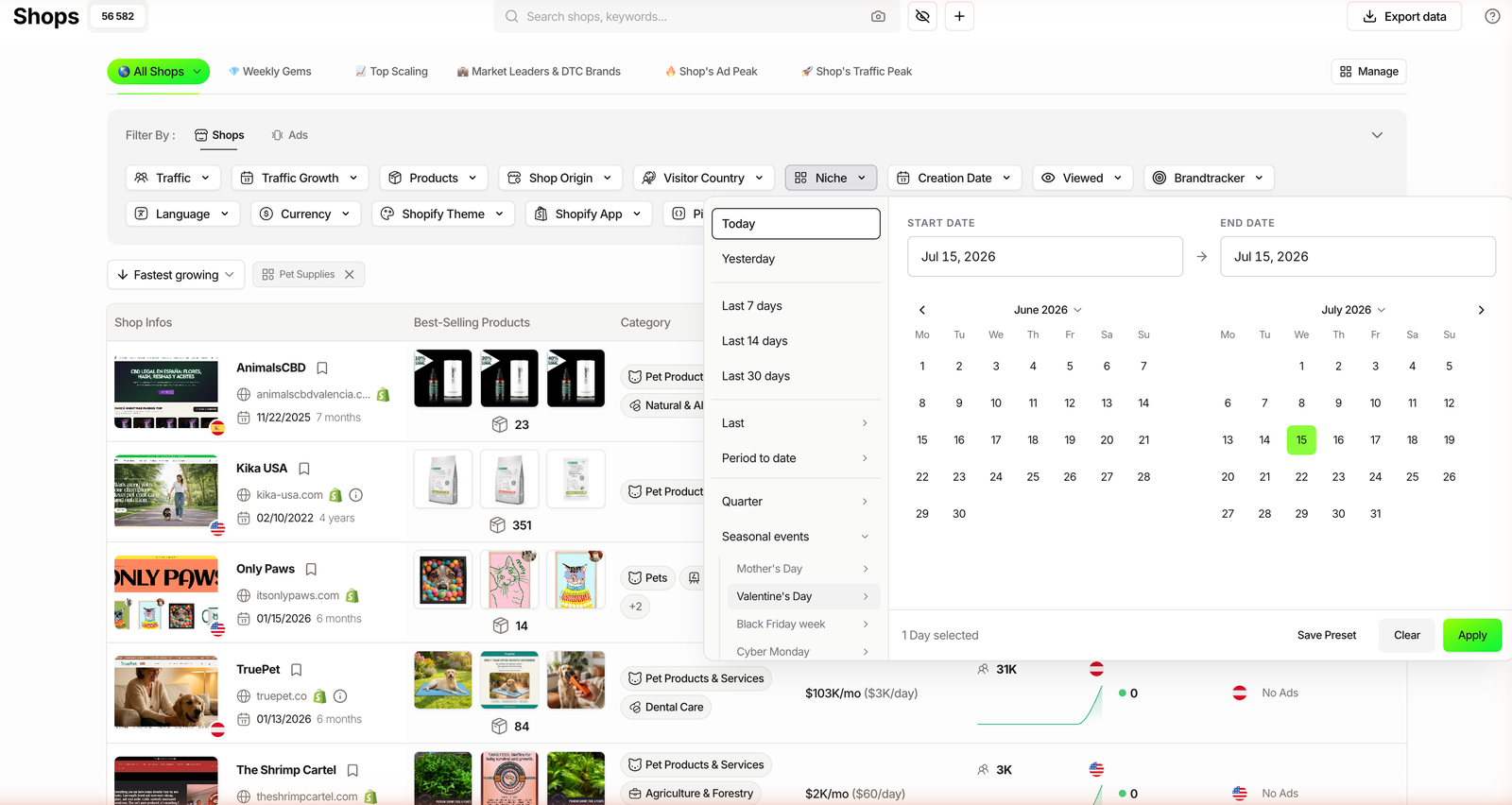
Match the plan to the shape. Evergreen niches want content and email that keep paying off, seasonal niches want tight timing and a clean exit before demand fades.
Find your own niche in the data
The best niche for you is not on any list, it is the one you can validate today. The workflow inside TrendTrack’s Shops module is the same every time, and it starts with the niche filter you saw above.
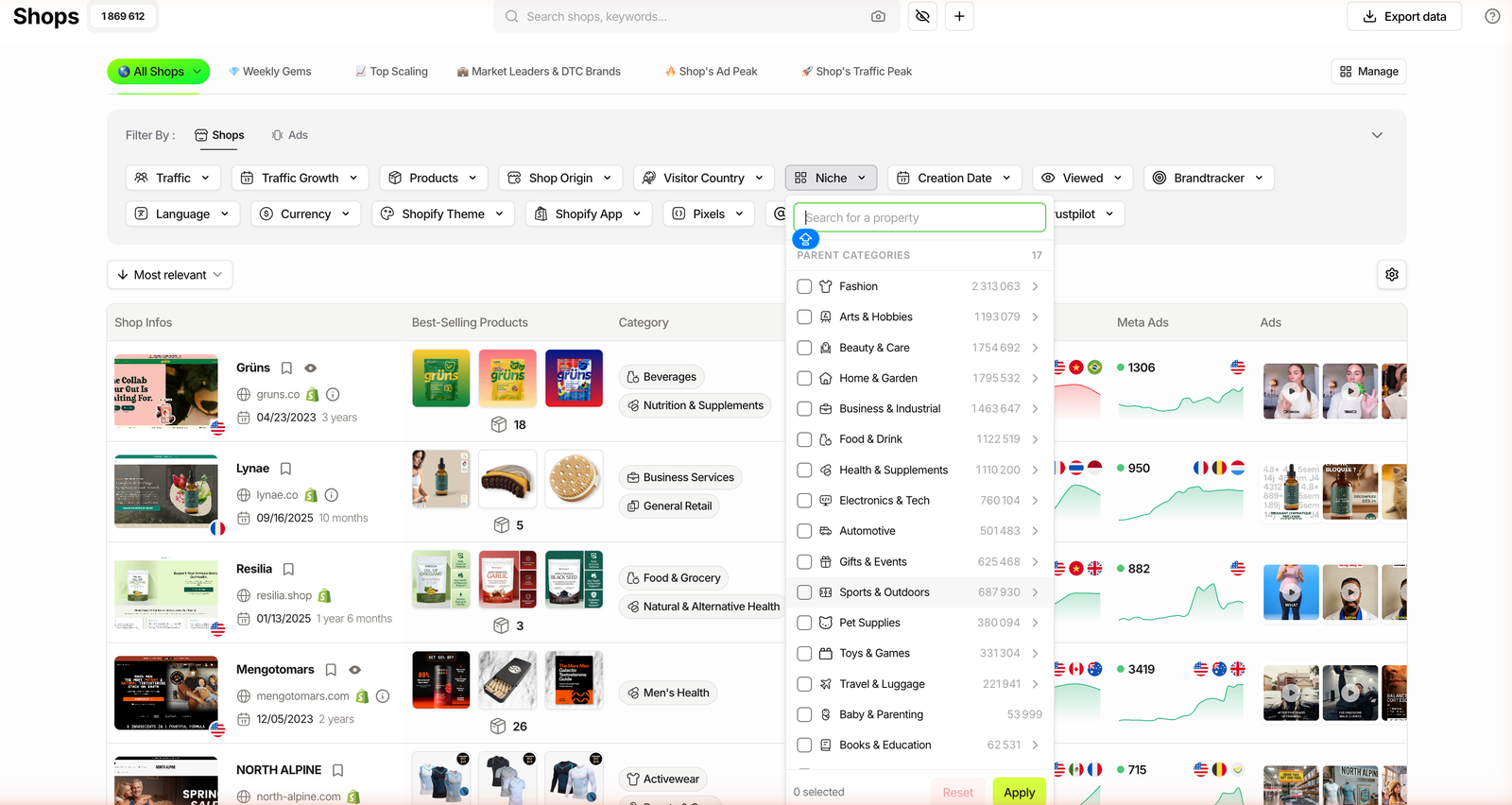
Pick a niche, then sort the index by Fastest growing and set Traffic Growth to Rising over a 3-month window. Add a best-seller price range so you only see stores selling at margins you can match, and read what their winning products have in common.
Plan check: the niche filter, traffic growth and Est. Revenue live in the Shops module, which is on Starter ($59/mo). Cross-checking a niche against live ad volume needs the Ads module, which starts on Pro ($89/mo).
Related guide
The Shopify Store Database, Explained
Filter 1.87M stores by niche, traffic and estimated revenue.
If you want to compare this against other ways to scout demand, our roundup of product research tools covers where each one fits. But for reading a niche through real store data, the Shops index is where the work happens.
Screen niches inside TrendTrack
Frequently asked questions
What is the most profitable dropshipping niche?
There is no single most profitable niche, profit comes from margin and repeat buyers, not the category label. In practice, Health & Supplements, Beauty & Care and Pet Supplies tend to combine high margins with repeat purchases, which is why so many stores cluster there. TrendTrack’s index tags over 1 million Shopify stores in each of the first two, so treat them as crowded, and win on a sharp sub-niche and a strong offer.
Are saturated niches like fashion still worth it?
Yes, but not as a broad fashion store. Fashion is the single largest category in TrendTrack’s index at 2,279,874 stores, so a generic apparel shop competes with everyone. The stores that scale pick a narrow angle, one body type, one aesthetic, one problem, and use ad data to find the exact product pulling demand. Saturation is a signal that demand exists, not a stop sign.
How many products should a dropshipping niche have?
Enough to build a coherent catalog, but not so many that sourcing and ads spread thin. A focused store often launches with 5 to 20 products and one clear hero. In TrendTrack’s Shops filter you can screen stores by product count and by best-seller price, which shows how real stores in a niche structure their catalog before you copy the pattern.
Should I pick a broad niche or a sub-niche?
Start with a sub-niche. A broad niche like Home & Garden holds 1,772,575 indexed stores, so a narrow angle, small-space gardening, pet-safe cleaning, one room, gives you cheaper ads, a clearer message and a community to sell to. You can always widen the catalog once one angle proves out.
How do I know a niche is trending and not dying?
Look at movement, not just size. In TrendTrack you can sort the Shops index by Fastest growing and filter Traffic Growth to Rising over a 3-month window, which surfaces niches gaining traffic right now. Cross-check with live ad counts: a niche with rising traffic and many active ads is being funded, a quiet one is cooling.
The bottom line
There is no magic niche. The best dropshipping niche is the one where you can find repeat buyers, a workable margin and a product you can prove in three seconds of video.
The eight categories here are proven starting points, but the edge is in validation. Pick a lane, read the data, and let real stores show you what is already working before you spend.
Stop guessing which niche to chase.
Screen 1.87M Shopify stores by niche, traffic growth and estimated revenue, then validate before you build. Shops is on Starter ($59/mo, or $42/mo billed annually), and the free Chrome extension lets you x-ray any store you land on.