Last verified July 2026. Ad copy examples analyzed on a paid TrendTrack account, using the Brandtracker and the Ads module.
You can lift a competitor’s hook word for word, drop it on your product, and still watch it flop. The words are not the ad. The structure underneath them is.
That structure comes down to three levers you can actually read on any ad that is already running: how long the copy is, how it opens, and what it asks you to do. Learn to read those three and you stop copying lines you do not understand.
Ad copy analysis means reading the text of ads that are already live to find the repeatable levers behind them: the hook (the first line), the length (how much it says), and the CTA (what it asks for). You study winners still spending, not opinions, then reuse the structure, not the exact words.
Disclosure: some links on this page are affiliate links. If you subscribe through them we may earn a commission at no extra cost to you. We tested every TrendTrack feature mentioned here on a paid account.
What ad copy analysis actually means
Most sellers write ad copy from a blank page, then guess why it did not work. Ad copy analysis flips that: you start from ads that are proven to keep running, and you reverse engineer the patterns that make them work.
The point is not to plagiarize. It is to see the skeleton. The same way you can spy on your competitors’ ads to learn which creatives are scaling, you can read the copy to learn which arguments and offers keep winning in your niche.
Creative vs copy: the creative is the image or video. The copy is the text, the primary text above the media, the headline under it, and the call to action. This guide is about the copy.
One thing runs through all of it: the angle, the argument the copy leans on. Two ads can sell the same product on opposite angles, one on saving time, the other on status, and the copy is where that choice shows. Read for the angle first and the tactics start to make sense.
Where do you read this copy in the first place? The cheapest starting point is the free Facebook Ad Library, where every active ad on a page is public. We walk through it in our guide to reading raw ad copy for free.
The catch is that a public library shows you the text but not the signal. It does not sort by how long a copy has run, or how many ads reuse it. That gap is exactly what turns raw copy into analysis, and we come back to it below.
Ad copy length: how long should it be?
There is no magic word count, and anyone who quotes one is selling a template. Length is a function of price, awareness, and platform, not a rule.
Short copy wins on impulse. A cheap, visual, problem-solving product often needs one hook line and a CTA, because the image does the selling. Long copy wins when the buyer needs convincing: higher price, new mechanism, or a claim that demands proof.
Awareness stage matters as much as price. A cold audience that has never seen the product needs more setup, while a warm retargeting audience scrolls past anything that repeats what it already knows.
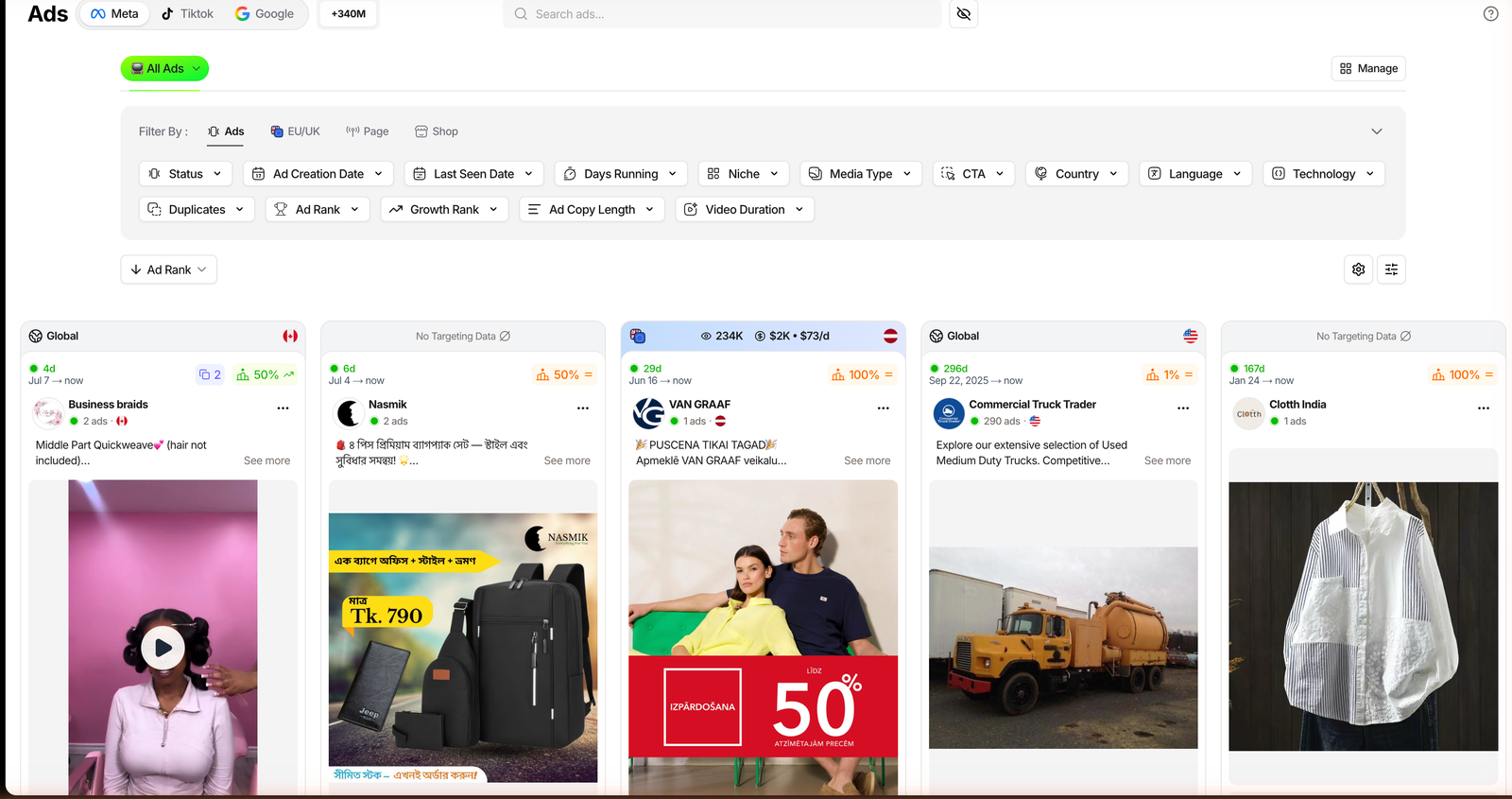
The practical move is to read the winners, not your gut. Filter live ads in your niche by copy length and watch where the long runners cluster. That range, not a fixed number, is your target.
| Copy length | Works when | Platform tilt | Main risk |
|---|---|---|---|
| Short (one to two lines) | Impulse, low-ticket, visual product does the selling | TikTok, Reels | Too thin to build trust |
| Medium (short paragraph) | One clear benefit plus a proof point and an offer | Meta feed | Middle gets skimmed |
| Long (multi-paragraph) | High-ticket, new mechanism, skeptical buyer | Meta, high-intent | Loses cold traffic early |
Platform changes the math. On Meta the primary text can run long and still convert warm audiences. On TikTok the on-screen text is short and the spoken script carries the weight, which is why the TikTok Creative Center is worth a look for that format.
Hooks: the first line does most of the work
If length decides how much you say, the hook decides whether anyone reads it. On Meta it is the first line of the primary text. On TikTok it is the first three seconds, spoken.
A hook has one job: earn the next line. Strong ones tend to fall into a handful of patterns, and once you can name the pattern, you can build your own instead of copying a sentence that only worked for someone else’s product.
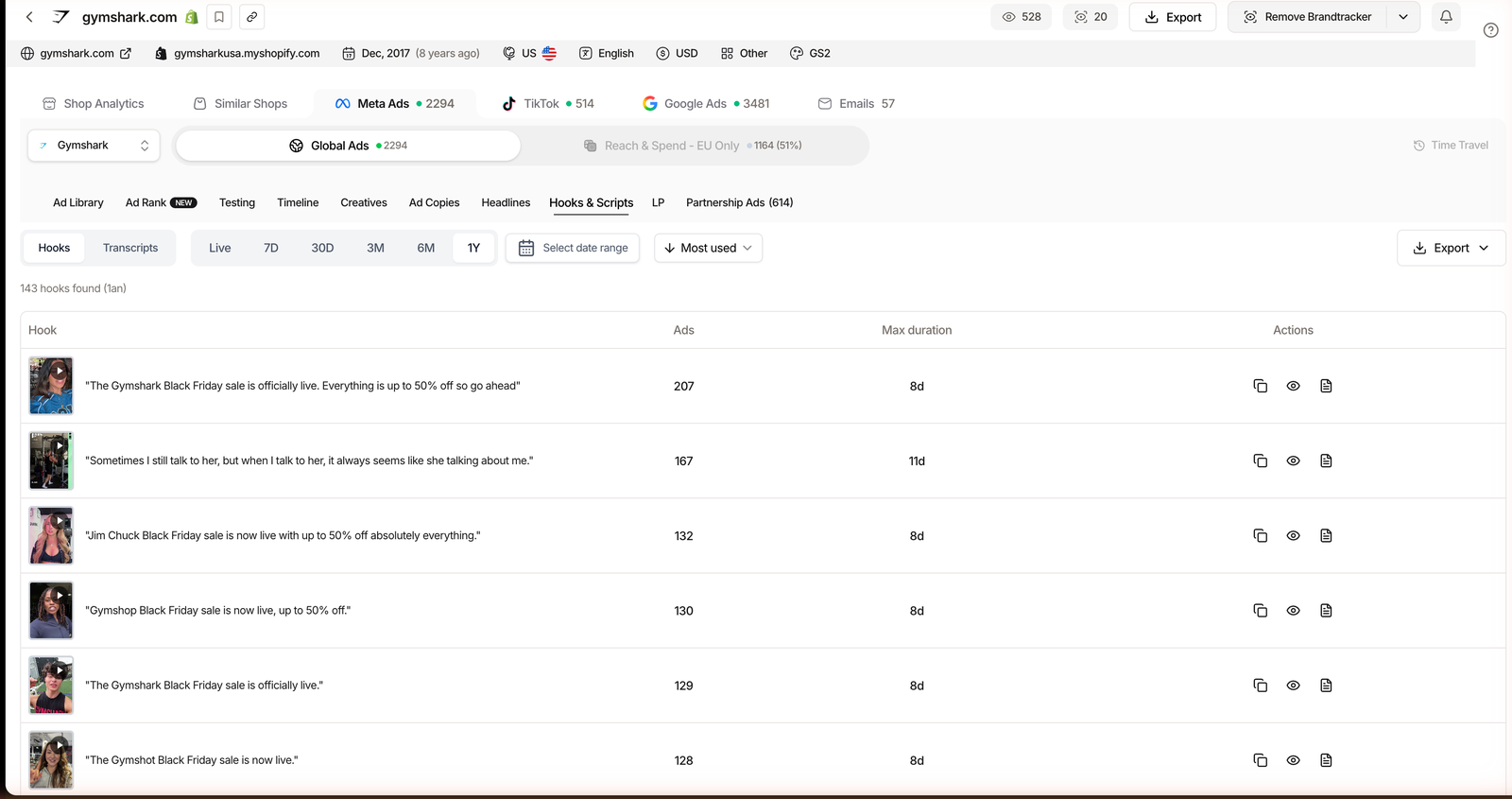
Reading hooks on video used to mean watching every ad by hand. TrendTrack transcribes competitor video ads in its Hooks & Scripts tab, so a spoken opener becomes text you can scan and sort. Sorting by max duration is the quiet trick: a hook attached to the longest-running ads has already outlasted the ones that flopped.
Here is the trap the myth points at. A hook that goes viral for one product carries context: an audience, an angle, an offer. Bolt the same sentence onto an unrelated product and the context is gone, so the hook is dead on arrival.
So read hooks in context. Which product, which angle, and how long has that ad kept running? A hook that has spent for weeks is a stronger signal than one that looks clever.
CTAs: what the button and the last line ask for
Every ad makes two asks, not one. There is the native CTA button (Shop now, Learn more, Order now) and there is the last line of the copy. They should point the same direction.
The button is not decoration. It signals buyer temperature. “Shop now” and “Order now” push warm, ready-to-buy traffic. “Learn more” suits a higher-ticket or education-first product where the click is a soft yes.
Which button matches a $79 product? Rarely the same one that fits a $19 impulse buy. Reading the CTA choices of the winners in your niche tells you how warm they expect their traffic to be.
| CTA button | Buyer intent it signals | Best for |
|---|---|---|
| Shop now | Warm, ready to browse and buy | Impulse and low-ticket products |
| Order now | Decision made, push to checkout | Single-product and offer ads |
| Learn more | Cooler, needs convincing first | High-ticket, new mechanism |
| Get offer | Price-driven, promotion first | Sales, bundles, seasonal deals |
Related guide
The Ads library: filter 337M ads by copy
Ad Copy Length and CTA filters across the whole Meta, TikTok and Google index.
How to analyze a competitor’s ad copy in TrendTrack
Free libraries show you the text. To turn text into analysis you need the signals a public library hides: how long a copy has run, how many ads reuse it, and which headlines repeat.
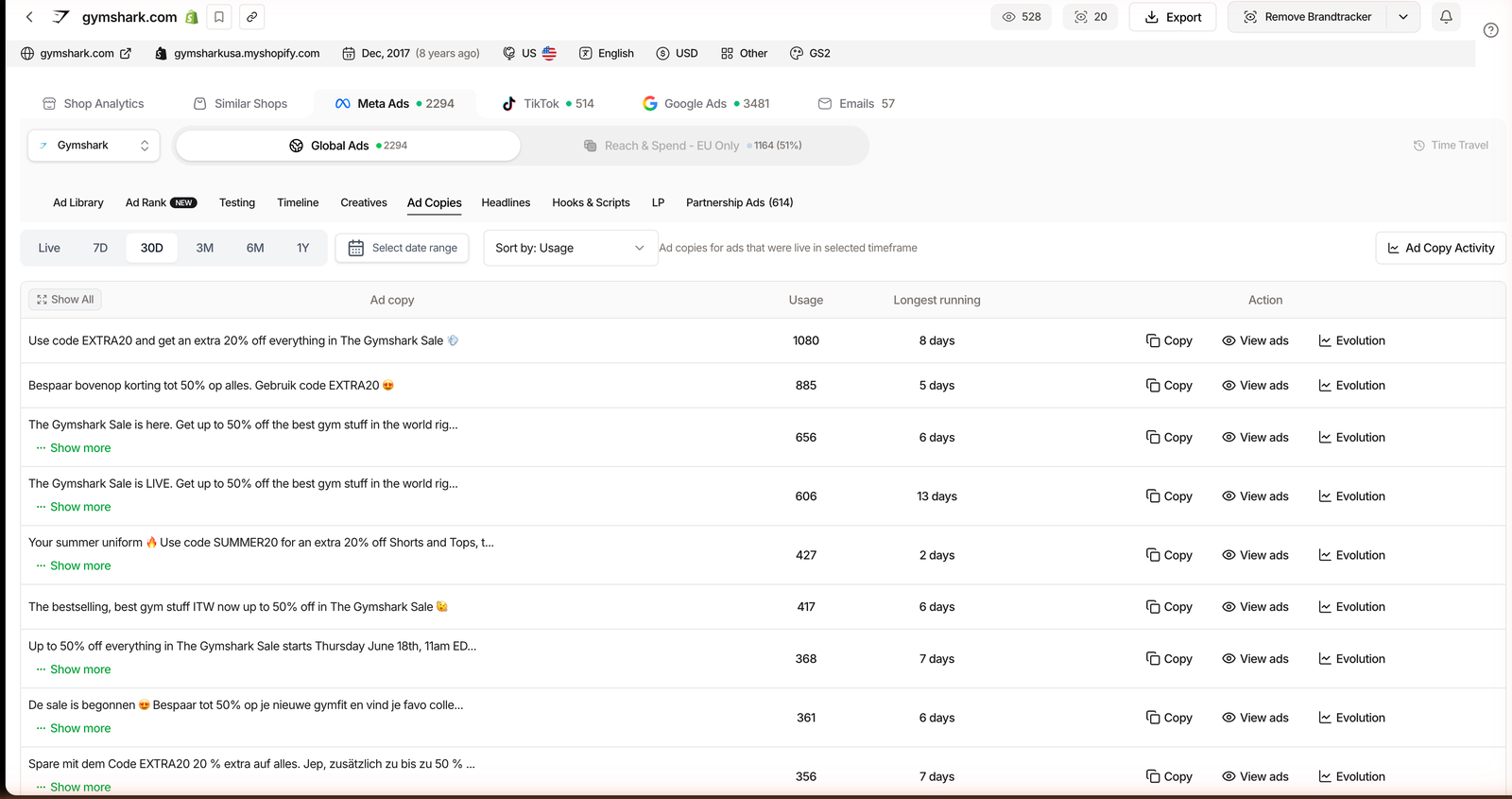
Inside the Brandtracker, the Ad Copies tab ranks a competitor’s texts by usage and by longest running, with an Evolution view for how a copy has changed over time. Watching that evolution tells you what an advertiser tested and kept, which is a shortcut past your own guesswork. The Headlines tab does the same for the bold line under the media, so you can see which offers a brand repeats. Longevity and reuse are the clearest proof a piece of copy is doing its job.
In the Ads module you get a per-ad view. The Copy Reuse signal flags when a text is “used in N other ads”, which is a fast tell that the advertiser trusts it enough to spread it across a whole account. You can also filter the whole index by Ad Copy Length, sort by longest active, and search the CTA field to see which buttons dominate a niche. Stack those filters and you go from a wall of ads to a shortlist of copy worth studying.
Plan check: reading one competitor’s copy fits Starter’s 2 Brandtrackers ($59/mo, or $42/mo billed annually). Screening copy across the full Ads and Advertisers index starts on Pro ($89/mo).
If you analyze copy weekly, this is where a tool earns its keep. Tracking a handful of competitors and reading their longest-running texts beats scrolling the feed and hoping a pattern jumps out. Do it once and it is a snapshot; do it every week and you start to see which angles a niche is converging on.
One honest limit: usage counts and run-time are observed signals, not certified spend. They tell you what an advertiser keeps running, which is a strong proxy for what works, but treat them as directional. A copy can run long because it converts, or because nobody has swapped it out yet, so pair the signal with common sense.
Source: TrendTrack, checked July 2026.
Related guide
The Brandtracker: track a competitor’s whole funnel
Ad Copies, Headlines and Hooks & Scripts tabs on any store you follow.
A copy teardown checklist
Put it together into a repeatable pass. Next time you open a competitor’s ad, run it through this instead of reacting to the vibe.
Teardown checklist
- Read the hook alone. Which pattern is it, and does it earn the next line?
- Note the length. Short, medium, or long, and does it fit the price?
- Find the promise. What single outcome is the ad selling?
- Spot the proof. Demo, review, number, or none?
- Locate the offer. Price, discount, bundle, or guarantee?
- Check the CTA. Does the button match the copy’s temperature?
- Read the angle. Problem, identity, or desire?
- Check the run time. How long has it stayed live?
The last point is the tiebreaker. A copy that has run for weeks has survived the only judge that matters, the advertiser’s own budget.
Benchmarks at a glance
Length: match the cluster of long-running winners in your niche, not a fixed word count.
Hook: name the pattern, keep the context (product, angle, offer), rebuild in your own words.
CTA: pick the button that matches buyer temperature, and make the last line say the same thing.
FAQ
What is ad copy analysis?
Reading the text of ads that are already running to find the repeatable levers behind them: the hook (first line), the length, the offer, and the CTA. Instead of guessing what to write, you study winners still live and reuse their structure, not their exact words. Tools like TrendTrack let you rank a competitor’s ad copies by usage and how long they have been running, so you see which lines actually keep spending.
How long should a Facebook ad copy be?
There is no magic length. Impulse, low-ticket products often win with short primary text (one hook line plus a CTA), while considered or high-ticket offers usually need longer copy to build belief. The reliable move is to filter live winners by ad copy length and copy the range the top ads cluster in, not a fixed word count. On TikTok, the spoken script matters more than on-screen text.
What makes a good ad hook?
A hook earns the next three seconds. Strong ones name a specific problem, open a curiosity gap, make a bold claim with instant proof, or call out the exact buyer. What kills a hook is borrowing a viral line that has nothing to do with your product or offer. Read competitor hooks in context (which product, which angle, how long the ad has run) before you reuse the pattern.
Which CTA works best for dropshipping ads?
It depends on buyer intent. “Shop now” and “Order now” push warm, ready-to-buy traffic; “Learn more” suits higher-ticket or education-first products; “Get offer” leans on a promotion. The button should match the last line of your copy and the temperature of your audience. In TrendTrack you can filter the Ads library by CTA type to see which buttons the winners in your niche actually use.
How do you find a competitor’s best-performing ad copy?
Track their store, then read the copy signals: which lines run longest, which are reused across many ads, and which headlines repeat. TrendTrack’s Brandtracker has an Ad Copies tab that ranks a competitor’s texts by usage and longest running, a Headlines tab, and a Hooks & Scripts tab that transcribes their video ads. Longevity and reuse are the clearest proof a piece of copy is working.
The takeaway
Ad copy analysis is not about stealing sentences. It is about reading the three levers under every winning ad: length, hook, and CTA, then rebuilding them for your product.
Do it by hand in a free library to learn the patterns. Then, when you want to read the signals a library hides, run the same pass at scale and spy on the copy that is already winning in your niche.