Last verified 2026-07-15. Ranges read from live ad cards, the Ads module Days Running filter, and the Brandtracker Timeline on a paid TrendTrack account.
You open a competitor’s ad and the badge reads 74 days live. Before you screenshot the creative or lift the hook, that number is the part worth reading. Most people scroll straight past it.
Days running is the quiet metric that separates a real winner from an ad that just happened to load in your feed. Learn to read it and you stop copying tests that already failed.
Winning ads rarely run for days. The ones that matter run for weeks to months, and evergreen creatives often stay live 45 to 90+ days, because advertisers only keep paying for ads that stay profitable. Treat days running as a survival signal, not a guarantee: read it against the store’s spend and its niche, never in isolation.
What “days running” actually measures
Days running is the length of continuous time a single creative has stayed active. It counts from the moment the ad first went live to its last seen date. It is not the date the page or store was created, and it is not how long the product has existed.
That distinction matters. An old store can launch a brand new ad today, and a young store can already have a creative that has run for two months.
The clock belongs to the ad, not the advertiser. This is the same read you make when spying on competitors’ ads at scale.
The three signals TrendTrack reads on every ad. Source: Ads module and ad detail, checked 2026-07-15.
Two things set the frame. First, an ad’s Status tells you if it is still running or already inactive. Second, its First Seen date anchors the start of the count.
The free Meta Ad Library shows you the ads, but it timestamps continuous run time poorly, which is exactly the gap a proper spy tool fills.
So how long do winning ads actually run?
Here is the honest answer. Most creatives are cut inside the first week, because that window is pure testing.
The ones that survive are the minority, and the true winners run for weeks to months. Anything past 45 days is usually an evergreen that has earned its budget.
| Days running | What it usually means | How to treat it |
|---|---|---|
| 0 to 3 days | Still in testing, most of these get cut | Ignore it as a signal |
| 4 to 14 days | Survived the first cull, showing early legs | Worth watching, not copying yet |
| 15 to 45 days | Validated creative, still paying its own way | A candidate to model |
| 45 to 90+ days | Evergreen winner, deep in profit | Study the copy, LP and offer |
Read those bands as a signal, not proof. A long run tells you an advertiser keeps choosing to pay, which is strong evidence, but it is still evidence you have to confirm with reach and spend.
Why a long run usually signals a winner
The logic is pure economics. Nobody funds 60 days of paid distribution for an ad that loses money. Every extra day a creative stays live is a vote of confidence, paid in the advertiser’s own budget.
That is why run length beats a screenshot. A slick creative might be one week into a test that flops by day ten. A plain, ugly ad that has run eight weeks has already answered the only question that matters: does it convert at scale?
Run length pairs best with Ad Rank, TrendTrack’s ranking of winning creatives that shipped on 2026-01-29. A long run plus a holding or rising rank is the gap between an ad that still works and one that is merely still switched on.
Related guide
Ad Copy Analysis: Length, Structure, What Converts
The copy behind the ads that survive longest, broken down.
TrendTrack makes this concrete inside a Brandtracker. The Ad Copies tab lists a competitor’s copy with a Usage count and a Longest running column, so you can see which exact message has held the longest. The copy that survives is the copy that is still converting.
When a long run can lie
Days running is a strong signal, but it is not a lie detector. An ad can stay technically active while barely spending, which makes it look important when it is not. Always check what they actually spend to keep it live before you trust the number.
A long run is trustworthy when
- Estimated reach stays high across the run
- Estimated spend is meaningful, not near zero
- Ad Rank holds or climbs over time
- It runs across several countries
A long run can mislead when
- Estimated reach sits near zero
- It is single-country, low-budget retargeting
- A recent duplicate reset the counter
- A dormant ad was reactivated after a gap
Retargeting is the classic trap. A brand can leave one evergreen retargeting ad live for months on a tiny budget, so the run length looks heroic while the reach is thin. Keep in mind that estimated reach and spend are estimates, not audited figures, so weigh them as direction, not gospel.
Duplicates are the other quiet distortion. When a brand relaunches the same creative, the counter can start fresh, so a cosmetic re-upload borrows the look of a brand new test while a proven ad reads younger than it really is. Cross-check a creative against its duplicates before you trust the date.
What the “right” run length depends on
So how long is long enough? It depends, and the honest answer has four levers: platform, budget, offer and season.
Platform is the big one. Meta tolerates long-running evergreens, so on Meta a creative past 30 days is a genuinely strong signal. TikTok fatigues faster, so there you watch refresh frequency more than raw longevity, since even winners get swapped sooner.
| Platform | A strong run looks like | What to weigh most |
|---|---|---|
| Meta | 30+ days live and holding | Raw longevity |
| TikTok | Shorter runs, steady replacement | Refresh frequency |
| Consistent presence over weeks | Continuity, not spikes |
Budget and offer bend the rest. A well-funded brand can keep a creative alive longer simply because it can absorb rising costs, and a seasonal offer will naturally cap the run at the length of the promotion.
The operator rule is simple: compare an ad to the baseline of its niche, never to an absolute day count. Thirty days is impressive for a $200 product and ordinary for a $19 impulse buy.
How to check days running yourself
Related guide
How the TrendTrack Ads library works
Filters, sorts and the Days Running slider, step by step.
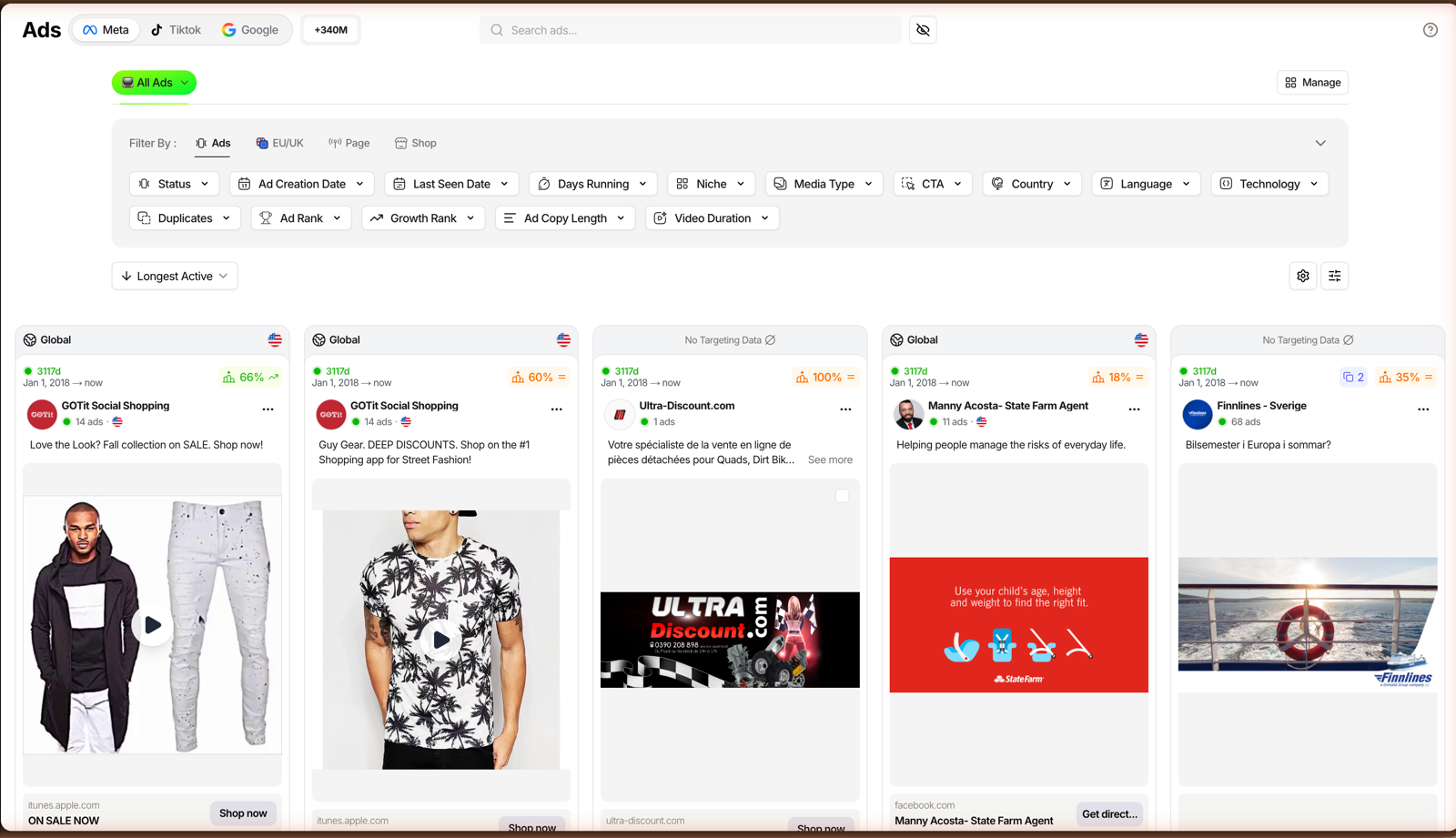
You do not have to eyeball this. The Ads module carries a Days Running filter inside its Ads filter group, and a Longest Active sort that reorders the whole library, more than 337M ads across Meta, TikTok and Google, by run length.
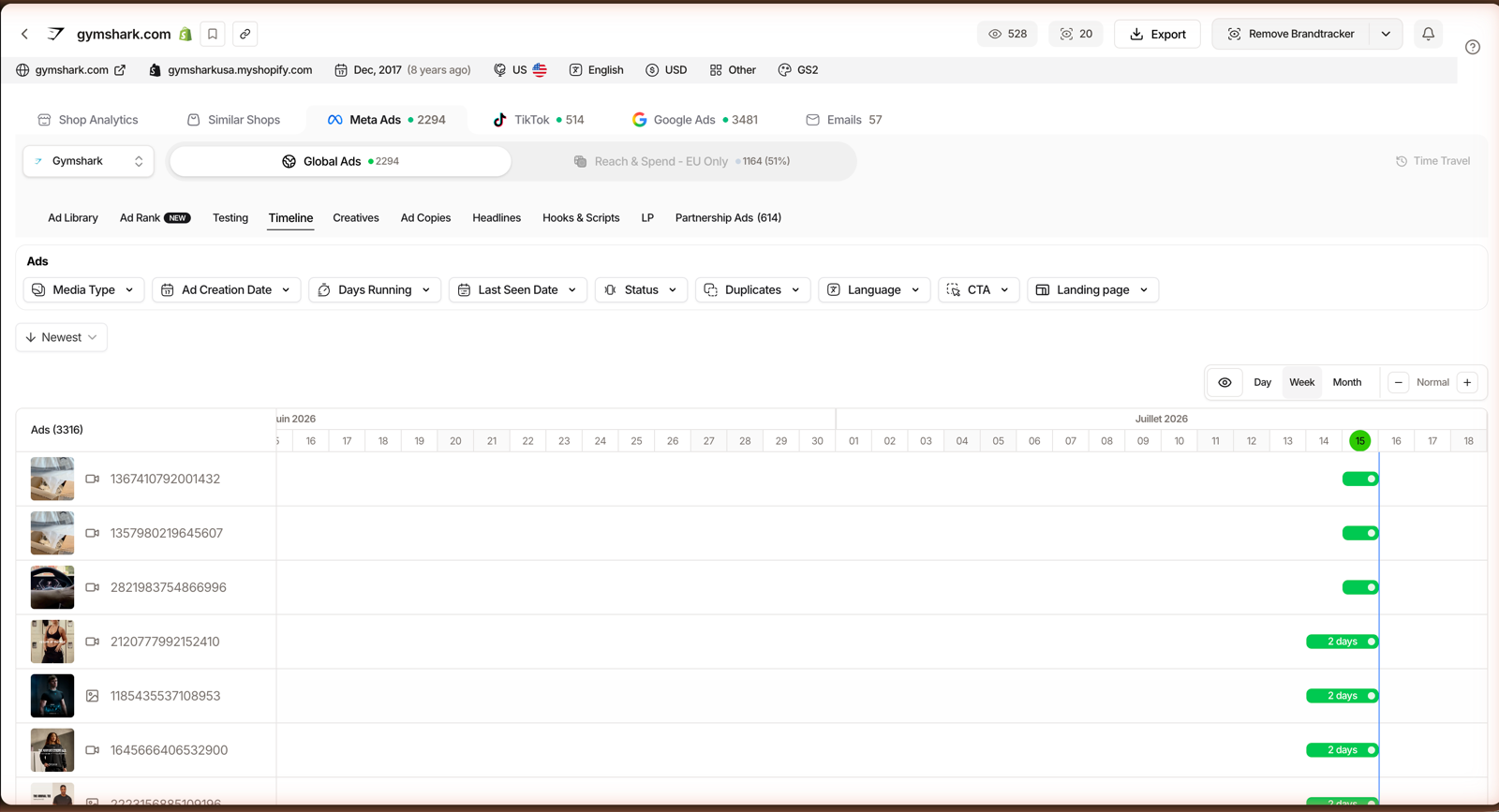
For a single competitor, the Timeline tab in a Brandtracker is the clearest view. It draws every ad as a horizontal bar across a Gantt chart, so a creative that stretches for months is impossible to miss next to the tests that blink out in days.
Reading it is fast. Find the two or three bars that stretch far wider than the rest, then click into each to confirm the creative, its landing page and its estimated reach. Those long bars are the ads a competitor has bet on.
Plan check: the Ads module and its Days Running filter start on Pro ($89/mo, or $63/mo billed annually). Starter ($59/mo) still gives you two Brandtrackers, and their Timeline and Ad Copies tabs read one store’s longevity without Pro.
Disclosure: some links on this page are affiliate links. If you subscribe through them we may earn a commission at no extra cost to you. We tested every TrendTrack feature mentioned here on a paid account.
Put together, the workflow is quick: filter by run length, confirm with reach and spend, then open the Timeline to see how a winner sits against the brand’s failed tests. That is the read you get inside TrendTrack’s Ads module, and the free Chrome extension lets you x-ray a store before you ever pay.
See the Days Running filter live
FAQ
How long do most winning ads run?
Most creatives are killed within the first week, that is the testing phase. The winners tend to run for weeks to months, and evergreen creatives often stay live 45 to 90+ days. Treat a long run as a survival signal from the advertiser, not a promise that the ad still performs today.
What does “days running” mean on an ad?
It is the length of continuous time a single creative has stayed active, counted from when it first went live to its last seen date, not the date the account was created. In TrendTrack, the ad card shows this duration and you can sort the whole library by Longest Active.
Does a long-running ad always mean it is profitable?
No. An ad can stay technically active with almost no reach or spend, especially low-budget retargeting.
Read run length against the store’s estimated spend and reach before you copy it. Duration plus sustained reach is the trustworthy combination.
How long should I run my own ad before killing it?
There is no universal number, it depends on budget, platform and offer. A common operator rule is to give a Meta creative enough budget to exit the learning phase, then judge it against your niche baseline rather than an absolute day count. TikTok creatives usually fatigue faster, so plan to refresh them sooner.
The bottom line on days running
Winning ads run for weeks and months, not days, because paid distribution is a cost the advertiser only keeps paying when it works. So read run length as a survival signal, then confirm it against estimated reach, spend and Ad Rank before you model anything.
Do that in relative terms, always against the niche baseline, and days running becomes one of the cleanest tells in ad spy you have.