Last verified July 15, 2026. Method and tool gating checked on a paid TrendTrack account; database counts read live in-app.
Most people think product research is scrolling TikTok until something looks viral, then ordering it from AliExpress. That is discovery, and it is the easy 10%.
Real research answers a harder question: is anyone already making money with this, and can you? Finding a product you like is not the same as finding a product with proven demand and room to profit.
Dropshipping product research is the process of finding products with proven demand and profit room, then confirming a competitor is already scaling them. Do it in three passes: manual discovery, data validation, and ad-spy reverse-engineering.
Disclosure: some links on this page are affiliate links. If you subscribe through them we may earn a commission at no extra cost to you. We tested every TrendTrack feature mentioned here on a paid account.
What product research really is (and the myth that burns months)
The myth costs beginners entire quarters. You spot a product, you feel good about it, you build a store, you run ads, and only then do you learn nobody wanted it at your price.
Flip the order. Discovery finds candidates. Validation checks demand. Proof confirms someone is already scaling the exact thing. Skip the last two and you are gambling with ad budget.
Manual scouting
- Free and instant to start
- Good for taste and inspiration
- Surfaces what is trending now
What it can’t tell you
- Whether a creative actually converts
- If the niche is already saturated
- A store’s estimated revenue
So treat manual work as the front door, not the whole house. The three-pass method below adds the proof layer that turns a hunch into a shortlist you can defend.
Think of it as a funnel for your own ideas. Discovery might hand you fifty candidates, validation cuts that to five that show real demand, and proof leaves one or two a competitor is already scaling. Each pass is cheaper than the ad test that would have taught you the same lesson.
The criteria a winning product has to clear
Before any tool, get the scorecard right. A winning product is not the flashiest one; it is the one that clears a short list of hard filters. Miss two or more and you are betting, not researching.
Margin is the criterion beginners fudge most. Work it backwards: if a product lands at $8 with shipping, you need to sell it near $30 to $35 to cover ads, fees and still keep profit. A 2x markup leaves nothing for a cold-traffic ad budget, which is why the 3x to 4x rule is not arbitrary.
Why lean on data for the rest? Because the honest signals live at scale. TrendTrack indexes a large enough slice of the market to check demand and competition against real stores, not vibes.
Source: TrendTrack in-app headers, checked July 2026.
Timing counts as much as the product
A product that clears every criterion can still lose if you find it late. The window between a product proving itself and the market flooding it is where the margin lives, and it closes faster every year.
This is why the Creation Date filter with its seasonal-event presets is useful: it lets you spot stores that launched around a specific season, so you can prepare a gift or holiday angle weeks before the searches spike rather than chasing trending products for 2026 once everyone else already sells them.
Level 1, beginner: manual discovery done right
Start free. The goal at this level is a wide net of candidates, not a decision.
A good product research tool costs money, but discovery does not have to. Three free sources do most of the early work, and each one shows a different slice of the market.
Where beginners actually look
The Facebook Ad Library shows every active ad by page, so you can see what advertisers are pushing right now. TikTok’s For You feed and the Creative Center surface what is catching attention, and marketplaces like AliExpress reveal order counts on the supply side.
Read each source for a different signal. The Ad Library tells you who is spending, TikTok tells you what is trending, and marketplace order counts tell you what is already selling in volume. Together they turn a vague idea of trending products into a concrete list you can screen.
Phase 1 checklist
- Save 15 to 20 candidates that pass the wow-factor and margin tests.
- Screenshot the ad or product page for each, note the price.
- Flag anything you have seen from more than five stores as likely saturated.
Here is where manual alone stalls. The Ad Library shows you the ads, but not which ones are winning or for how long. You end up with a folder of maybes and no way to rank them.
Saturation is the blind spot that hurts most. Scrolling a feed, you cannot tell whether ten stores or ten thousand are already running the same product. That number decides whether you are early or late, and manual browsing simply does not surface it.
Level 2, intermediate: validate demand with real data
Now you separate the hunches from the contenders. Pull up Google Trends to check whether interest in a keyword is rising or fading, and read store-level signals to see if traffic is actually growing.
Read the shape of the curve, not just the last spike. A steady climb is a real trend, a single tall spike is often a fad that already peaked, and a sawtooth pattern usually means seasonality you can plan around. Knowing how to find trending products means telling those three shapes apart before you commit budget.
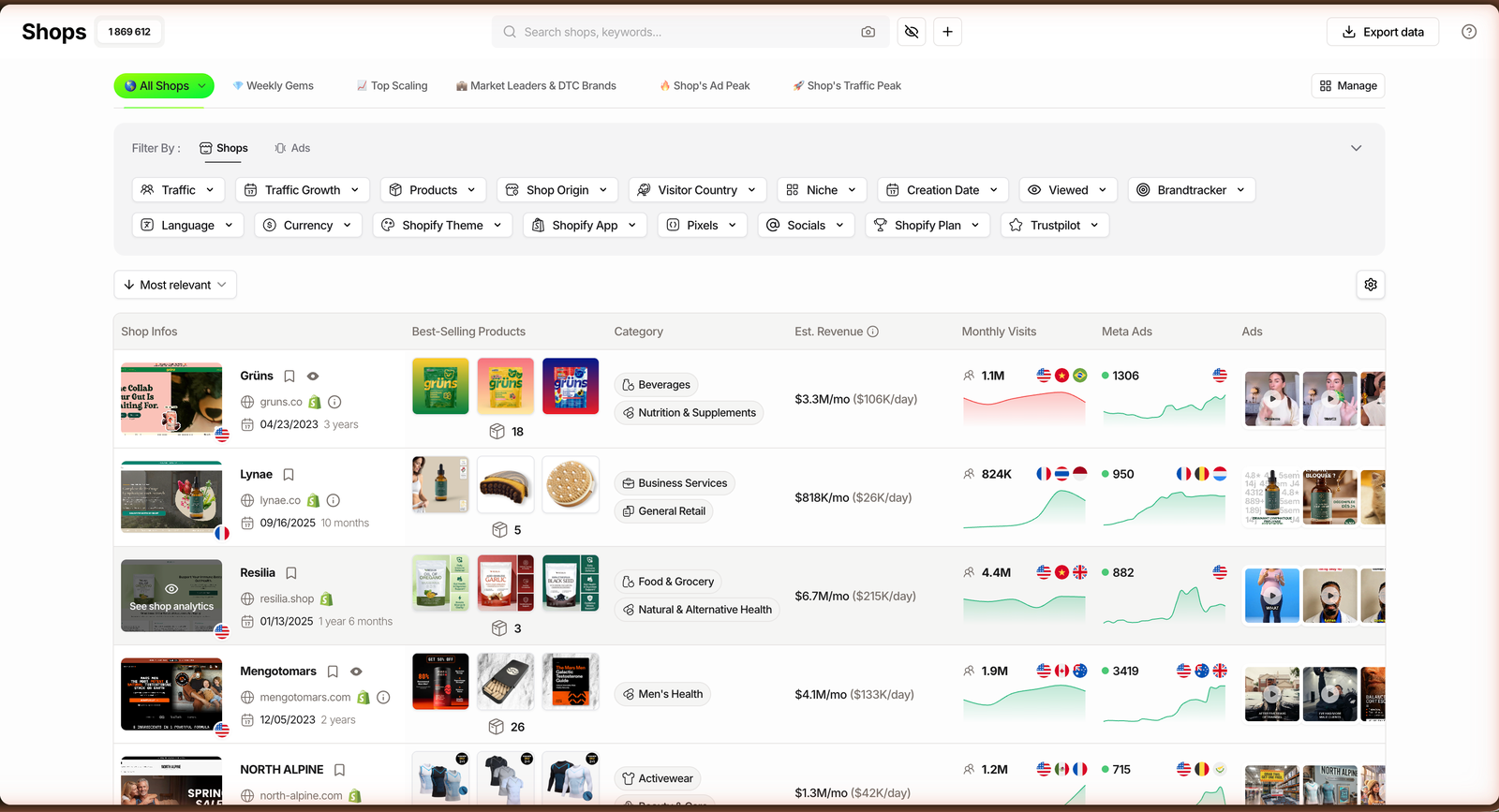
This is what the store database is for. Inside TrendTrack you can search the Shopify store database and filter by niche, best-seller price, traffic growth and 14 other parameters, then screen live Shopify stores to see which ones are selling your candidate and growing. We ran every filter on a paid account.
Niche is where most validation starts. The Niche filter carries 17 parent categories with live store counts, from Fashion and Home & Garden down to Pet Supplies and Toys & Games, so you can size how crowded a space is before committing. Pairing a niche with the Traffic Growth rule (rising visits over a 1, 3 or 6 month window) is the fastest way to find the best dropshipping niches that are still climbing rather than fading.
Phase 2 checklist
- Confirm search interest is flat-to-rising, not collapsing.
- Find at least one store selling it with growing monthly visits.
- Check the best-seller price to confirm your 3x to 4x margin holds.
Two smaller features earn their place here. AI Image Search, shipped March 7, 2026, lets you drop a screenshot of a product and pull up the stores selling it, which is discovery and validation in one step. The Est. Revenue column, hidden by default, gives a per-store monthly and daily estimate so a busy niche does not fool you into thinking every shop is profitable.
Clear all three checks and the product stops being a guess. Fail the traffic test and you move on before spending a cent on creative.
Level 3, advanced: reverse-engineer what’s already scaling
The fastest research is not finding a new product. It is finding a store that has already done the work and reading its playbook.
Ad spy makes that possible. TrendTrack’s Ad Rank feature, shipped January 29, 2026, ranks winning creatives even without EU impression data, and sorting by longest active surfaces the ads a competitor has trusted for months. You can spy on live ad creatives and see the exact hooks, copy and landing pages behind them.
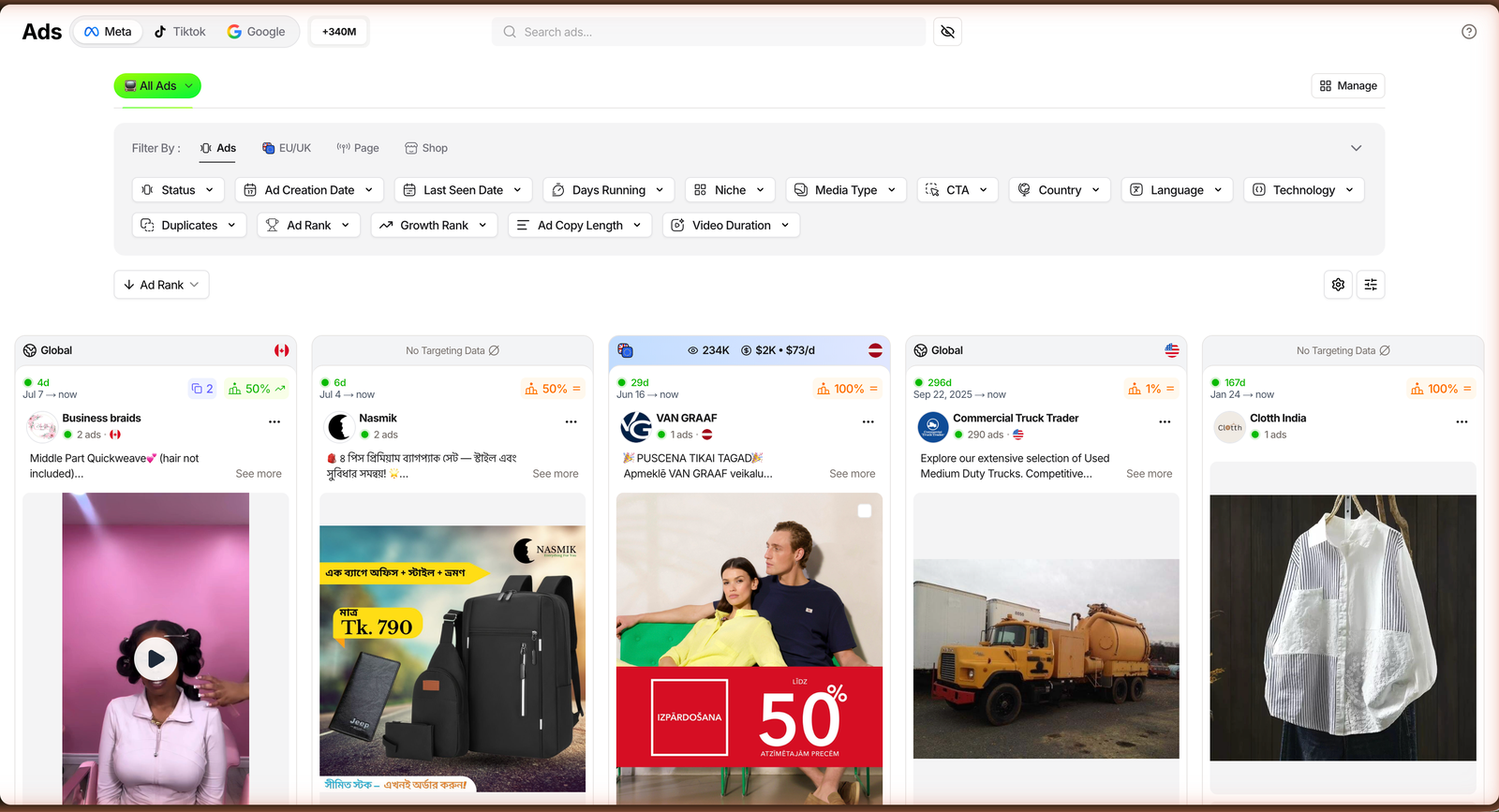
The store side matters as much. The Est. Revenue column gives a monthly and daily estimate per store, so you can tell a busy-looking shop from one that is genuinely scaling. Keep in mind that number is estimated, not audited revenue, so read it as direction, not gospel.
There is a second budget signal worth knowing. Because EU and UK ad transparency rules expose real reach, TrendTrack converts that into an estimated ad spend using a configurable CPM. When a competitor’s estimated spend keeps climbing week over week, that is a stronger vote of confidence than any single viral clip, since nobody scales spend on a product that is losing money.
Plan check: screening the store database and 2 Brandtrackers work on Starter ($59/mo, or $41/mo billed annually). The Ads and Advertisers modules, real EU ad spend and unlimited email spy start on Pro ($89/mo, or $62/mo annually).
So beginners can validate demand on Starter, and once ad spy becomes the bottleneck, Pro unlocks the reverse-engineering layer. That upgrade is the moment the tool earns its keep.
Competitor analysis goes deeper than a single ad. On a store’s page you get Similar Shops, its Meta and Google ad history, and even its email flows, so you can map a whole funnel instead of copying one creative. This is where a spy tool for dropshipping stops being about products and starts being about playbooks.
Read the winning creative, not just the product
A scaling product is only half the lesson. The other half is why its ad works, and that lives in the creative. Inside a tracked store, the Hooks & Scripts tab transcribes the first seconds of a competitor’s video ads, Ad Copies shows which text they reuse most, and the landing page tab reveals the exact offer page behind the click.
Worth copying
- The hook angle that keeps running
- The offer structure on the landing page
- The format mix (video vs image)
Not worth copying
- The exact product if it looks saturated
- Ads that ran once and stopped
- Branding tied to their name, not yours
Copy the mechanics, not the store. The goal is to understand why a funnel converts, then rebuild that logic around your own product and angle.
Related guide
Best Product Research Tools for Dropshipping
The full landscape, tested and ranked by use case.
Test before you scale
Research narrows the field. Testing settles the argument. No amount of spy data replaces putting a small budget behind your top pick and reading what real buyers do.
Run a modest test, then read the right signal. Views and clicks are cheap validation; add-to-carts and purchases are the real vote. A creative that earns views but no carts is a hook problem, not a product problem, and that distinction saves budgets.
Set a rule before you launch, so emotion does not spend your money. Decide the cost-per-add-to-cart you can accept and the number of days you will give a creative, then hold to it. If the test dies on that metric, the answer is no, and a fast no is worth as much as a slow yes.
Research is not a one-time act either. Winning products for 2026 will not be the winners of next quarter, so the operators who keep finding them treat this as a weekly loop. Brandtracker alerts, added July 7, 2026, will ping you when a store you follow launches new ads, which turns manual re-checking into a passive feed.
The full workflow, one table
Put the three passes side by side and the method becomes a routine you can repeat weekly.
| Phase | What you do | Free tool | TrendTrack shortcut |
|---|---|---|---|
| Discover | Build a wide candidate list | Ad Library, TikTok | AI Image Search |
| Validate demand | Check interest and traffic | Google Trends | Shops filters, Est. Revenue |
| Check competition | See what is already scaling | N/A | Ads, Ad Rank |
| Test | Small paid test, read carts | Your ad account | Brandtracker alerts |
The free column alone is a complete method; the shortcut column just removes the manual grind at each step. Whichever tools you use, the order does not change: never let a product skip from discovery straight to a paid test without the two proof passes in between.
FAQ
What is dropshipping product research?
It is the process of finding products with proven demand and enough margin, then confirming a competitor is already scaling them. You run it in three passes: manual discovery, data validation, and ad-spy reverse-engineering. The first pass builds a list, the next two prove which candidates are worth a paid test.
How do you find winning products for dropshipping?
Cross demand signals (live ads running past 30 days, rising traffic) with margin math (a 3x to 4x markup over landed cost) and proof that a real store is scaling the product. The manual scroll starts your list; store and ad data confirm which items can actually carry ad spend.
What are the criteria for a winning product?
Proven demand, a 3x to 4x margin, a wow factor or clear problem it solves, a market that is not saturated (or a season that fits), easy shipping (light, not fragile), and an obvious ad hook. A product that fails two or more of these is a bet, not a researched pick.
Do you need a paid tool for product research?
No, not to start. Facebook Ad Library, TikTok and Google Trends are free and enough for discovery. But they do not show which creatives are winning or a store’s estimated revenue. Ad spy, which starts on Pro ($89/mo), shortens validation by ranking live ads and reading competitor funnels.
How do you know if a product is saturated?
Look for many advertisers running the same creative, ads that have run for months across dozens of stores, and prices getting slashed. A growing competitor with few copycats means the window is still open. These are estimates and signals, not certainties, so weigh them together rather than trusting any one alone.
The takeaway
The method beats the tool. Discovery, validation, proof, then a real test: run those four in order and you stop guessing with your ad budget. You can do it free with the Ad Library, TikTok and Google Trends.
Paid data does not replace the method, it just compresses the two slowest passes, validation and competition, from days into an afternoon. If you want to understand what TrendTrack actually is before deciding where it fits, start there, then put the whole workflow in one tab.