Last verified July 15, 2026. Prices and module gating checked live in the TrendTrack app; ad-spy counts read from the app headers and the What’s new changelog.
Running Facebook ads for dropshipping in 2026 is a different game than it was three years ago. This guide maps the whole landscape: whether the channel still works, where it quietly bleeds beginners, and how operators decide before they spend a dollar.
We tested TrendTrack’s ad modules on a paid account while writing this, so the spying parts are hands-on, not theory.
Yes, Facebook ads still work for dropshipping in 2026, but only under real conditions: enough margin to absorb a rising CPM, several creative angles a week, and a habit of studying live winners before you spend. Blind launches on a low-margin product are what actually died.
Disclosure: some links on this page are affiliate links. If you subscribe through them we may earn a commission at no extra cost to you. We tested every TrendTrack feature mentioned here on a paid account.
Do Facebook ads still work for dropshipping in 2026?
Here is the honest tension. Search interest in the exact phrase “facebook ads for dropshipping” is down roughly 56% year over year, and every forum has a thread declaring the channel dead.
Yet Meta is still where most scaling dropshipping stores buy their traffic. The decline in searches is a shift in mood, not proof the ads stopped converting.
Source: TrendTrack app headers and What’s new changelog, checked July 13, 2026.
So the real question is not “do Facebook ads work.” It is “do they work for a store like yours, run the way you plan to run them.” The rest of this guide answers that, arguments for, arguments against, and the numbers that decide it.
Why Facebook still wins for dropshippers
Meta’s first advantage is raw audience scale. Almost every buyer you want is reachable, and the optimization engine is mature enough to find them from your creative alone.
That matters for dropshipping specifically. You rarely have a brand or a warm list, so you lean on the algorithm to introduce a product to cold traffic, and Facebook is still the best at that.
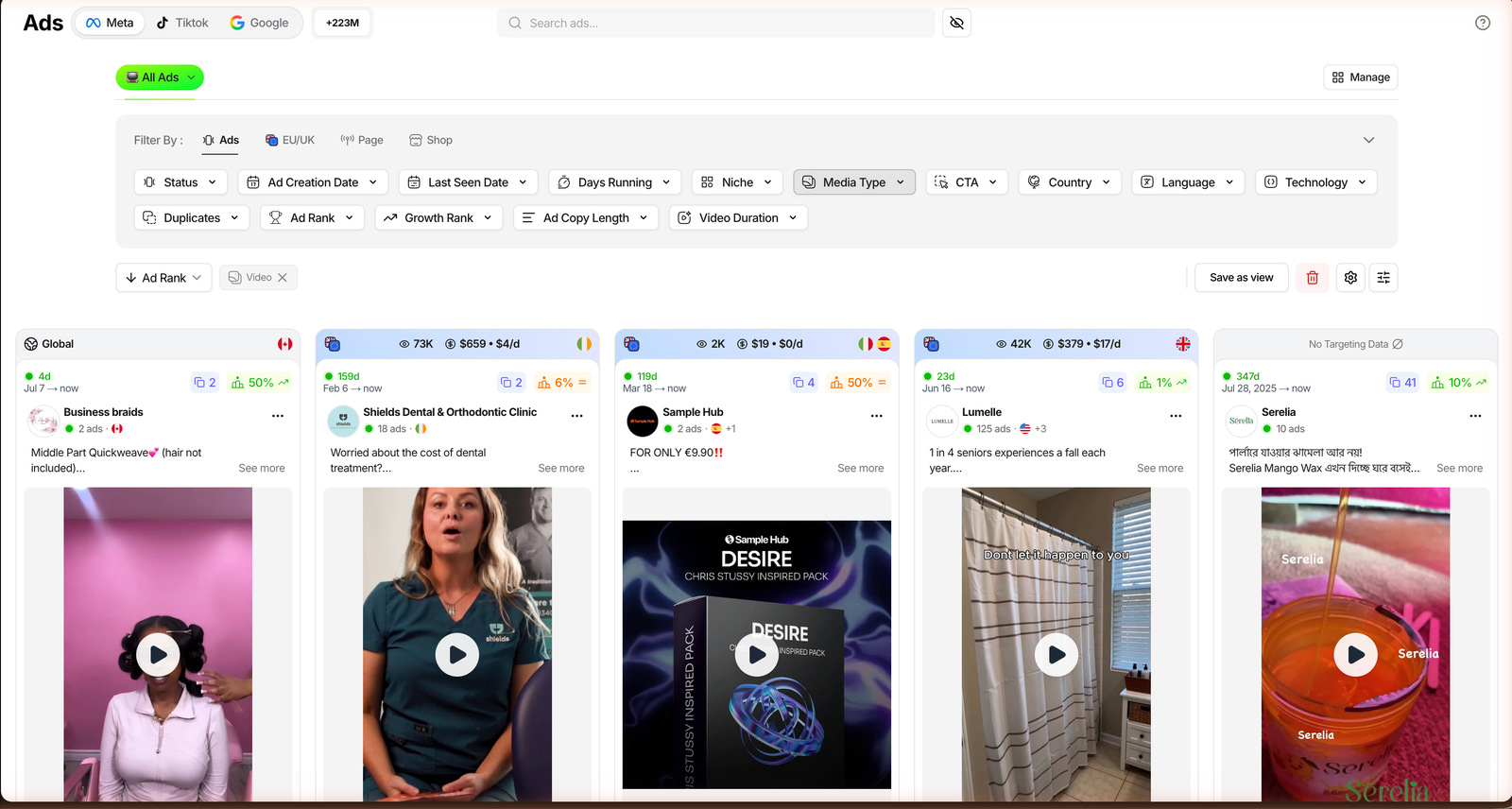
The second advantage is that the channel is now transparent. EU and UK rules force advertisers to expose reach, so you can read a competitor’s estimated spend and see which creatives are carrying their account before you build your own.
You still launch and manage the campaigns inside Meta Ads Manager. But the winning move happens before that, in research, which is where most beginners skip straight to spending.
Broad targeting also matured. You no longer stack narrow interests and hope; you hand Meta strong creative and a clean signal, and it finds the buyers. For a dropshipper testing a new product, that lowers the skill barrier on setup and raises it on creative.
Retargeting is the third piece. Meta remains strong at pulling back visitors who did not buy, which is where a lot of dropshipping margin is actually recovered.
Where Facebook ads punish dropshippers
Now the other side, because it is real. CPMs trend up over time, so the same reach costs more each season and a thin-margin product runs out of room fast.
Post-iOS signal loss made optimization noisier. Conversions are modeled more and measured less, so early tests can look worse than they are and push you to kill winners too soon.
Creative fatigue is brutal. A hook that prints for a week can flatline the next, which is why operators who survive produce 5 to 10 angles a week instead of boosting one static image.
There is also account risk. Dropshipping niches get flagged, and a ban on a single-account setup can zero your store overnight. That is an operational cost, not a rumor.
The hidden cost is creative production. Winning on Meta now means a steady output of native video, and if you cannot produce or commission that volume, the channel stalls no matter how good your product is.
And the free research layer is thinner than it looks. The Facebook Ad Library shows you which ads are live, but not how long each has really run, which one is winning, or any spend outside EU and UK transparency. It also has no cross-store filtering.
Related guide
Facebook Ad Library: The Complete Guide
The free way to see every live Facebook ad, and exactly where it stops.
What decides whether Facebook ads work for your store
Stop asking if Facebook ads work in general. The honest answer is that it depends on four numbers you already control, and they predict success better than any niche trend.
Why it still works
- Unmatched cold-traffic reach and creative-led targeting
- EU and UK transparency lets you study live winners
- Mature retargeting recovers lost visitors
Where it hurts
- Rising CPMs crush thin margins
- iOS signal loss makes early tests noisy
- Creative fatigue and account-ban risk
| Factor | Green light | Red flag |
|---|---|---|
| Net margin per order | ~$25 or more after product and shipping | Under ~$15, no room to learn |
| Average order value | Bundles or higher-ticket lift AOV | Low-AOV single item only |
| Creative you can produce | 5 to 10 angles a week | One static image, boosted |
| Spy before you spend | Yes study live winners first | No launch blind |
Two green lights and you have a channel worth working. Two red flags and Facebook will teach you an expensive lesson before it teaches you anything useful.
A phase-by-phase Facebook ads plan for dropshipping
Winning stores do not run Facebook ads as one big bet. They move through four phases, and each phase has a clear signal that tells you to advance.
Phase 1: Research and spy
Before you build anything, find products already scaling on Meta and the exact creatives doing it.
- Pull live competitor ads and sort by how long each has run.
- Note the hooks, offers and landing pages that repeat.
- Read estimated EU spend to separate real winners from noise.
Phase 2: Create
Turn research into your own angles. You are not copying a single ad, you are collecting proven patterns and remixing them.
- Write several distinct hooks per product, not variations of one.
- Match format to what wins in the niche, usually short video.
- Keep a swipe file of angles you can produce fast.
Phase 3: Test
Now spend, but small and disciplined. The goal of this phase is learning, not profit, and how you test decides everything downstream. This is also where how to test a product before you scale saves you the most money.
- Run modest daily budgets per ad set and hold long enough to exit the learning phase.
- Kill clear losers quickly and protect the few creatives that hold a profitable cost per purchase.
- Judge on margin, not clicks.
Phase 4: Scale
Only proven winners get real budget. Scaling an unproven ad is the fastest way to lose money on Meta. Know your ceiling first: a cost per acquisition calculator sets the most you can pay per order.
- Increase budget gradually so the algorithm keeps the learning it earned.
- Refresh creative before fatigue sets in.
- Add retargeting to recover the visitors who did not buy.
| Phase | What you do | Signal to move on |
|---|---|---|
| Research | Spy on live winners, log hooks and offers | A product with proven, long-running ads |
| Create | Build several hooks and angles | 3 to 5 creatives ready to run |
| Test | Small budgets, kill losers fast | A creative holds a profitable cost per purchase |
| Scale | Raise budget on winners, add retargeting | Margin holds as spend climbs |
Research winning Facebook ads before you spend
Every phase above leans on the first one. The single highest-leverage habit in dropshipping ads is to spy on your competitors’ ads before you commit budget, so you test proven demand instead of a guess.
Plan check: TrendTrack’s Ads and Advertisers modules start on Pro ($89/mo, or $62/mo billed annually). Starter ($59) covers Shops, 2 Brandtrackers and the free Chrome extension, but not ad spy.
Free tools show you that ads exist. A dedicated ad-spy layer shows you which ones are winning. Inside TrendTrack’s Ads module you can filter Meta ads by Ad Rank, days running, estimated EU spend and the tech behind the store, then open any ad to see its full copy, landing page and reuse history.
Ad Rank matters because it works even where EU impression data is missing. Shipped in January 2026, it ranks how well an ad performs relative to its peers, so a “Top 1%” filter surfaces the creatives worth studying instead of the ones that simply exist.
Go one level deeper with the Brandtracker. Point it at a competitor and it follows their whole Meta funnel, including a Hooks & Scripts tab that transcribes their video ads and shows how long each hook has run.
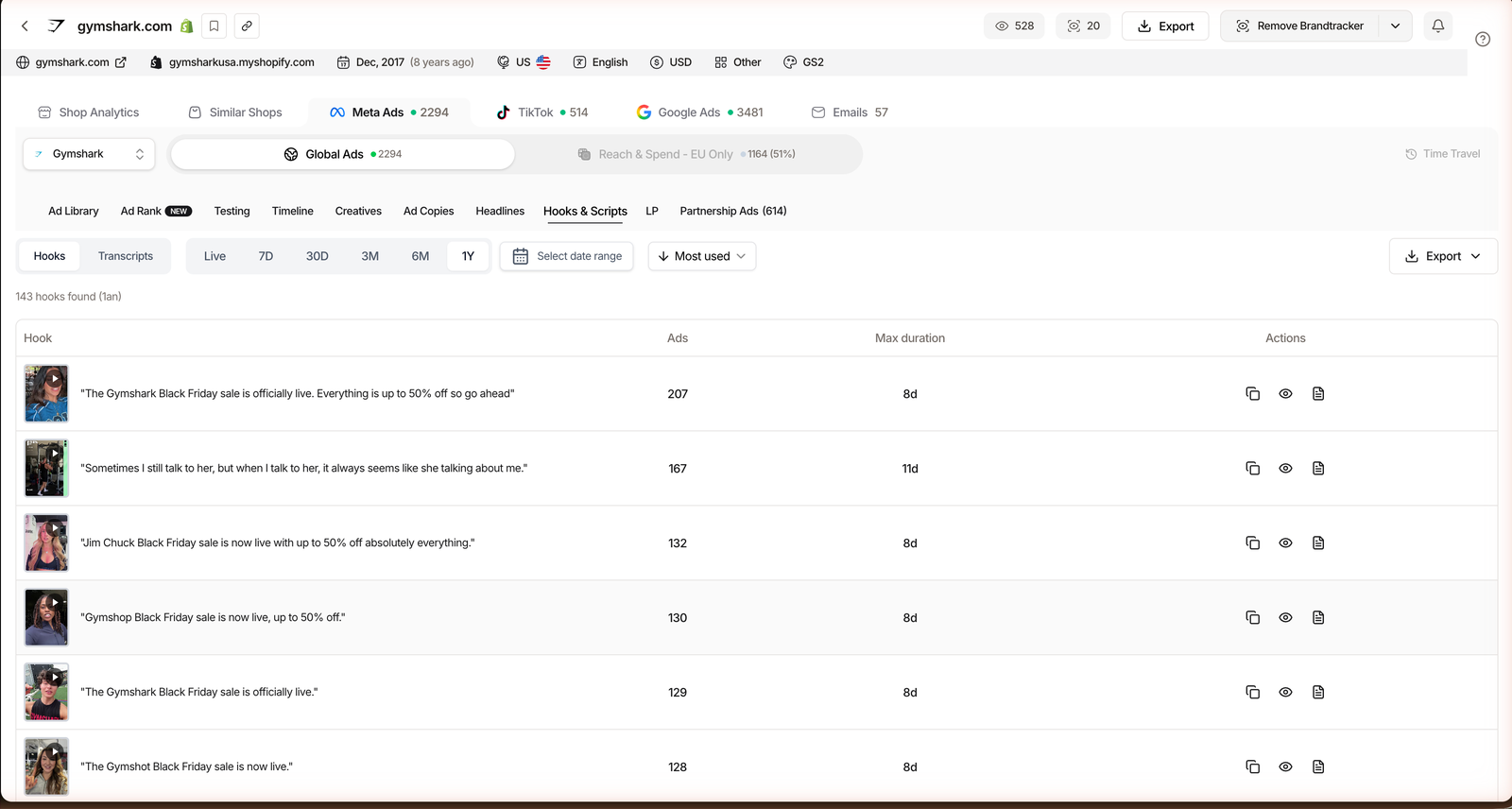
That is the difference between guessing and modeling. You are not inventing a hook from scratch, you are starting from ones the market already rewarded.
Related guide
TrendTrack Ads Library Tutorial
Filter 340M+ ads by Ad Rank, EU spend and days running.
FAQ
Do Facebook ads still work for dropshipping in 2026?
Yes, but conditionally. Search interest in the phrase has fallen (about 56% year over year), yet Meta is still where most scaling dropshipping stores buy traffic. What changed is the bar: rising CPMs and post-iOS signal loss punish thin-margin, single-creative launches. Stores that keep working treat Facebook as a creative-testing machine, run several ad angles a week, and study live competitor winners before spending. If your margin and creative output can support that, it still works.
How much should you budget to test a Facebook ad for dropshipping?
There is no universal number, and anyone promising one is guessing. A common operator approach is a small daily test budget per ad set held long enough to exit the learning phase, then killing losers fast and reallocating to the few creatives that hold a profitable cost per purchase. Your real floor is margin: if one sale nets under ~$15 after product and shipping, paid testing rarely leaves room to learn. Treat every figure as directional, not a promise.
Is Facebook Ad Library enough to spy on competitor dropshipping ads?
It is a great free start and it is official, but it has hard limits. The Facebook Ad Library shows you which ads are live and their creative, but not how long each has really run, which one is carrying the account, or any spend outside EU and UK transparency rules. It also has no cross-store filtering. Tools built on top of it add days-running, an Ad Rank signal, estimated EU spend and full-text search, which is what turns “these ads exist” into “this one is winning.”
What profit margin do you need to run Facebook ads for dropshipping?
Enough to survive a bad first week. Because CPMs rise and early tests lose money before they learn, low-AOV single items with a few dollars of margin leave no room. Operators generally look for healthy margin per order (bundles, higher AOV, or higher-ticket items help), so a rising cost per purchase does not instantly go negative. The exact number depends on your niche and creative, but “spy first, then test with real margin” beats launching blind on a low-margin product.
Are TikTok ads better than Facebook ads for dropshipping?
Neither is universally better; they suit different creatives and audiences. TikTok rewards native, fast, UGC-style video and can be cheaper on impressions, while Facebook offers deep retargeting, older buyers and mature optimization. Many stores test a creative on TikTok, then scale winners on both. The smarter move is not picking a platform up front but researching what already scales on each. TrendTrack tracks both Meta and TikTok, including TikTok organic, so you can compare before you spend.
The verdict: when Facebook ads make sense for dropshipping
Facebook ads are still a strong channel for dropshipping, they are just no longer a forgiving one. If you have real margin, can ship several creatives a week, and research before you spend, the math works as well as it ever did.
If you are selling a low-margin single item and boosting one image, the channel will drain you, and no targeting trick fixes that. The fix is upstream: pick a product with room, then spy on live Facebook ads at scale to model what already works.
Start with research, move through the four phases, and let the numbers, not the hype, decide how far you push.