Last verified July 15, 2026. Feature counts, gating and prices checked on a paid TrendTrack account; testing metrics reflect standard Meta and TikTok media-buying practice.
Most stores that fail did not pick bad products. They scaled unproven ones.
Testing is the cheap part of dropshipping. Scaling a product you never validated is where budgets disappear. This guide maps the full path from “this looks interesting” to “put real money behind it,” in four phases you can run on almost any product.
To test a product before you scale: validate demand with free signals and competitor data, run one clean paid test with a fixed budget and a single variable, judge it on cost per purchase against breakeven, then scale only what clears the bar. Spend small to buy data, not to force a winner.
What “testing” really means before you scale
A test and a scale are two different jobs. A test spends a small, fixed amount to buy one thing, data, while a scale pours budget behind a product the test already proved. Mix the two and you are gambling, not media buying.
Testing sits at the end of research, not the start. If you have not shortlisted candidates yet, start with the pillar on how to find winning products first, then bring the survivors here.
TrendTrack index and changelog, checked July 2026.
Here is the mindset that keeps you solvent: a validated product is not a winning product. Validation says demand exists. Only a test tells you whether your creative, offer and margin can turn that demand into a profitable purchase.
Phase 1: Validate demand before you spend a dollar
The cheapest test is the one you never have to run. Before a product earns paid traffic, it should clear a demand bar you can read for free.
Look at the free signals first. Search interest over time (you can check demand on Google Trends), marketplace review counts, and how many competitors are actively selling it. A product nobody advertises and nobody reviews is a hypothesis, not a candidate.
Related guide
Winning Product Criteria: The Checklist
The bar a product should clear before it earns a test.
Competitor ad data is the strongest free signal. If a product’s ads have been running for weeks and multiple stores push it, demand is already proven. That changes your test: you are no longer testing whether people want it, only whether your execution beats what is live.
This is where an ad-spy layer earns its place. Inside TrendTrack you can filter roughly 337M ads (checked July 2026) by how long each has been live, and cross-read a store’s estimated revenue. Keep in mind those revenue and reach numbers are estimated, not audited, so treat them as direction.
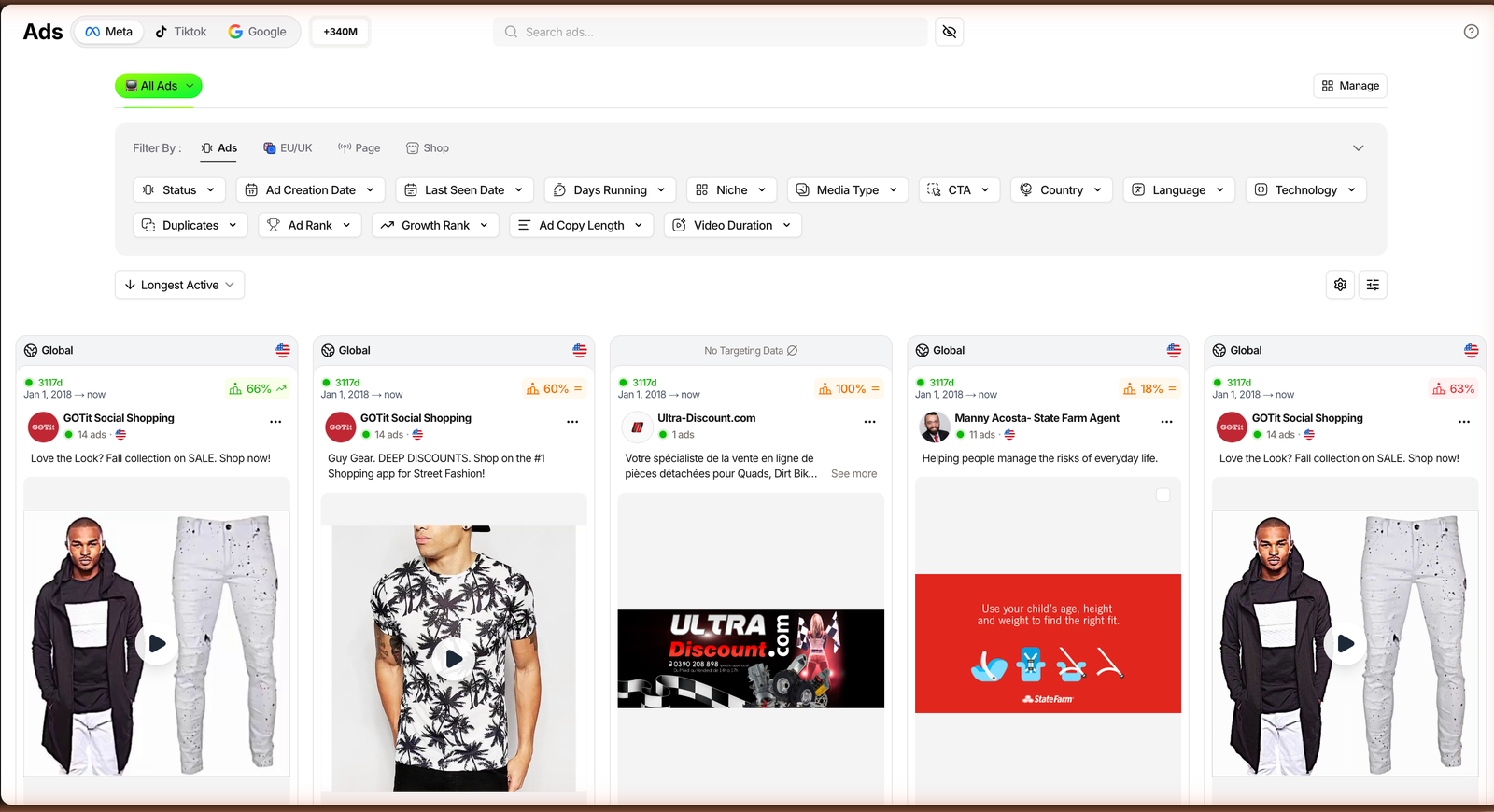
Plan check: reading competitors’ live ads uses the Ads module, which starts on Pro ($89/mo). Starter ($59/mo) covers Shops, 2 Brandtrackers and the free Chrome extension, so you can still validate demand on the cheaper tier.
Phase 2: Set up a clean test
A dirty test teaches you nothing. If you change the product, the creative and the audience at once, a good result tells you nothing about why. Change one variable at a time.
Set the budget and the window before you launch, then hold to them. A common starting approach is to give one product enough spend to reach several times its target cost per purchase before you call it. That number is a planning tool, not a guarantee.
Build the campaign cleanly. Whether you split-test creatives inside Meta Ads Manager or run broad, keep the structure simple so the data stays readable. For the angles and hooks themselves, work from real demand, not guesses; the full method sits in the guide to dropshipping product research.
Phase 3: Read the signals that decide
Now the test talks back. Ignore the vanity metrics (likes, reach, “engagement”) and watch the ones tied to money. Each one flags a different failure point.
| Metric | Healthy signal | Watch | Kill signal |
|---|---|---|---|
| Click-through rate | Above your account norm | Around norm | Well below norm |
| Cost per click | Stable, affordable | Climbing | Rising with no sales |
| Add-to-cart rate | Carts filling steadily | Carts, few checkouts | Clicks, no carts |
| Cost per purchase | At or below breakeven | Slightly above breakeven | Far above breakeven |
| Video hold rate | Strong first 3 seconds | Drop after hook | Early cliff, no watch |
Give it enough data before you judge. A verdict after 20 clicks is noise, not signal. Decide your minimum sample (impressions, clicks, add-to-carts) and your minimum window up front, and only call the test once both are met.
Phase 4: Kill or scale
The decision is simpler than it feels. If cost per purchase sits at or below breakeven with room to optimize it is a scale candidate; if it is clearly underwater well past your threshold, cut it and move to the next product. Indecision is the most expensive outcome.
One trap: do not confuse a promising test with a durable winner. The market decides that, and you can read the market. In TrendTrack’s Ads module you can sort live ads by how long they have been running; a product surrounded by long-running competitor ads has legs, while a field of ads that all died in days is a warning.
Related guide
TrendTrack Ads Library
Sort live ads by how long they have been running to spot proven winners.
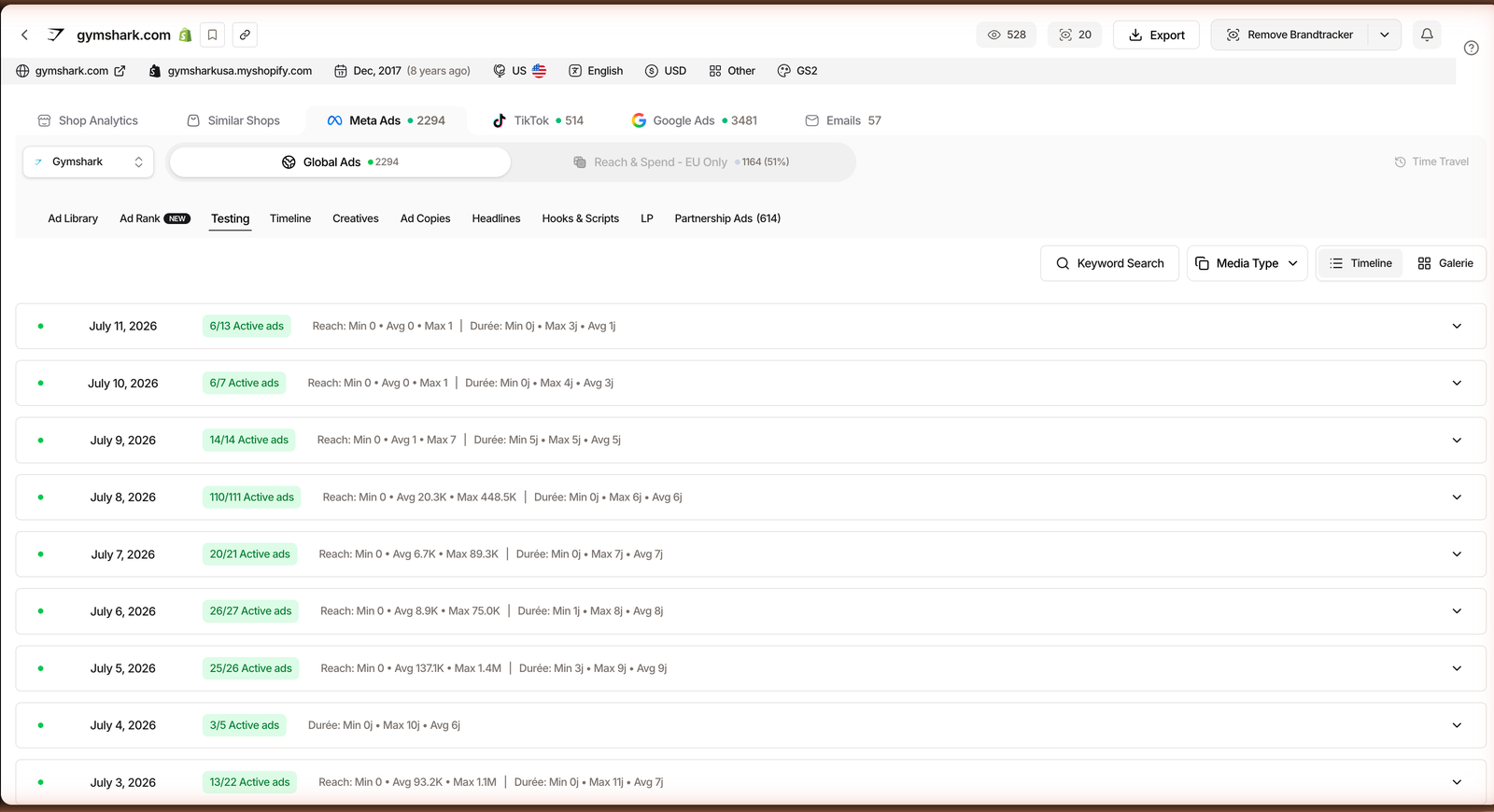
You can even watch a brand test in waves. A Brandtracker records a store’s daily ad-test activity, so you can see it launch batches of creatives, kill the losers, and scale the survivors, then borrow the pattern for your own product.
When you do scale, scale the winner without breaking it. Raising a budget too fast resets the algorithm’s learning and can spike your cost per purchase overnight.
The safer path is to lift spend in steps, duplicate the winning ad set into fresh audiences, and keep judging the same money metrics at the new volume. A product that holds its cost per purchase as you scale is the one worth building a store around.
The test-before-scale checklist
Put the four phases on one page. Do not move to the next row until the current one gives you a green light.
| Phase | Do this | Green light to move on |
|---|---|---|
| 1. Validate | Check free demand signals and competitor ad longevity | Real, proven demand exists |
| 2. Set up | One product, one variable, fixed budget and window | Clean campaign is live |
| 3. Read | Watch money metrics, not vanity ones, to your sample | Enough data for a stable read |
| 4. Decide | Scale at or below breakeven, kill if underwater | Clear kill or scale call |
The tighter you validate in Phase 1, the fewer products you pay to test in Phase 2. That is where an ad-spy tool pays for itself: it narrows the field before you spend, so your test budget goes to candidates that already show demand.
Disclosure: some links on this page are affiliate links. If you subscribe through them we may earn a commission at no extra cost to you. We tested every TrendTrack feature mentioned here on a paid account.
Screen the winners before you test
From $59/mo (or $42/mo billed annually). Ad spy starts on Pro ($89/mo).
FAQ
How much should you spend to test a dropshipping product?
There’s no universal number, but a common approach is to give one product a fixed test budget over a set window, often a few times its target cost per purchase before you judge it. The point is to buy enough data to see a trend, not to force a winner. Set the number before you launch, hold to it, and treat any budget figure as a planning tool rather than a guarantee.
How long should you run a product test before killing it?
Run it long enough to leave the learning phase and gather a stable read, usually a few days of consistent spend rather than a few hours, since judging a test after 20 clicks is noise. Decide your minimum window and minimum sample (impressions, clicks, add-to-carts) in advance, and only call it once both are met. If the numbers are clearly underwater well past your threshold, cut it.
What metrics tell you a product is worth scaling?
Watch the metrics tied to money, not vanity: cost per purchase against your breakeven is the decider, while click-through rate and add-to-cart rate tell you whether the creative and the offer are landing. A test that sits at or below breakeven with room to optimize is a scale candidate, whereas likes and reach alone prove nothing. Confirm the trend holds across a few days before you pour in budget.
How do you know if a product is already saturated?
Saturation is hard to prove, but you can read signals. In TrendTrack’s Ads module you can sort live ads by how long they’ve been running and see how many advertisers push the same product; a crowded field of long-running ads means you’re late unless you bring a fresh angle. Est. Revenue and competitor ad longevity are estimates, so treat them as direction, not verdicts.
Can you test products without spending on ads?
Partly: organic content (TikTok, Reels) and a small store can validate interest before you pay for traffic, and free signals like Google Trends, marketplace demand and competitor ad longevity narrow the field first. But paid testing is still the fastest way to get a clean, comparable read on cost per purchase. Free validation reduces how many products you pay to test; it rarely replaces the paid test entirely.