Last verified July 2026. TikTok Shop fees and requirements checked against TikTok’s published US seller policies; TrendTrack features tested on a paid account.
Can you actually make money on TikTok Shop? Do you need a business, a warehouse, or a big following to start? And how much does TikTok take on every sale?
Those three questions decide whether TikTok Shop is worth your time. This guide answers them in order, then walks you from a blank Seller Center account to a live shop, and finishes with the part most sellers skip: finding products that already have demand before you list anything.
To sell on TikTok Shop in the US you must be 18 or older, have a valid ID, and (for companies) a registered business. TikTok charges a 6% referral fee on most categories. You can ship orders yourself, use TikTok Shipping, or let Fulfilled by TikTok handle logistics.
Disclosure: some links on this page are affiliate links. If you subscribe through them we may earn a commission at no extra cost to you. We tested every TrendTrack feature mentioned here on a paid account.
Can you sell on TikTok Shop?
The bar to get in is lower than most people assume. You need to be 18 or older, based in the US, and able to verify your identity with a valid government ID.
Companies register with a business entity, but individuals can join as a private seller. If you have never sold online before, it helps to treat this like any other channel and start a dropshipping business the right way first, then plug TikTok Shop in as a sales surface. If you also sell on Meta, our Instagram Shop versus TikTok Shop breakdown weighs the two.
When you apply, TikTok asks you to pick a seller type up front. The four options shape your onboarding:
- Private Seller: an individual selling their own products.
- Reseller: selling brands or goods you source.
- Dropshipper: listing products fulfilled through a supplier.
- Affiliate Marketer: promoting other sellers’ products for commission.
Approval usually lands in 3 to 5 days once your documents check out. There is no follower requirement to open a shop, so you can sell before you have an audience.
Set up your TikTok Shop, step by step
Everything happens inside the TikTok Shop Seller Center. Here is the shape of it before we go step by step.
Step 1: Pick your seller type and create the account
Sign up at Seller Center with your email or TikTok login, then choose one of the four seller types above. Your choice sets which documents TikTok asks for next.
Step 2: Verify your identity and business
Upload a government ID and, for a company, your business registration. This is the step that gates approval, so use details that match your legal paperwork exactly.
Step 3: Add your shop details and list products
Name your shop, add a logo, pick your main product category, and create your first listings with titles, images, price, and stock. Accurate categories matter because they can change your referral fee.
Step 4: Connect payout and go live
Link a bank account for payouts, verify your phone number, and submit. Once TikTok approves, your products can appear in the shop tab, in videos, and in LIVE sessions.
What it costs: TikTok Shop fees
TikTok Shop runs on a single referral fee rather than a stack of listing charges. Here is the fee picture as published for US sellers, checked July 2026.
| Fee | What it is | Rate |
|---|---|---|
| Referral fee | All-in platform cut on customer payment, plus platform discount, minus tax. | 6% (5% some categories) |
| New-seller rate | If your first sale lands within 60 days of onboarding. | 3% for 30 days |
| Refund admin fee | Kept when an order is refunded or cancelled. | 20% of referral, cap $5/SKU |
| Fulfilled by TikTok | Pick, pack, and ship through TikTok’s warehouses. | $2.86 to $3.58/unit |
| Creator commission | You set it to attract affiliate creators. | 10% to 30% (optional) |
The referral fee bundles marketplace commission and payment processing into one number, so there is no separate transaction charge on top. Independent shipping ended March 31, 2026, so US orders now route through TikTok Shipping or Fulfilled by TikTok.
How you actually sell: content, creators, and fulfillment
Listings alone do not sell on TikTok. Demand comes from short videos, LIVE sessions, and creators tagging your products, which is why the same product can flatline on one account and scale on another.
That content engine is also why so many sellers pair the shop with running TikTok ads to push proven creatives further. Organic first, paid amplification second, is the usual order.
On fulfillment, you have three routes. Pick the one that matches your stock and shipping speed, because TikTok holds you to delivery windows of roughly three days for Express and up to six for Standard.
| Option | Who ships | Best for |
|---|---|---|
| TikTok Shipping | TikTok assigns the carrier, you pack. | Sellers who hold stock but want label help. |
| Seller Shipping | You control the whole process. | Established stores with their own logistics. |
| Fulfilled by TikTok | TikTok stores, picks, and ships. | Hands-off sellers who can send stock in. |
Creators are the multiplier. Inside Seller Center you open an affiliate plan (Open, Targeted, or Shop) and set a commission, usually 10% to 30% depending on category, so creators earn a cut for every sale they drive.
Find products worth selling before you list
Here is where most new shops lose money: they list whatever a supplier pushes, then wonder why nothing moves. The fix is boring but it works. Validate demand before you commit a listing.
You want proof that a product is already selling on TikTok, not a hunch. That means reading which creatives are live, how long they have run, and which niches are heating up, which is exactly the kind of signal you can track TikTok demand at scale instead of scrolling for hours.
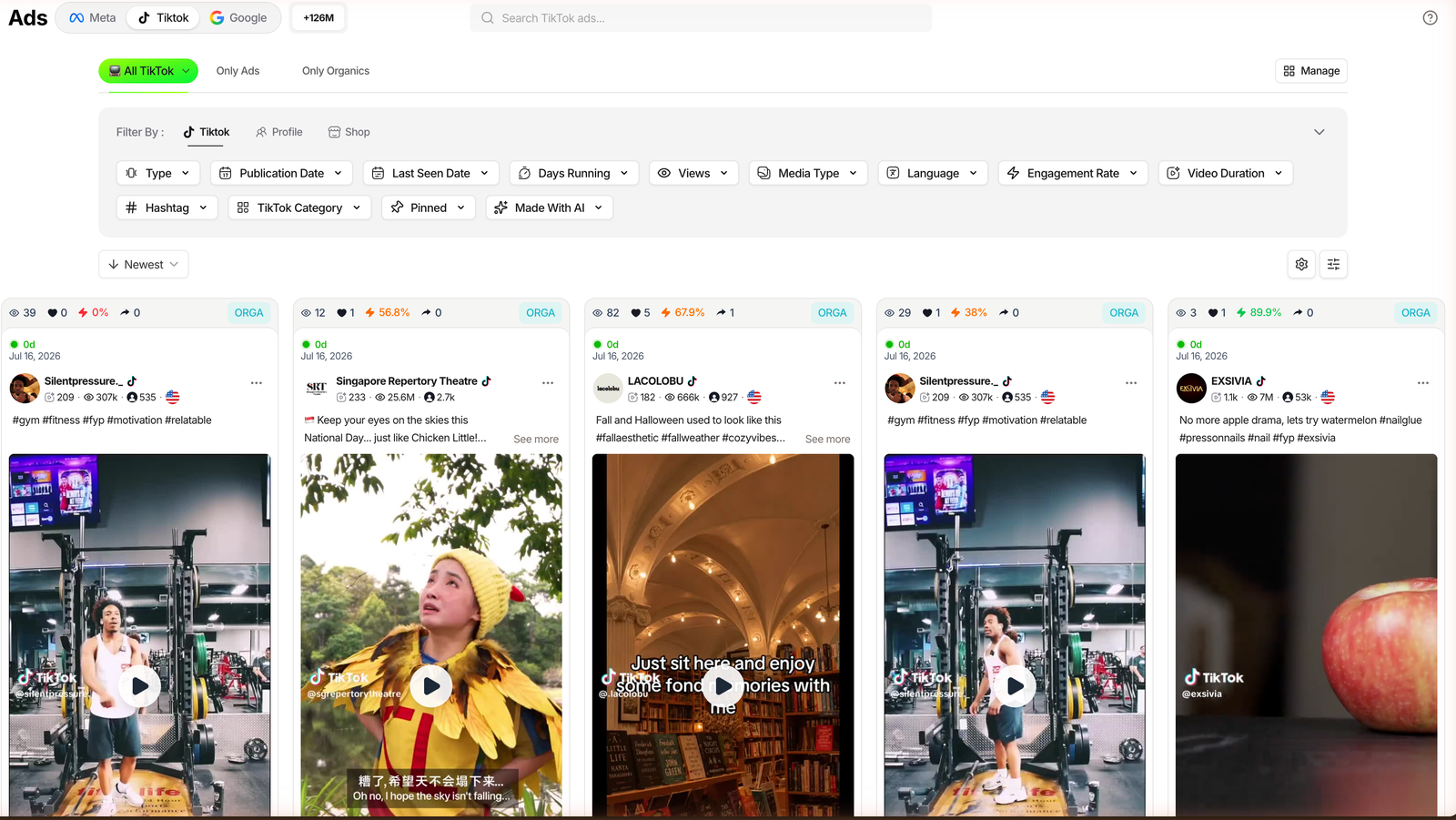
TrendTrack indexes ads across Meta, TikTok, and Google in one place, a base of more than 337 million ads at last check. Filtering the TikTok tab by niche, Ad Rank, and days running surfaces the creatives that keep running, which is the closest thing to a demand signal you get from the outside.
Plan check: TikTok ad spy lives in the Ads module, which starts on Pro ($89/mo, or $63/mo billed annually). Starter ($59) covers Shops and two Brandtrackers, but not the Ads or Advertisers modules.
Related guide
The best TikTok ad spy tools in 2026
Compare the tools that surface winning TikTok creatives.
Spy on what is already scaling on TikTok
Once you know a niche has demand, the next question is who is winning it and how. This is where tracking a whole competitor beats scrolling a feed.
Related guide
How the TrendTrack Brandtracker reads a competitor’s funnel
Track a store’s TikTok ads and organic content side by side.
The Brandtracker’s TikTok view is the useful part here. It splits a tracked store’s TikTok presence into ads and organic, so you can see whether their sales come from paid pushes or from content that simply took off. TrendTrack tracks the organic side too, which most ad-spy tools ignore.
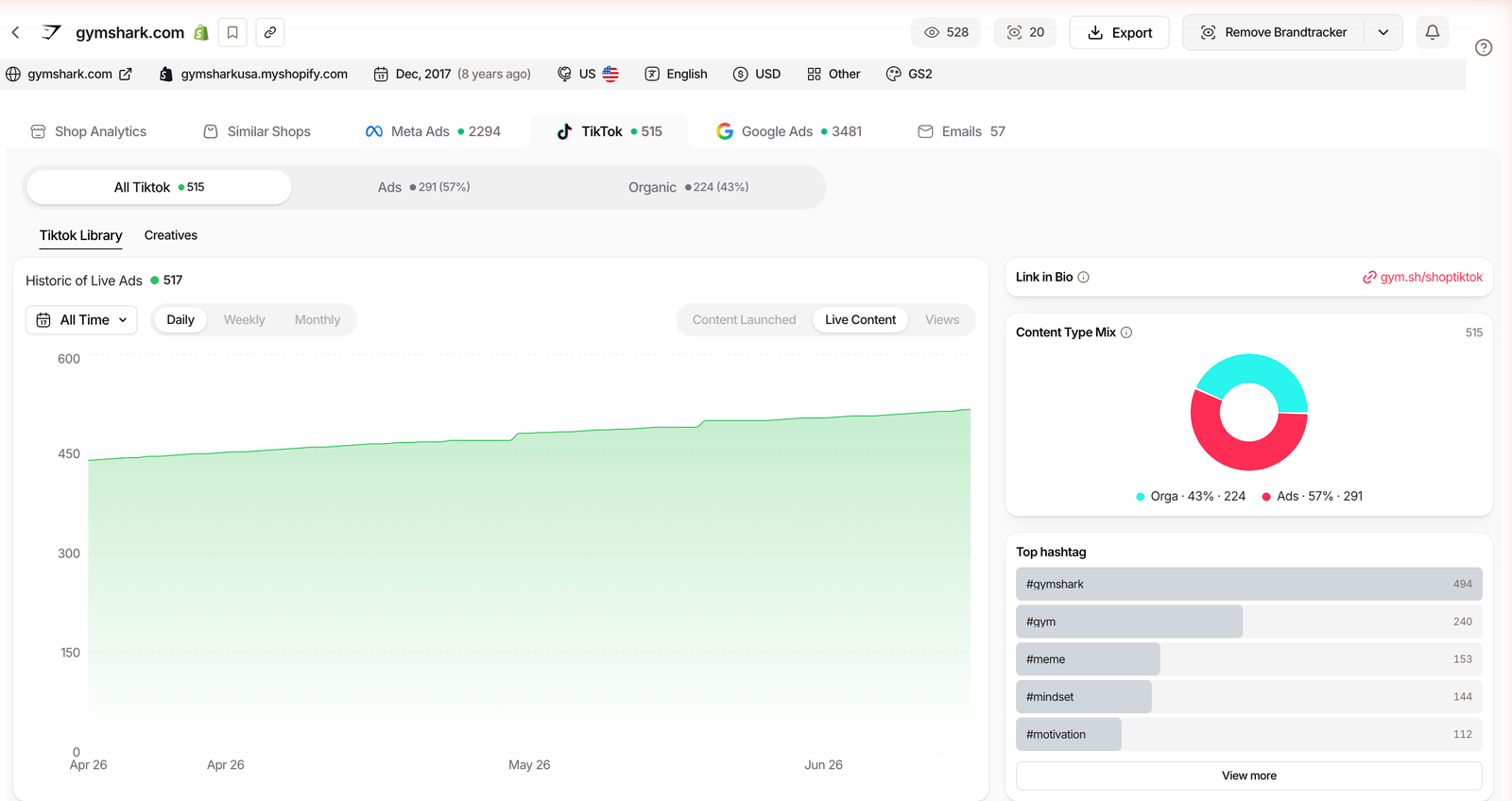
From there you get the content type mix, the top hashtags a brand rides, its link in bio, and rankings by views, likes, and shares. Read a few competitors this way and the product angles, hooks, and price points that already convert stop being a guess.
Your TikTok Shop launch checklist
Pull it together into four phases. Work top to bottom and do not launch paid pushes before the basics are solid.
| Phase | Action | Done when |
|---|---|---|
| Set up | Register, verify ID and business, connect payout. | Shop approved and live. |
| Validate | Check live TikTok creatives and niches for demand. | You have proof, not a hunch. |
| List | Create listings priced above the 6% plus fulfillment. | Margins survive the fee stack. |
| Scale | Post organic video, recruit creators, add ads. | Sales come from more than one source. |
FAQ
Do you need a business license to sell on TikTok Shop?
Not always. Individuals can register as a private seller with a valid government ID; companies need a registered business.
You must be 18 or older and based in the US with a valid ID. Approval usually takes 3 to 5 days.
How much does TikTok Shop take per sale?
TikTok’s published US referral fee is 6% of the customer payment (plus platform discount, minus tax) for most categories, with some like certain jewelry at 5%. New sellers who make a first sale within 60 days of onboarding pay a reduced 3% for the next 30 days. Fees checked July 2026.
Can you dropship on TikTok Shop?
Yes, “Dropshipper” is one of the seller types you can pick at signup, but you still need reliable fulfillment. Since independent shipping ended March 31, 2026, US orders route through TikTok Shipping or Fulfilled by TikTok, so your supplier lead times and stock have to keep up with TikTok’s delivery windows.
How many followers do you need to sell on TikTok Shop?
Sellers do not need a follower minimum to open a shop. Creators who want to earn affiliate commission promoting products have historically needed a threshold (often around 1,000 followers), but as a seller you can list and sell without a large audience by using ads and affiliate creators.
Is TikTok Shop worth it in 2026?
It depends on your margins. With a 6% referral fee plus fulfillment and optional creator commissions of 10 to 30%, thin-margin products get squeezed. It works best when you validate demand first, price for the fee stack, and lean on organic video or affiliate creators rather than paying for every view.
The bottom line
TikTok Shop is easy to open and unforgiving to wing. The setup takes days, the 6% referral fee is predictable, and fulfillment now runs through TikTok’s rails.
The edge is not in the signup flow, it is in what you list. Validate demand with real ad and organic data before you commit, price above the fee stack, and let content do the selling. Do that and TikTok Shop becomes a channel worth the effort rather than a graveyard of dead listings.