Last verified July 16, 2026. Platform mechanics and TrendTrack figures checked live on a paid account; the margin figures are worked examples, not guarantees.
You upload a t-shirt design at 9am. By noon it is live on your store, no stock ordered, no cash out of pocket. Then the first sale drops, and the confirmation email shows the part nobody posts about: $4 kept on a $24 shirt.
That gap is the whole story of print on demand in 2026. The model is genuinely easy to start and genuinely hard to make pay. This guide walks the entire thing, how it works, what you actually keep, how to launch, which platform to pick, and the one step that decides whether any of it makes money.
Print on demand (POD) lets you sell custom products like t-shirts, mugs and posters that a partner prints and ships only after a customer buys, so you carry no inventory. In 2026 it is still a real business, but margins are thin and the edge is knowing what will sell, not the printing.
In this guide
What print on demand actually is
Print on demand is a fulfillment method. You design a product, list it on your store, and a print partner produces and ships each unit only after someone orders it.
Nothing is made in advance. There is no box of 200 shirts in your spare room and no upfront invoice. You pay the base cost once, per sale, after the customer has already paid you.
The catalog goes far past t-shirts. Hoodies, mugs, tote bags, phone cases, posters, stickers and journals are all standard POD products. If a blank can hold a print, someone offers it on demand.
Who reaches for this model? Creators turning an audience into merch, brands extending a line without new warehousing, and sellers who just want to test product ideas cheaply. The common thread is simple: none of them wants to gamble cash on stock that might not move.
The case for print on demand
The appeal is real, and it is worth being clear about before we get to the downsides.
Why POD still pulls people in
- No inventory risk. You never buy stock you might not sell.
- Low startup cost. A store, a design tool and a print partner cost close to nothing to set up.
- Cheap to test. You can launch ten designs in an afternoon and kill the nine that flop.
- A catalog nobody else has. Your artwork is unique, which gives you a brand angle a generic reseller can’t copy.
That last point matters more than the rest. Unlike classic dropshipping, where you resell the same generic gadget as a hundred other stores, print on demand gives you a product that only exists on your shelf.
There is a speed argument too. Because you are not sourcing or storing anything, the gap between an idea and a live product is a single afternoon. You can ride a trend while it is still moving, not three shipping weeks after it peaked.
The catch nobody screenshots
Here is the part the “start POD today” videos skip. The same features that make it low-risk also make it low-margin and slow.
The real limits
- Thin margins. The print partner takes the biggest slice, so you keep less per sale than on almost any other model.
- Slower shipping. Each item is made to order, which adds production time on top of transit.
- Less quality control. You rarely touch the product before your customer does.
- Heavy saturation. The low barrier that let you in let everyone else in too.
The demand signal backs this up. US search volume for “print on demand” is down roughly 18% year over year, a sign the hype cycle has cooled and the easy traffic has thinned.
None of that makes POD dead. It makes it a business that rewards operators over dabblers, which is a very different pitch from the one that first sold it.
Print on demand vs dropshipping
People search “print on demand vs dropshipping” as if they are rivals, but they are two flavors of the same idea: you hold no stock, and a supplier ships to your buyer.
The real split is the product. POD sells custom items made to order, your artwork on a blank, so your catalog is unique but demand is unproven. Dropshipping resells existing generic products, so you get faster access to items that are already trending, at the cost of selling the same thing as everyone else.
Choose POD if
You want a branded, one-of-a-kind catalog and you can create or commission designs that speak to a specific niche.
Choose dropshipping if
You want speed to a proven, in-demand product and you would rather compete on offer and marketing than on design.
Plenty of stores run both. A branded POD line for identity and margin, plus a proven dropshipped hero product to pull cold traffic, is a common and sensible mix.
What neither model changes is the hard part. You still have to pick something people want and put it in front of them, and that is a research problem long before it is a printing or shipping one.
What POD costs and what you actually keep
Margins are the number that decides everything. In POD they are structurally thin, because the print partner owns the production, so the base cost is fixed and high relative to what you can charge.
A worked t-shirt example
Let’s put real figures on a shirt. Treat this as a worked example: your own prices, partner and shipping will move the numbers.
| Line item (example $24 tee) | Amount |
|---|---|
| Retail price you charge | $24.00 |
| Base cost (blank + print) | -$12.00 |
| Shipping | -$4.50 |
| Payment + platform fees | -$1.20 |
| Net margin before ads | $6.30 (~26%) |
That $6.30 is your entire budget for getting the sale. If a paid click costs you $6 to $8 to convert, the shirt sells at a loss.
This is why organic reach, an existing audience or a niche people already care about matter so much in POD. The margin only survives when your traffic is cheap or free.
Related guide
Dropshipping Profit Margins
How thin margins really get, and the numbers to hit before you scale.
You can widen that margin, and you should. Pricing above the reflex $20, bundling two designs, or adding a simple upsell all lift the average order value, which is the lever most POD sellers ignore.
The other lever is repeat buyers. A customer who trusts your print quality and comes back for a second drop costs you nothing to acquire, and that second sale is where thin-margin stores finally breathe.
How to start print on demand
Setup is the easy half. The path below is the same one you would follow when starting an ecommerce store, with the print partner slotted in for fulfillment.
The launch checklist
1. Pick a niche
The single most common POD mistake is going broad. A store for “dog people” is beaten by a store for “border collie owners who do agility”.
A tight niche gives you sharper designs, a clearer audience to reach, and buyers who feel seen. Look for a group with both passion and spending power (a hobby, a profession, a fandom), because people buy shirts to signal who they are.
2. Choose a print partner
Your partner sets your base cost, your product quality and your delivery times. It is the most consequential pick after the niche, and we compare the main three below.
Order a sample of your own product before you promote it. You are about to put your brand on something you have never touched, so pay the few dollars to see and feel it first.
3. Create designs
You do not need to be an illustrator. Clean typography, a strong slogan or a simple graphic that nails the niche outperforms fussy art on a t-shirt.
Make three to five variations per concept. You are testing the market, not showing a portfolio.
4. List and price
Most POD stores run on Shopify because it plugs straight into every major print partner. Price from the base cost up, and confirm your margin survives shipping and fees before you publish.
Resist the urge to undercut. On a made-to-order product, a race to the bottom just hands your thin margin to the print shop. Compete on the design and the niche, not the price tag.
5. Get traffic
This is where POD is won or lost. Free or cheap attention (short-form video, a niche community, an email list) is what keeps that thin margin intact. Many sellers pair a store with selling on TikTok Shop, where organic reach can carry a design without a big ad budget.
If you do run paid ads, watch your numbers ruthlessly. With only a few dollars of margin per shirt, a cost per sale that creeps past your net wipes out the order, so test small and scale only what stays profitable.
Printful, Printify, or Gelato?
There is no single best print partner, only the right fit for your catalog and market. Here is how the three most common choices differ.
Printful
In-house production and tighter quality control, at a higher base cost. Best if consistency matters more than price.
Quality
Printify
A wide network of print shops with the lowest base costs and a huge catalog. Best for protecting margin.
Low cost
Gelato
Local production across many countries for faster international shipping. Best if you sell worldwide.
Global
All three sync with Shopify and the other major store platforms, so the integration rarely decides it. Base cost, print quality and shipping location do. If most of your buyers sit in one country, a partner that prints there beats one shipping from overseas.
The practical move is to test the same design across two of them. Order a sample from Printful and Printify, compare the print and the delivery time, and let your own eyes decide.
The part POD tools won’t do: knowing what will sell
Printful and Printify will happily print anything. Neither one tells you whether a design or a product has any demand behind it. That blind spot is where most POD stores quietly die.
Disclosure: some links on this page are affiliate links. If you subscribe through them we may earn a commission at no extra cost to you. We tested every TrendTrack feature mentioned here on a paid account.
Validating demand before you design is the highest-leverage habit in this whole model. One way we do it is by studying stores that already sell in the niche, using TrendTrack’s Shops index of 1.87M+ Shopify stores (checked July 2026).
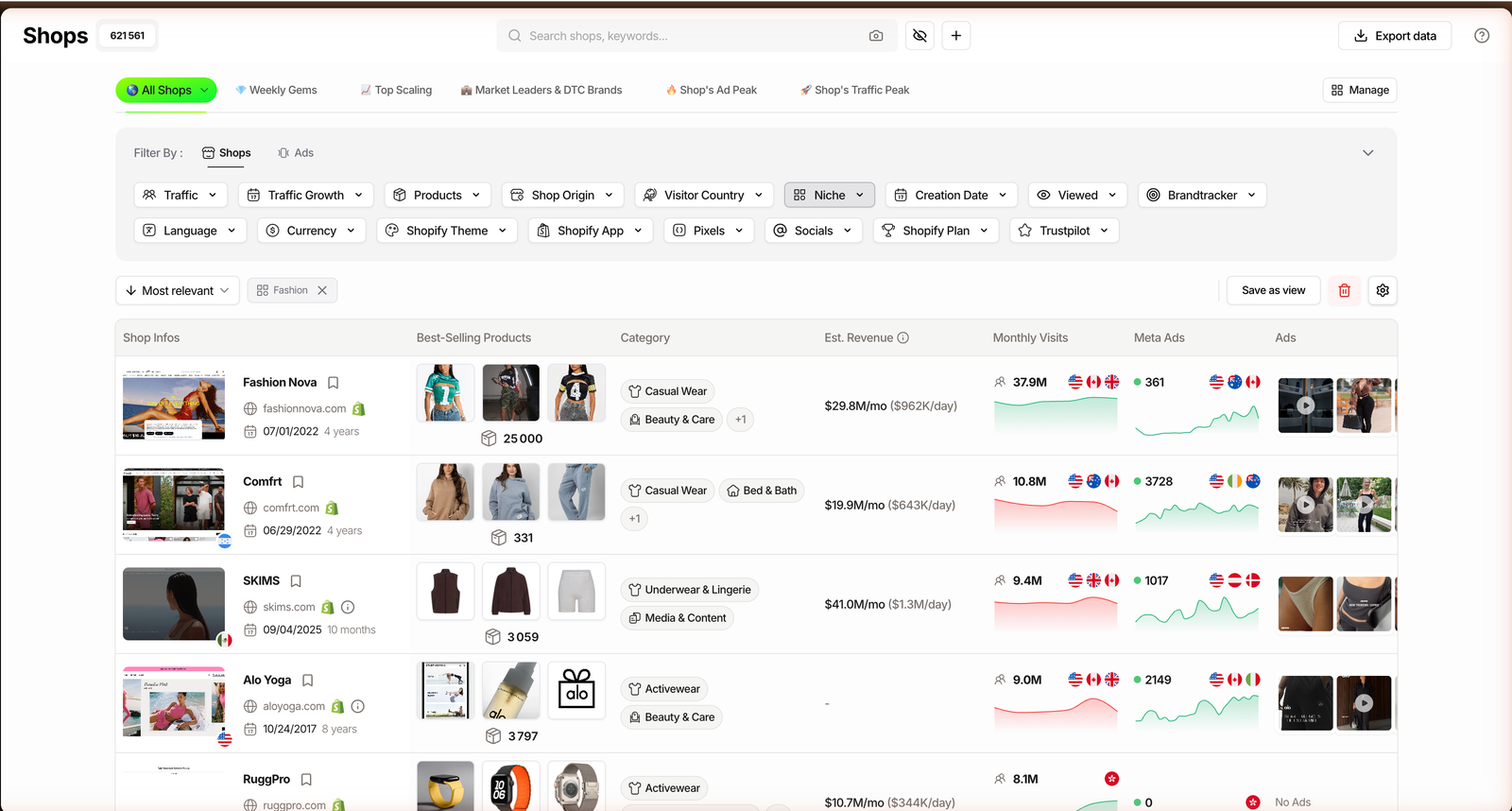
Filter to a niche, switch on the estimated revenue column, and you can see which apparel stores are pulling real volume instead of guessing from a few viral posts. The revenue figure is an estimate, not audited, so read it as a direction rather than a fact.
Screen live stores in TrendTrack
The Shops module sits on every plan from Starter ($59/mo, or $41/mo billed annually), and the free Chrome extension x-rays any store you land on. If you also want to see which creatives are scaling, the Ads module starts on Pro ($89/mo).
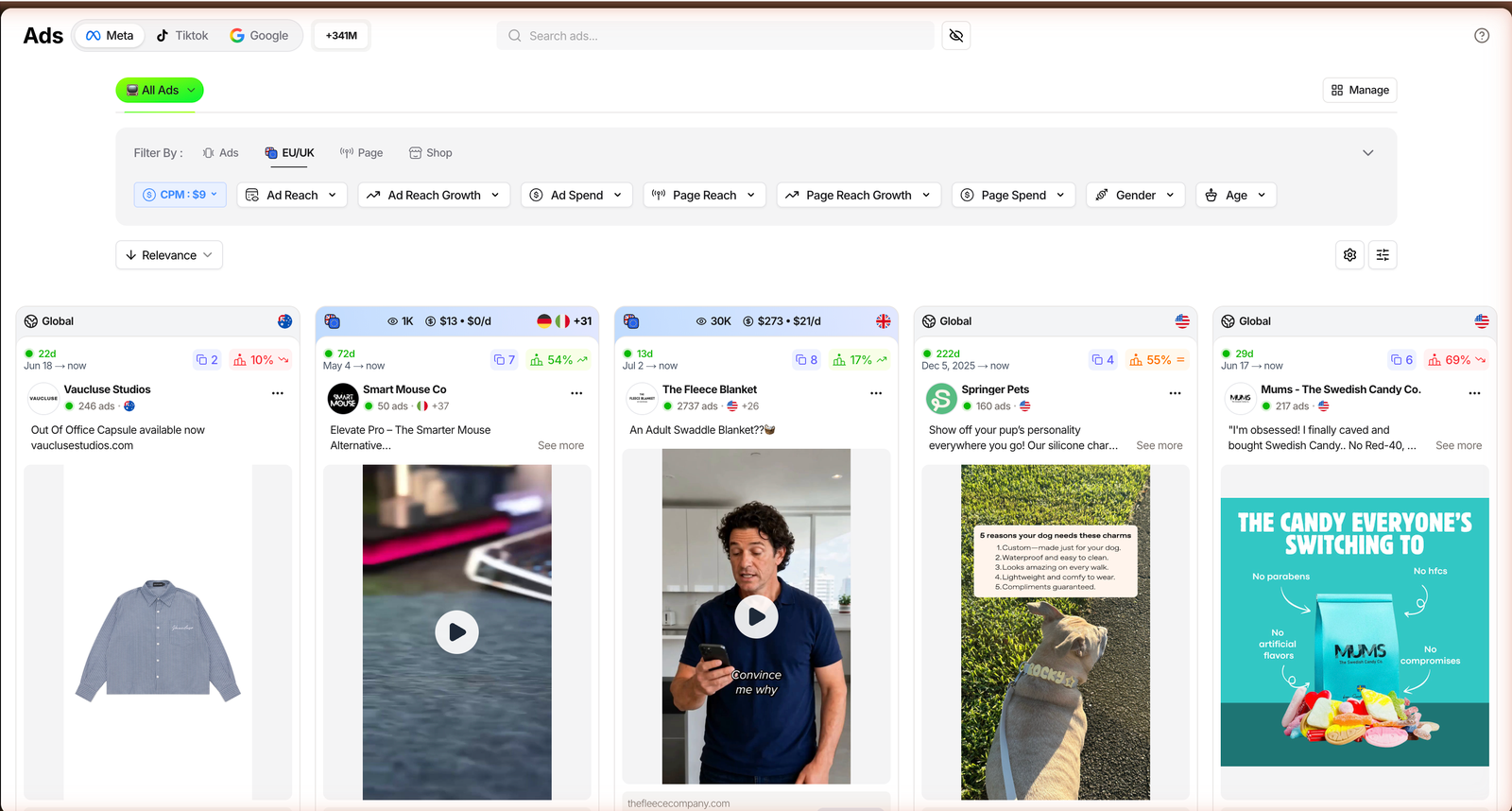
Reading the ads tells you which offers and angles are converting right now, so your next design answers real demand instead of a hunch.
The workflow is simple. Shortlist the stores winning in your niche, note which products show up again and again across them, then open their live ads to see the exact angle doing the work. By the time you touch a design tool, you are answering demand you have already watched, not guessing at it.
Related guide
How to Find Winning Products
The research workflow that tells you what’s selling before you design it.
So, is print on demand worth it in 2026?
The honest answer is: it depends on who you are. POD is not a passive money button, and the 18% drop in search demand means the crowd chasing that promise is thinning out.
But for the right operator it is still one of the cheapest ways to test product ideas and build a branded catalog with almost no downside. The table below is the quick read.
| Who you are | Fit? | Why |
|---|---|---|
| You have an audience or community | Yes | You sell to people who already trust you, so traffic is cheap. |
| You are strong at design and branding | Yes | POD rewards a unique catalog and a sharp niche angle. |
| You want fast, already-proven products | Limited | Classic dropshipping surfaces trending items faster than custom design. |
| You want passive, hands-off income | No | Thin margins only add up with real, ongoing marketing. |
| You are testing ideas on a tiny budget | Yes | No inventory means almost no downside to validating a niche. |
Think of it less as a business model and more as a skill test. If you can find an audience and give them a design worth wearing, POD turns that into revenue with almost no capital. If you cannot, no print partner will fix that for you.
Whichever bucket you fall in, the winning move is the same: validate before you design. Start by watching what already sells in your niche, then read a store’s estimated revenue and its live ads before you spend an hour in a design tool.
FAQ
How does print on demand work?
A partner prints and ships each item only after a customer orders it. You upload a design, list the product on your store, and when someone buys, the print provider (Printful, Printify, Gelato) produces it and ships it to your customer. You never hold stock and only pay the base cost once a sale is made, so upfront risk is low. Your job is the design, the store, and the traffic.
Is print on demand worth it in 2026?
It can be, but it is no longer easy money. US search demand for “print on demand” is down about 18% year over year, and margins are thin because the print partner takes the biggest cut. It works if you have a real audience or a strong niche angle and you validate demand before you design. It rarely works as a passive, post-a-design-and-wait play.
How much can you make with print on demand?
There is no guaranteed number, and anyone promising one is selling you something. On a typical $24 t-shirt you might keep $4 to $8 after the base cost and shipping, before ads. Volume and repeat buyers decide whether that adds up. The sellers who do well treat design and marketing as the real work, not the printing.
Print on demand vs dropshipping: what is the difference?
Both mean you hold no inventory and a supplier ships to your customer. The difference is the product: print on demand sells custom-designed items made to order (your artwork on a blank), while classic dropshipping resells existing generic products. POD gives you a unique catalog and brand angle; dropshipping gives you faster access to proven, already-trending products.
Which print on demand company is best?
There is no single best one, it depends on your catalog and market. Printful is known for tighter quality control and in-house production; Printify offers lower base costs through a wider network of print shops; Gelato leans on local production for faster international shipping. Most sellers test the same design across two of them before committing.