
Last verified July 17, 2026. TrendTrack counters and pricing read live on a paid account, supplier capabilities checked against our own July 2026 reviews. Every cost figure below is a worked example, never a quote.
Four different business models hide behind the words “private label dropshipping”, and most people arguing about it online are describing different ones.
The line that actually separates them is not branding. It is two things: who decides what the product is, and how early your money leaves your account.
Get those two straight and the rest of the decision gets simple. Get them wrong and you buy 500 units of something nobody wanted.
Private label dropshipping means selling a product built to your specification by a third-party manufacturer, under your own brand, while someone else stores and ships it. Unlike classic dropshipping, the product is yours to define. That exclusivity usually costs you an upfront order and a longer runway before your first sale.
Disclosure: some links on this page are affiliate links. If you subscribe through them we may earn a commission at no extra cost to you. We tested every TrendTrack feature mentioned here on a paid account.
What private label dropshipping actually is
Classic dropshipping sells a catalog product. You pick it, you list it, and so do four hundred other stores that same week.
Private label changes the input, not the logistics. The manufacturer builds to your spec, your formula or your design, then a fulfillment partner ships it under your label. The customer never sees a supplier name.
| What you get | Private label | White label | Classic drop | Print on demand |
|---|---|---|---|---|
| You set the specs | Yes | No | No | Limited (artwork only) |
| Product is exclusive to you | Yes | No | No | Limited |
| Your logo on the product | Yes | Yes | No | Yes |
| Cash out before first sale | High | Medium | None | None |
| Minimum order applies | Yes (usually) | Limited | No | No |
| Time to first listing | Weeks | Days | Hours | Hours |
Read that table as a single trade. Everything private label gives you on the left costs you time and cash on the right.
Private label vs white label
These two get swapped constantly, and the difference is worth money.
White label takes a generic product that already exists and puts your logo on it. Fast, cheap, and your competitor can buy the identical unit from the identical factory next Tuesday.
Private label means the product is made to your brief. A different formula, a changed dimension, your own colorway, your packaging. Nobody else sells that exact unit, which is the entire point.
In practice most brands walk the line between the two, starting with a lightly customised stock product and moving to a real spec once the sales justify the tooling.
What it actually costs to run
Nobody can quote you a total here, and anyone who does is guessing. The cost depends on category, factory and volume.
What you can know in advance is the shape of the bill. These are the lines that show up:
- Samples: you pay per unit, usually several times, across a few candidate factories.
- Unit cost at volume: your per-piece price, which falls as the order grows.
- Packaging and design: box, insert, label artwork, and any tooling the factory needs.
- Creative: product photos and video, because stock supplier images defeat the purpose of branding.
- Freight and duties: the line most first-timers forget, and the slowest one.
- Ad budget to test: unchanged from classic dropshipping, and still the biggest number.
The critical shift is timing, not size. In classic dropshipping the customer pays before you do, so where dropshipping margins actually land is a percentage question. In private label you pay first, so it becomes a cash-flow question.
Samples deserve their own line in that budget. Ordering from three factories costs real money and several weeks, and it is the only way to find out whose product survives contact with a customer.
Ask your supplier for a quote per line, not a total. Vague totals are where launches quietly go wrong.
Is it worth it versus plain dropshipping?
It depends entirely on whether the product is already proven. That is the whole answer, and the rest is detail.
What private label buys you
- A product competitors cannot price-match unit for unit.
- Control over quality, so returns stop being a lottery.
- Packaging and unboxing that justify a higher price point.
- An asset with resale value, since a brand can be sold.
- Repeat customers who ask for you by name.
What it costs you
- Cash locked in stock before a single sale.
- Weeks of lead time while trends move on.
- Minimum orders you cannot unwind if it flops.
- Quality control you now own, including the failures.
- A slow, expensive way to learn a product was wrong.
So the sequencing matters more than the model. Test the product the cheap way first, brand it once the data says people buy it.
Private label is not a beginner strategy dressed up as a shortcut. It is what you do to a winner after you have found one.
The trap: a minimum order is not a marketing cost, it is inventory. If the product misses, the money does not come back at the end of the month like a failed ad test does. It sits in a box until you sell it, discount it, or write it off.
Which raises the practical question: how do you know it is a winner before you wire the deposit?
Plan check: the store screening described below sits in the Shops module, included from Starter ($59/mo), along with 2 Brandtrackers and the free Chrome extension. The Ads and Advertisers modules start on Pro ($89/mo). For product validation alone, Starter does the job.
How to pick a product worth branding
The good news is that private label candidates leave fingerprints. Someone is already selling the generic version, and their store is public.
That is the shift in method. Instead of browsing a supplier catalog and guessing, you read what already sells, then decide what deserves your name on it.
Source: TrendTrack app, counters read live July 17, 2026.
Those filters matter here for one reason. Private label only pays back if the category already moves volume at a price that leaves room for your unit cost.
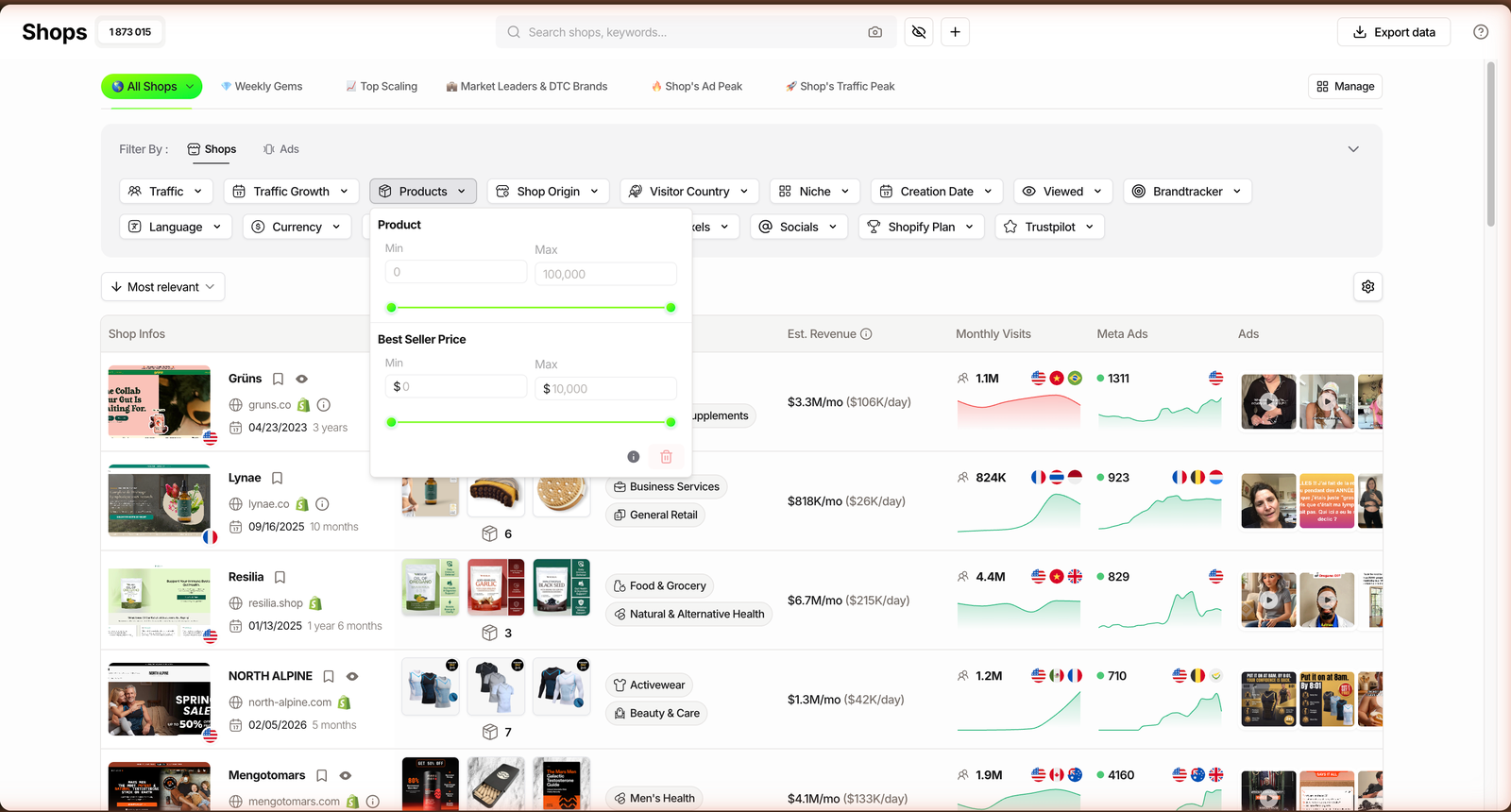
Filter by niche, set a best-seller price band that fits your target margin, and you get a list of stores already proving the price point works.
Related guide
Winning Product Criteria: The Checklist
The screening rules to clear before a product earns your money.
Price the best-seller before you price yourself
The Products filter takes a number of products range and, more usefully, a best-seller price range from $0 to $10 000.
Use it backwards. Decide the retail price your unit cost needs, then look only at stores whose best-seller already sits in that band.
If nobody sells that category at your required price, the problem is the category, not your marketing.
Find who already brands it
TrendTrack shipped AI Image Search on March 7, 2026. You paste a product image and it returns the stores selling that product.
For private label that is the fastest reality check there is. Screenshot the generic unit from a supplier catalog, run the image, and see how many brands already put their label on it.
Plenty of results means the product works and the position is crowded. Nothing at all is a warning, not an opportunity.
Validate demand before you commit to a minimum order
A minimum order is a bet with a long settlement date. The point of validation is to make that bet boring.
Three checks do most of the work, and none of them require you to spend on stock first.
None of this proves your version will sell. It proves the category has buyers, which is the part you cannot manufacture.
If you want to run these checks yourself, you can screen the index yourself before you talk to a single factory.

Read the launch dates, not the hype
Open any store and the Products tab lists its best sellers with price and creation date per product.
That date is the tell. A product added eight months ago and still on the best-seller list has survived something. One added last week has survived nothing.
The store page also shows monthly visits, traffic over time, and a Similar Shops list of around ten comparable stores, which is the fastest way to see whether one store got lucky or a whole category is moving.
Check the ads are still running
Live Ads Over Time answers the question that matters before a minimum order: is anyone still paying to sell this?
Ads that ran hard for three weeks and stopped usually mean the economics failed. Ads still running after months mean someone found a formula worth repeating.

Starter includes 2 Brandtrackers, which is enough to follow the one brand you are thinking of competing with. A tracker covers the whole store: Meta, TikTok, Google Ads and emails.
Watch it for a month before committing. If their ad count and landing pages keep changing, the category is alive.
Where private label products actually come from
Sourcing splits into two families: platforms that add branding on top of dropshipping, and factories that build to spec. Our supplier shortlist we’d actually use covers the full field, but the branding routes are worth separating.
The distinction that matters is whether a minimum order applies, because that is what turns a test into a commitment.
| Route | Branding you get | MOQ | Cash upfront | True private label |
|---|---|---|---|---|
| Alibaba | Factory-direct, build to spec | Yes | High | Yes |
| CJ Dropshipping | Custom packaging, inserts, POD | No | None | Limited |
| Zendrop | Custom packaging, inserts, private-label routes | Limited | Low | Limited |
| Spocket | Branded invoicing on every plan | No | None | No |
Only the factory route gives you a genuinely exclusive product. The others buy you a branded experience around a product other stores can still sell, which is often the right first step and rarely the last one.
A sensible order of operations falls out of that. Prove the product with no-MOQ fulfillment, add branded packaging once orders are steady, and go to a factory only when volume makes the minimum order look small.
Related guide
CJ Dropshipping: How It Works
The no-MOQ route to custom packaging, inserts and product media.
When private label is the wrong move
Three situations make it a bad call, and none of them are about ambition.
- The product is unvalidated. Branding a guess just makes the guess expensive, and slower to disprove.
- Cash is thin. If a minimum order leaves nothing for ad testing, you have bought stock you have no budget to sell.
- The category is regulated. Supplements and cosmetics carry compliance, labeling and liability that a private label puts on your name, not the factory’s.
That last one catches people out. Reselling someone else’s branded supplement makes them the responsible party, while putting your label on the bottle quietly makes you the one who answers for what is inside it.
FAQ
What is private label dropshipping?
Private label dropshipping means selling a product manufactured by a third party to your specification, under your own brand, while a fulfillment partner stores and ships it. The difference from classic dropshipping is control: you define the product rather than reselling a generic catalog item that hundreds of other stores list. That control usually comes with an upfront order and a longer lead time before your first sale.
What is the difference between private label and white label?
White label puts your logo on a generic product that already exists, and any other brand can buy the identical unit. Private label means the product is made to your brief, with your specification, formula or design, so nobody else sells that exact version. White label buys speed. Private label buys exclusivity, at the price of minimum orders and lead time.
Is private label dropshipping better than regular dropshipping?
Neither is better in the abstract, because they answer different questions. Private label moves cost forward, you pay for stock before anyone buys, in exchange for exclusivity and control. That trade only makes sense on a product whose demand is already proven. As a first test it is a slow, expensive way to learn something a cheap classic dropshipping test would have told you in a week.
Can you private label without a minimum order quantity?
Partly. Some fulfillment platforms brand the experience without a minimum: CJ Dropshipping offers custom packaging, inserts and print on demand with no MOQ, and Spocket includes branded invoicing on every plan with no minimums (both checked in July 2026). What they cannot give you is an exclusive product. A genuinely bespoke unit means a factory, and factories set minimum orders.
How much does it cost to start private label dropshipping?
There is no honest single number, because it swings with category, factory and volume. What you can plan for is the shape of the bill: samples, unit cost at volume, packaging and design, product photography, freight and duties, then your ad testing budget. Ask each supplier to quote line by line rather than as a total, and treat any figure you read online as a worked example rather than a quote.
How do you know a product is worth private labeling?
Look for proof that money already changes hands in the category before you commit. Check which stores sell the generic version, what their best sellers cost, how long those products have been listed, and whether their ads are still running. TrendTrack indexes 1 873 015 Shopify stores with that screening included from Starter ($59/mo). Its revenue figures are estimates, so read them as direction, not proof.
Verdict
Private label is a second move, not a first one. It rewards operators who already know a product sells and want to stop competing on a listing anyone can copy.
If you are launching your first store, stay in classic dropshipping until something works. If a product is already paying for its ads, branding it is how you stop renting your margin. If you sell supplements or cosmetics, price the compliance before the packaging.
Would you order 500 units of a product you have not checked the data on?
Screen 1 873 015 Shopify stores by niche, best-seller price and live ads before you send a deposit. Store screening is included from Starter ($59/mo), or $41/mo billed annually. The Ads and Advertisers modules start on Pro ($89/mo).