Last verified July 15, 2026. Prices and module counts checked against a paid TrendTrack account and the July 2026 What’s new log.
You saw the product three times this week: a clip on TikTok, an ad in your feed, and a store already selling it for $34.99.
Now you are one budget away from finding out whether it was a real winner or a good-looking money pit. A checklist beats a hunch every time.
A winning product passes four tests: proven demand, a clear angle, workable economics, and beatable competition. This guide turns those into 12 pass/fail criteria you can score in minutes, before you spend a dollar on ads.
Disclosure: some links on this page are affiliate links. If you subscribe through them we may earn a commission at no extra cost to you. We tested every TrendTrack feature mentioned here on a paid account.
How to use this checklist
Twelve criteria, grouped into four phases. Score each one as a pass or a fail as you work down the list.
A quick rule we use: nine or more passes out of twelve means it is worth a paid test. Anything under that, keep it on the shortlist and keep hunting. The same logic drives most winning-product finder tools, only slower when you do it by hand.
Treat the middle scores as a caution zone. A product that lands at seven or eight is not dead, it just has a hole you need to name before you spend. Usually it is thin margin or a copy-paste market, and both are fixable with a better angle.
The point of scoring is discipline. A hunch tells you to test everything; a scorecard tells you which two products out of ten deserve your budget first. Here are the four phases you are about to score.
Phase 1: Demand, is anyone already buying it?
Start here, because it is the cheapest to check and the fastest to kill a dud. If nobody is paying to sell it, you are the test, not the follower.
Would you bet $300 on a product with zero live ads anywhere?
One caution: a viral spike is not the same as demand. A product can trend for a week on TikTok and be dead by the time your samples land. Sustained, paid advertising is the stronger signal, because ad accounts stop spending the moment a product stops converting.
- It already has live ads running. Someone is spending money to sell it right now. Free check: search the product on the Facebook Ad Library.
- Those ads show longevity. An ad still running after three or four weeks is a winner, not a failed test. Losing creatives get killed in days.
- Search interest is rising or flat, not a dead fad. A 30-second look at Google Trends tells you if the curve is climbing or already crashed.
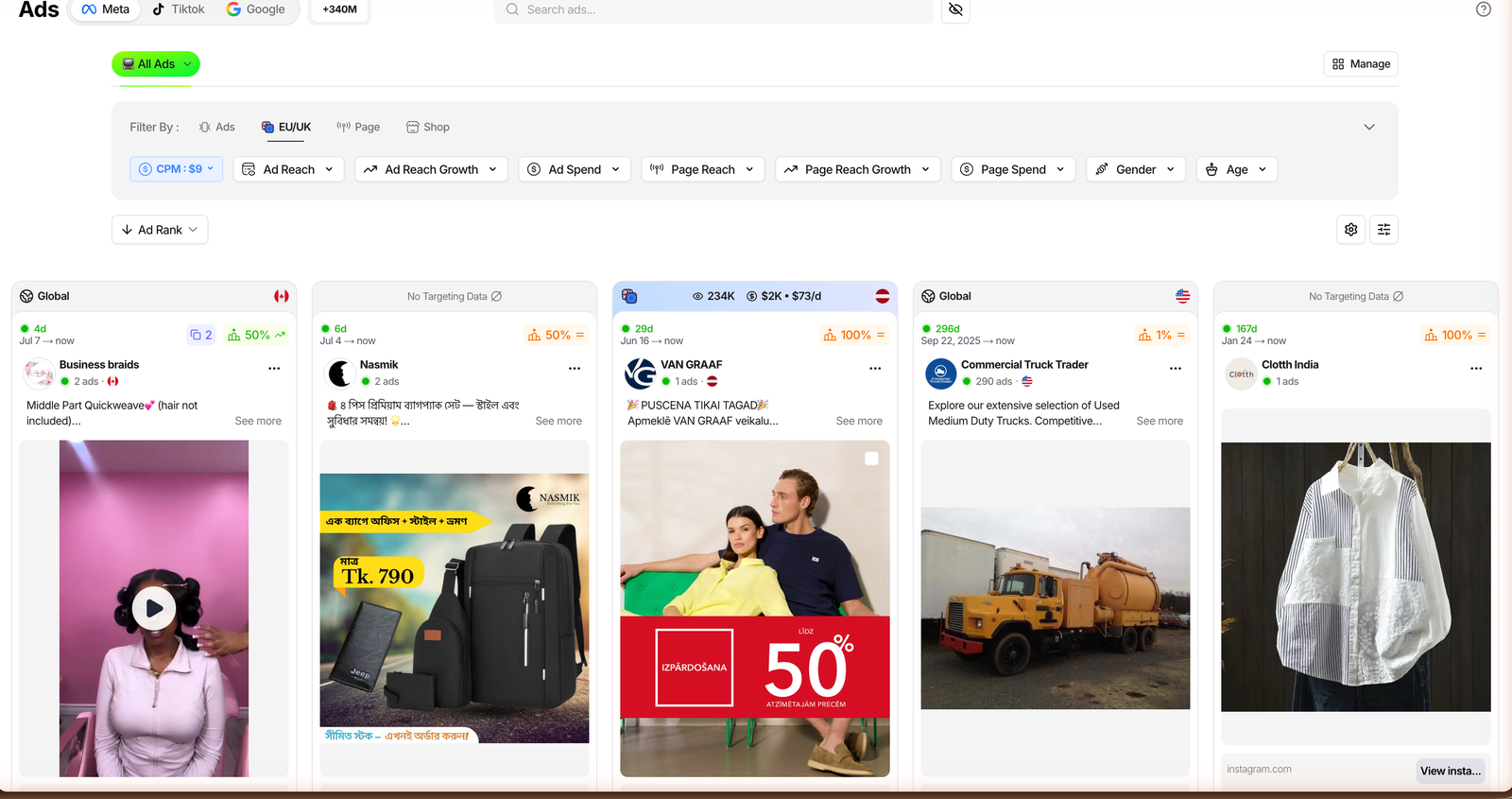
TrendTrack does the same read at scale. The Ads module indexes +337M ads across Meta, TikTok and Google, and you can sort by Longest Active or filter by Ad Rank, its ranking of winning creatives shipped January 29, 2026, to surface the ads that keep running.
Plan check: the Ads and Advertisers modules start on Pro ($89/mo). Starter ($59/mo) covers Shops, 2 Brandtrackers and the free Chrome extension, but not ad spy.
Related guide
TrendTrack Ads Library, explained
Filter 337M live ads by Ad Rank, longevity and niche.
Phase 2: The product and the angle
Demand proves people buy it. This phase asks whether you can make them stop scrolling and pick your version.
- Clear wow factor or a real problem solved. There has to be a reason to stop the thumb: a visible transformation, a fix for a daily annoyance, or a genuine “I need that”.
- It demos well in a three-second hook. Dropshipping is won on video. If the product cannot show its value in the first three seconds, the ad math gets hard.
- It is not sold in every local store. Perceived scarcity protects your price. When buyers can grab it at the corner shop, your margin evaporates.
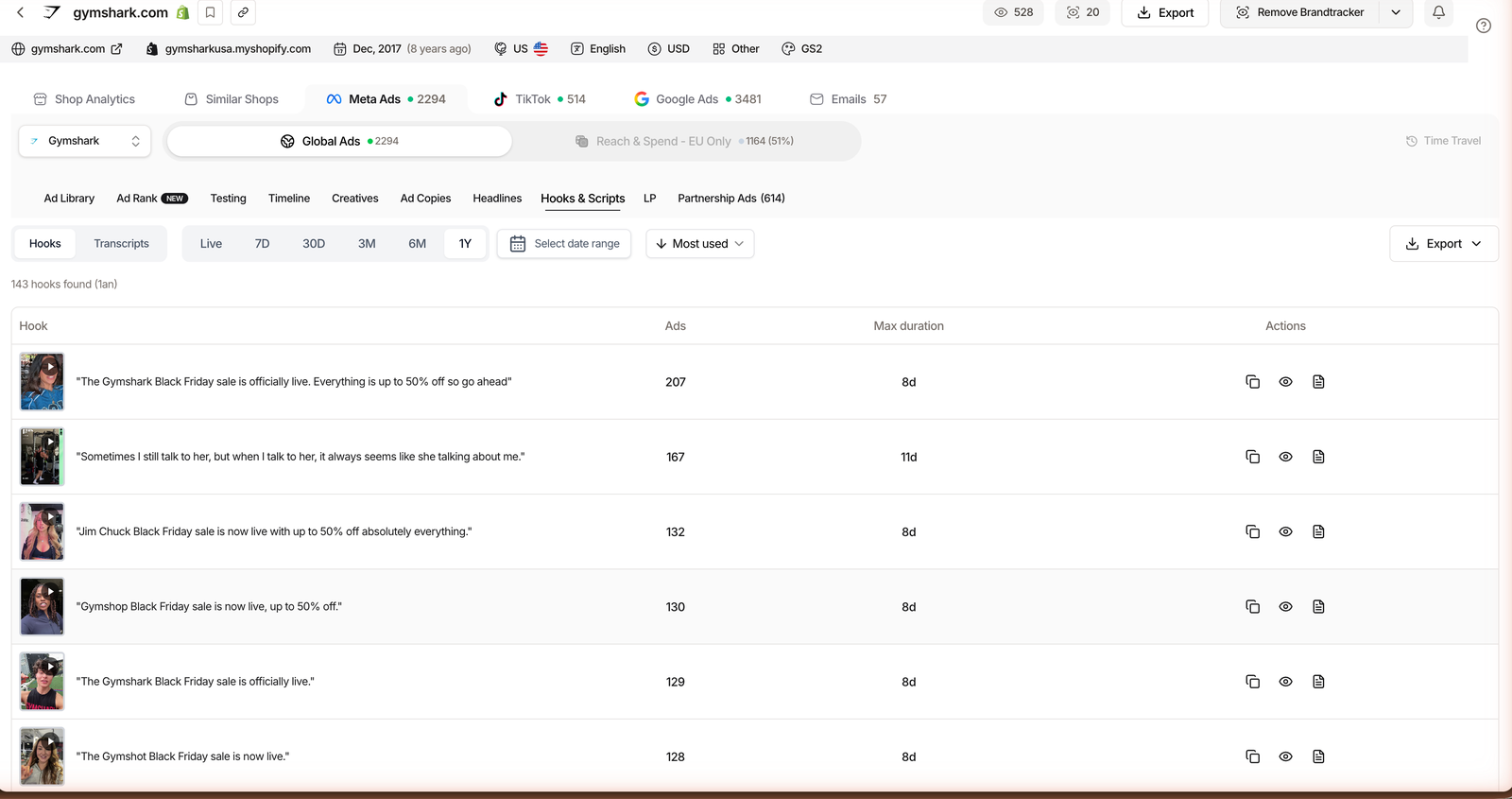
This is where a competitor teardown pays off. The Brandtracker Hooks & Scripts tab transcribes a rival’s video ads, so you can read the exact opening line and angle that is already converting, then write a sharper one.
The angle matters as much as the product. Two stores can sell the identical item and only one scales, because it framed the same object around a different pain: better sleep, a cleaner desk, a gift that lands. When you score criterion 4, ask what problem the product owns, not just what it does.
Phase 3: The economics
A product can have demand and a great hook and still lose money on every order. The math has to work before you scale.
Returns are the quiet margin killer people forget to score. A fragile item that arrives cracked one time in ten does not just cost you that refund, it costs the ad spend that won the sale. Cheap, sturdy and compact is not a nice-to-have, it protects every other number on the page.
- Room for a 3x-plus markup. After product cost, shipping and ad spend, you want the sell price at least three times your landed cost. Under 2x, one bad ad day wipes the profit.
- It sits in a workable price window. Impulse buys clear fastest in the low-to-mid range; high-ticket earns more per sale but needs trust and proof.
- Light, durable and cheap to ship. Heavy, fragile or oversized items bleed margin on freight and returns.
| Price band | Fit for dropshipping | Why |
|---|---|---|
| Under $15 | Hard | Margin too thin once ads and shipping are paid. |
| $15 to $40 | Impulse sweet spot | Room for a 3x markup and still an easy yes. |
| $40 to $80 | Strong | Higher order value, still low friction. |
| $80 to $150 | Needs trust | Better margin, but buyers hesitate without proof. |
| $150-plus | High-ticket | Fewer sales, bigger margin, needs reviews and a real brand. |
General guidance, not TrendTrack data. Your niche and offer shift these bands.
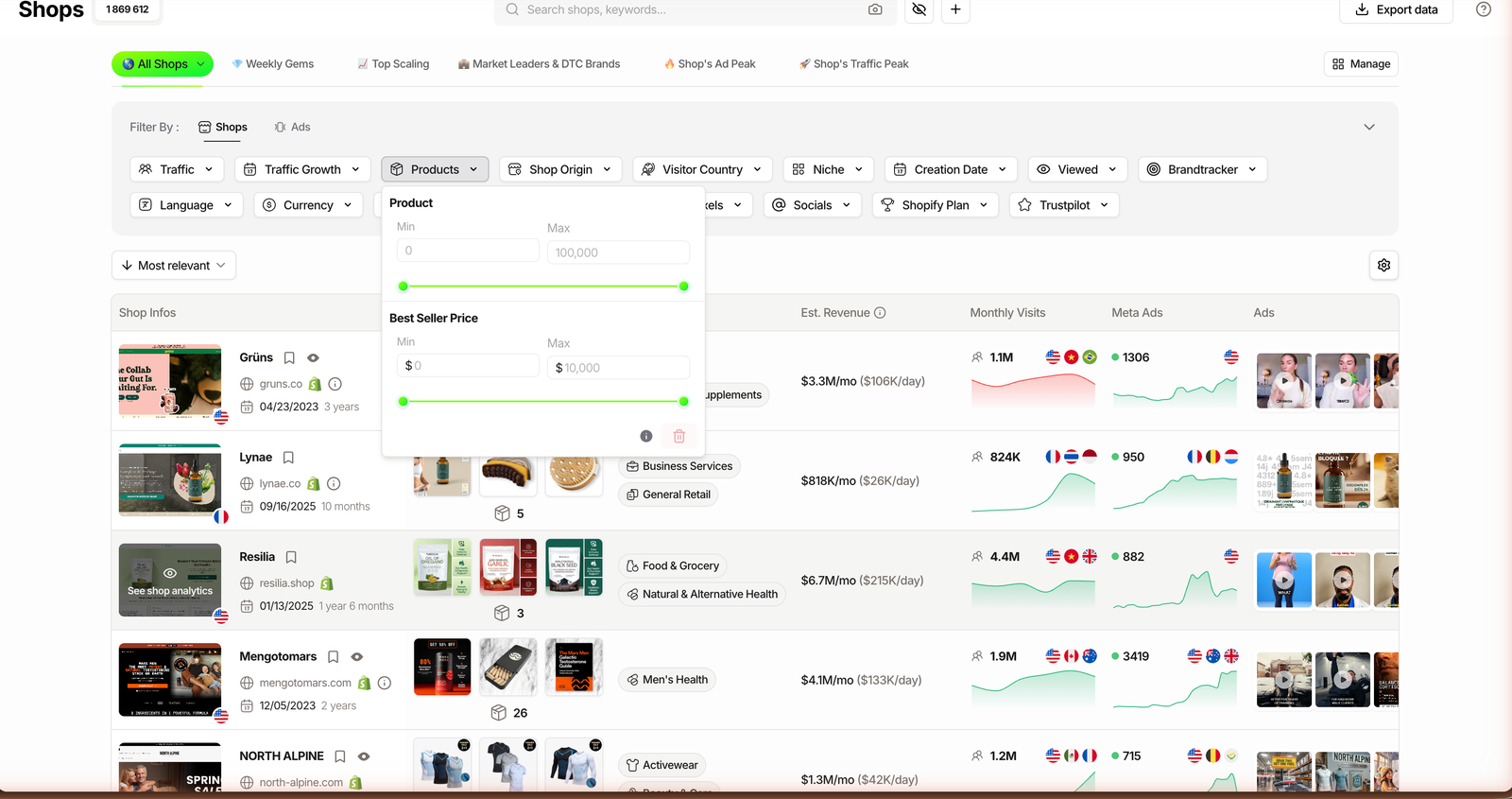
You can screen Shopify stores by 17 filters in TrendTrack, including the best-seller price band (from $0 to $10,000) and rising traffic growth, so the economics and the demand line up before you commit.
Phase 4: Competition and supply
The last phase is where beginners get it backwards. Competition is not the enemy; it is the proof that money is on the table.
The trap is confusing a crowded market with a saturated one. A market is only saturated when every seller runs the same creative to the same audience at the same price. If you can find a slice nobody is speaking to, competition just did your validation for free.
Supply is the risk beginners underrate. A product that sells beautifully and then goes out of stock for three weeks hands your customers, and your ad data, straight to the next seller. Confirm you can reorder at volume before you pour spend into it.
- Validated by competitors, but still differentiable. Other sellers confirm demand. Your job is a new angle, bundle or creative, not a carbon copy of their store.
- Reliable, restockable supply. One flaky supplier or a patented, brand-locked item can end your run mid-scale. Confirm you can reorder.
- A targetable audience. Either a broad impulse buyer or a passionate niche you can actually reach on Meta or TikTok.
TrendTrack index, counts checked July 13, 2026.
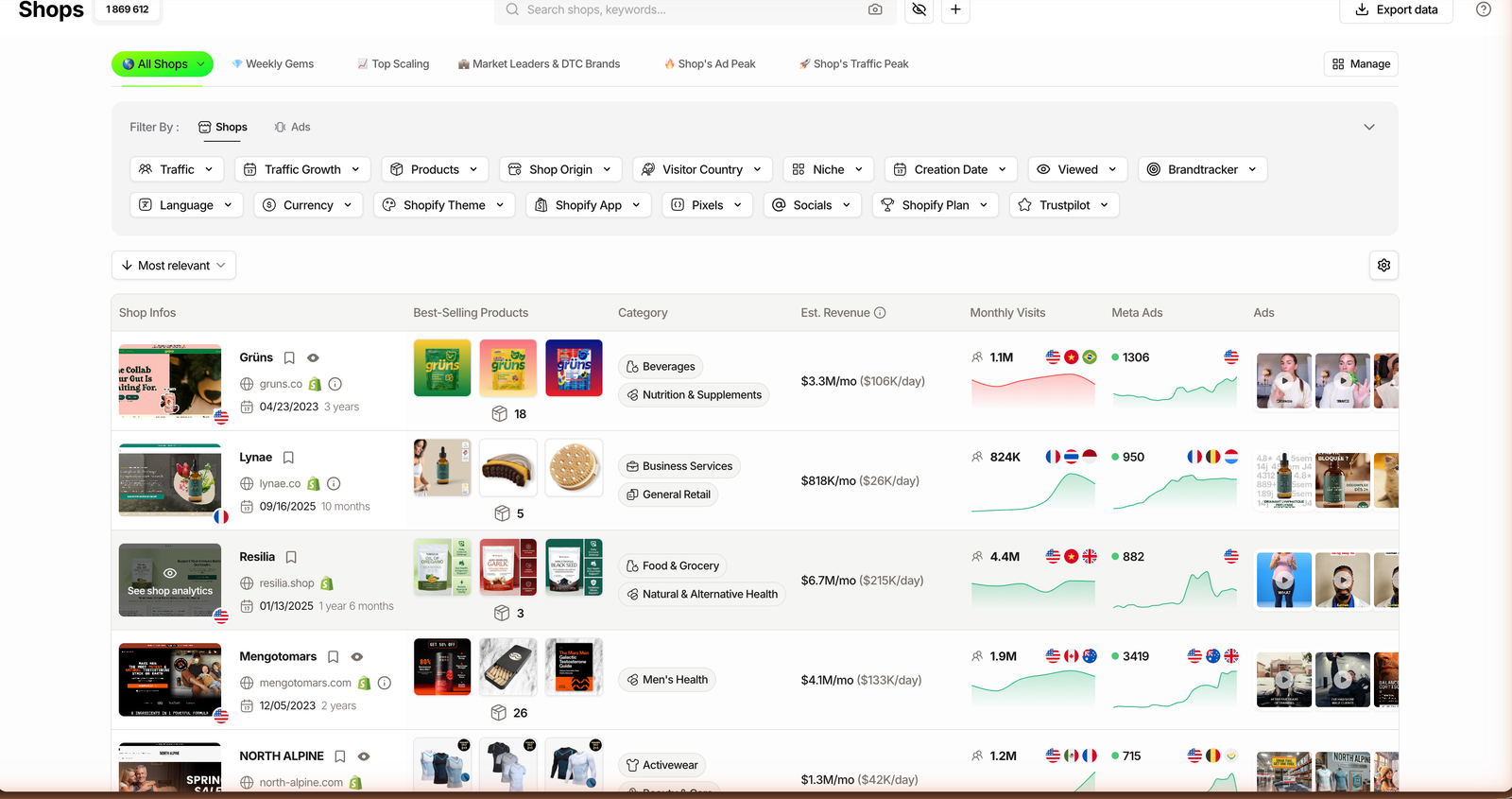
TrendTrack estimates a store’s revenue as a monthly and daily figure, shown as an estimate, not audited sales. Read it as a speedometer from the outside: directional proof that a niche is moving, not a certified number.
Red flags that auto-fail a product
Some signals are not just weak scores, they are hard stops. If a product trips one of these, no angle saves it.
Green lights
- Live ads running 30-plus days
- Rising traffic on the stores selling it
- A clean 3x-plus margin after shipping
- A hook that shows value in 3 seconds
- Supply you can reorder on demand
- An angle nobody else is running yet
Red flags
- Zero live ads on any platform
- A trend line that already peaked
- Margin under 2x after shipping
- Fragile, heavy or oversized
- Patented or brand-owned item
- Every store sells the identical listing
The full 12-point scorecard
Here is the whole checklist in one place. Score nine or more and it earns a paid test; anything less stays on the bench.
The last column is how to check each point fast, free where possible, or in seconds once you can check live ad counts and estimated revenue in one tab.
| # | Criterion | What a pass looks like | How to check it |
|---|---|---|---|
| 1 | Live ads running | Multiple active ads today | Facebook Ad Library or TrendTrack Ads |
| 2 | Ad longevity | Ads running 3 to 4+ weeks | Sort by Longest Active or Ad Rank |
| 3 | Rising trend | Flat or climbing search interest | Google Trends |
| 4 | Wow factor | Clear reason to stop scrolling | Watch the top-running ads |
| 5 | Three-second hook | Value shown fast on video | Brandtracker Hooks & Scripts |
| 6 | Not everywhere local | Hard to buy offline | Quick retail check |
| 7 | 3x-plus margin | Sell price 3x landed cost | Supplier quote vs sell price |
| 8 | Price window | Impulse or justified high-ticket | Shops best-seller price filter |
| 9 | Ships cheap | Light, durable, compact | Product specs and weight |
| 10 | Differentiable | Competitors exist, angle open | Shops and Ads competitor scan |
| 11 | Reliable supply | Restockable, not brand-locked | Supplier check |
| 12 | Targetable audience | Broad or a reachable niche | Ad platform audience tools |
What the checklist looks like in practice
Take a product you have seen a hundred times: a compact LED sunset lamp that throws a warm gradient across the wall.
Demand is easy. Plenty of stores run live Meta ads, many active for months, and search interest has held through several seasons. That is three passes in Phase 1.
The angle holds too. It photographs beautifully, the effect lands in the first second of any clip, and you will not find it on a supermarket shelf. Phase 2 passes.
Economics are where it tightens. Landed cost is low enough for a 3x markup around the $30 mark, and it is light and compact. But it is glass and electronics, so fragile, which nicks the shipping criterion. Call it two and a half out of three.
Competition is the honest weak spot. Almost everyone sells the identical lamp, so criterion 10 rests entirely on your angle and creative, not the product. Supply is simple and the audience is broad, so two clear passes and one that depends on your execution.
Tally: roughly ten out of twelve. It clears the bar to test, with eyes open that the only real moat here is your marketing, not the object itself.
Score your pick before you test it
Running all twelve checks by hand across five products takes an afternoon: tabs for the Ad Library, a supplier chat, a Trends search, a spreadsheet that never quite matches.
TrendTrack collapses most of it into one session. Live ad counts and Ad Rank cover demand, Traffic Growth and estimated revenue cover traction, and cross-store filters cover competition, so your scorecard fills itself in minutes.
Start with the free Chrome extension for a quick x-ray of any store, then move up when you need the Ads module. From $59/mo (or $42/mo billed annually), with ad spy on Pro ($89/mo).
Screen Your Shortlist in TrendTrack
FAQ
What are the criteria for a winning dropshipping product?
A winning product passes four tests: proven demand, a clear angle, workable economics, and beatable competition. Broken down, that is 12 pass/fail criteria covering live ads, ad longevity, a rising trend, a wow factor, a strong hook, scarcity, margin, price window, shipping, differentiation, supply, and a targetable audience. Score nine or more and it is worth testing.
How do I know if a product is already selling?
Look for live ads: if sellers are running paid ads for it today, and those ads have been active for weeks, real money is behind it. You can spot this free in the Facebook Ad Library, or at scale in TrendTrack’s Ads module, which indexes over 337M ads and lets you sort by longevity and Ad Rank. Rising traffic on the stores selling it is a second confirmation.
What profit margin makes a product worth dropshipping?
A common rule is a 3x-plus markup: your sell price should be at least three times your landed cost after product and shipping. That headroom absorbs ad spend, refunds and the odd bad day, while under 2x a single expensive ad day can erase the profit. This is guidance, not a guarantee, since your real margin depends on your ad efficiency.
Is high competition a bad sign for a product?
No, competition usually means demand is validated and buyers are already spending. The real risk is copying a store detail for detail with no new angle, so treat rivals as proof the market is live and win on a sharper hook, a better bundle or a tighter audience. A product with zero competitors is more often a warning than an opportunity.
How much should a winning dropshipping product cost?
There is no magic price: impulse buys clear fastest in the $15 to $80 range, where a 3x markup still feels like an easy yes. High-ticket items above $150 earn more per sale but need trust, reviews and proof. Use TrendTrack’s best-seller price filter to see what price points are actually moving in a niche, and treat any revenue figure there as an estimate, not audited.