Last verified July 15, 2026. Prices, niches and store counts checked live in TrendTrack’s Shops module.
Four very different buyers keep high-ticket stores alive, and not one of them is chasing a $20 impulse buy.
Each one clicks buy on something that costs more than a dinner, not more than a coffee. That is the whole appeal of high-ticket dropshipping: fewer sales, bigger tickets, and margins measured in dollars instead of cents.
Below are 24 product ideas grouped by niche, plus the exact way to check demand before you commit to any of them.
High-ticket dropshipping means selling products that usually retail for $300 or more, shipped straight from the supplier. One $600 sale at a 25% margin nets around $150, so you need far fewer orders to profit. The catch is a heavier ad budget per sale and stricter supplier and support standards.
Disclosure: some links on this page are affiliate links. If you subscribe through them we may earn a commission at no extra cost to you. We tested every TrendTrack feature mentioned here on a paid account.
What counts as a high-ticket product (and what doesn’t)
There is no official line, but most operators treat $300 as the floor and anything up to a few thousand dollars as fair game. These are considered high ticket products because a single order moves real money through the dropshipping model.
Price alone does not qualify a product, though. Plenty of expensive dropshipping products carry thin margins or brutal return rates, which cancels the whole advantage. The point of going high ticket is the profit per sale, not the sticker.
The metric that matters is the absolute dollar margin, not the percentage. A 20% margin on an $800 item still leaves $160 to cover a click-heavy ad campaign. Screen every idea against real winning product criteria before you fall for a big number.
| Metric | High ticket ($600) | Low ticket ($30) |
|---|---|---|
| Margin per sale (25%) | ~$150 | ~$7.50 |
| Sales for $1,500 profit | 10 | 200 |
| Ad budget tolerance per sale | High | Very low |
| Return cost if it goes wrong | Heavy | Minor |
The trade-offs before you commit
High ticket is not free money. Returns are expensive to eat, buyers ask more questions before spending $700, and shipping a sofa is not the same as shipping a phone case.
Your ad budget per sale is also bigger, because you are convincing someone to make a considered purchase, not an impulse tap.
Pros
- Fat dollar margins per order
- Fewer sales to manage for the same profit
- Less impulse-driven, copycat competition
- Room to absorb a higher cost per acquisition
Cons
- Bigger ad spend before the first sale
- Costly returns and damage claims
- Longer sales cycle and more support
- Supplier reliability is non-negotiable
So is high-ticket dropshipping worth it? It suits sellers who have cash to test paid traffic and a supplier they trust to ship on time. If you are starting with no ad budget and no vetted supplier, a lower-ticket product is a gentler first move.
How we picked these
Every idea below survived the same screen. We filtered TrendTrack’s store index by best-seller price and niche, then cross-checked the estimated revenue column and whether stores in that lane were actually running ads. It is the same logic behind how to find winning products, applied to the pricier end of the shelf.
TrendTrack Shops and Ads indexes, counts checked July 2026.
Home and furniture
Home and Garden is the deepest niche in the index, sitting near 1,772,575 stores in July 2026, which tells you demand is not the problem. Typical price band here runs $300 to $1,500.
- Electric standing desks
- Modular sectional sofas
- Storage platform beds
- Wall-mounted murphy beds
- Kitchen islands and carts
- Ergonomic office chairs
Furniture ships well because buyers expect a lead time, which forgives supplier delays. Freight and white-glove delivery also raise the barrier for casual competitors, so the lane stays less crowded than gadgets.
The signal to check: stores with steady traffic growth and ads that have been live for weeks, not days.
Related guide
Best Dropshipping Niches
Where the demand and the margins actually line up.
Outdoor, wellness and recreation
This lane runs hot on social, and the tickets are the highest on the list, roughly $400 to $3,000. The wellness buyer especially will spend to recreate a spa at home.
- Infrared saunas
- Cold plunge tubs
- Outdoor pizza ovens
- Electric bikes
- Smokeless fire pits
- Inflatable kayaks and paddleboards
These products photograph well, which keeps video ad costs sane. The signal to check: how long the top ads have been running, since a creative live for a month is a demand vote.
| Niche | Example products | Price band | Signal to check |
|---|---|---|---|
| Home & furniture | Standing desks, sofas, beds | $300-$1,500 | Traffic growth |
| Outdoor & wellness | Saunas, plunge tubs, e-bikes | $400-$3,000 | Ad longevity |
| Home gym | Racks, trainers, treadmills | $300-$2,500 | Repeat advertisers |
| Garage & auto | EV chargers, 3D printers | $300-$2,000 | Est. revenue trend |
Home gym and fitness
Sports and Outdoors covers around 678,081 stores, and home fitness never fully cooled off after the at-home boom. Expect a $300 to $2,500 band.
- Power racks and squat cages
- Functional trainers and cable machines
- Folding treadmills
- Rowing machines
- Adjustable dumbbell sets
- Heavy-duty weight benches
Fitness gear sells on transformation angles, which is easy creative to test cheaply. The signal to check: the same brands advertising month after month, a sign the unit economics work.
Garage, auto and workshop
Two niches feed this lane: Automotive near 495,376 stores and Business and Industrial near 1,445,836. The buyer is practical and researches hard, so price sensitivity is lower. Band: $300 to $2,000.
- Rooftop tents
- Home EV chargers
- Hobby 3D printers
- Desktop laser engravers
- Modular garage storage systems
- Portable car lifts and jacks
These products have specs, and specs make ad copy easy to write and hard to fake. The buyer reads reviews and compares models, so a store that wins here usually wins on trust and content, not just a low price.
The signal to check: estimated revenue trending up on stores that are still small enough to copy.
Find your own high-ticket winner in TrendTrack
A list dates fast, so the real skill is spotting the next one yourself. TrendTrack’s Shops module lets you screen the whole store index the way we did, in a couple of clicks.
Related guide
TrendTrack’s Shopify Store Database
How the 1.87M-store index and its 17 filters work.
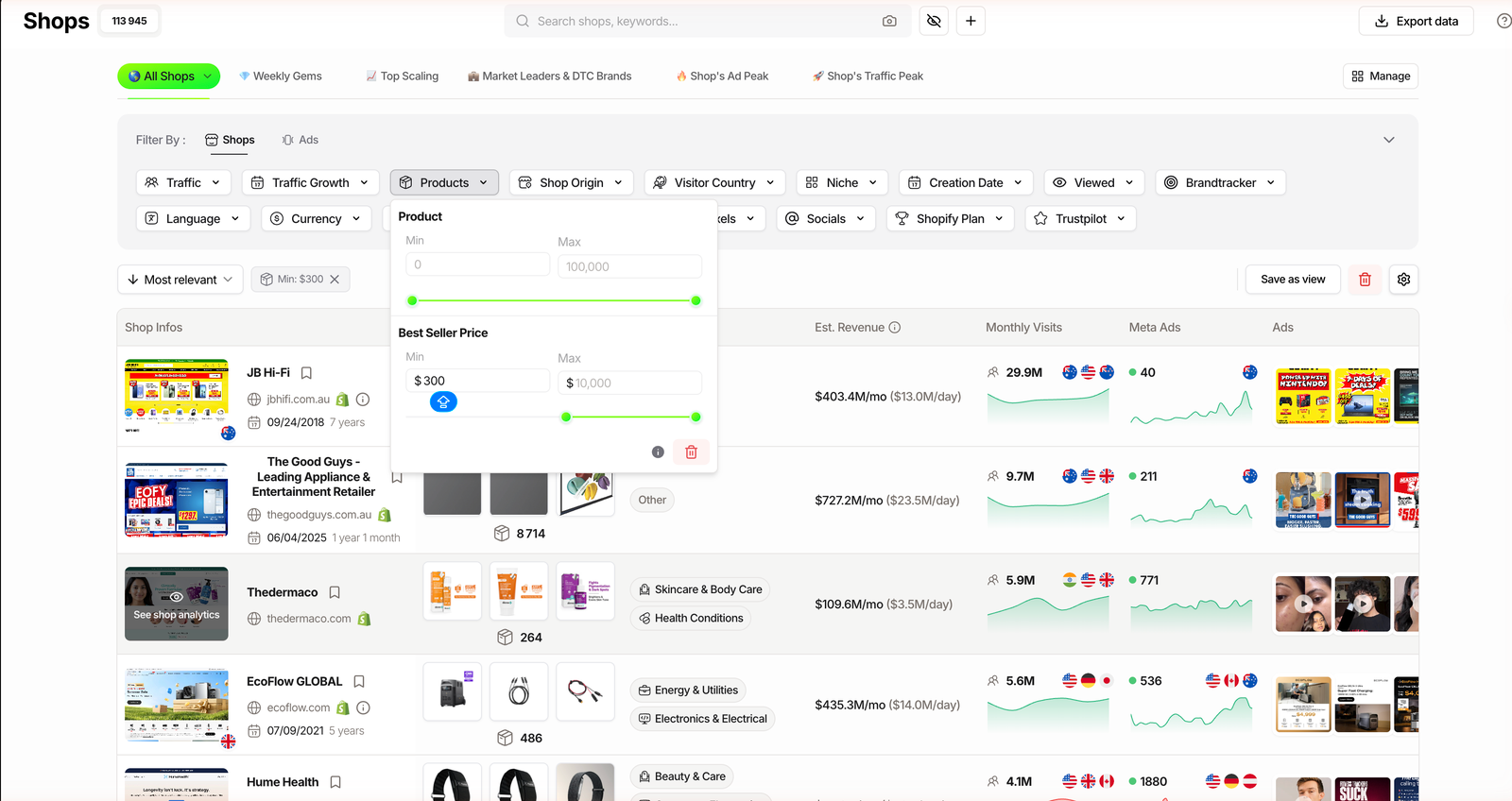
Open the Products filter and set the best-seller price minimum high, say $300, then pick a high-ticket niche like Home and Garden or Sports and Outdoors. The store list instantly narrows to shops selling at your target ticket.
Now read the shortlist. Turn on the estimated revenue column from the Manage shop view gear, sort by fastest growing or most live ads, and note which stores have creatives that have been running for weeks.
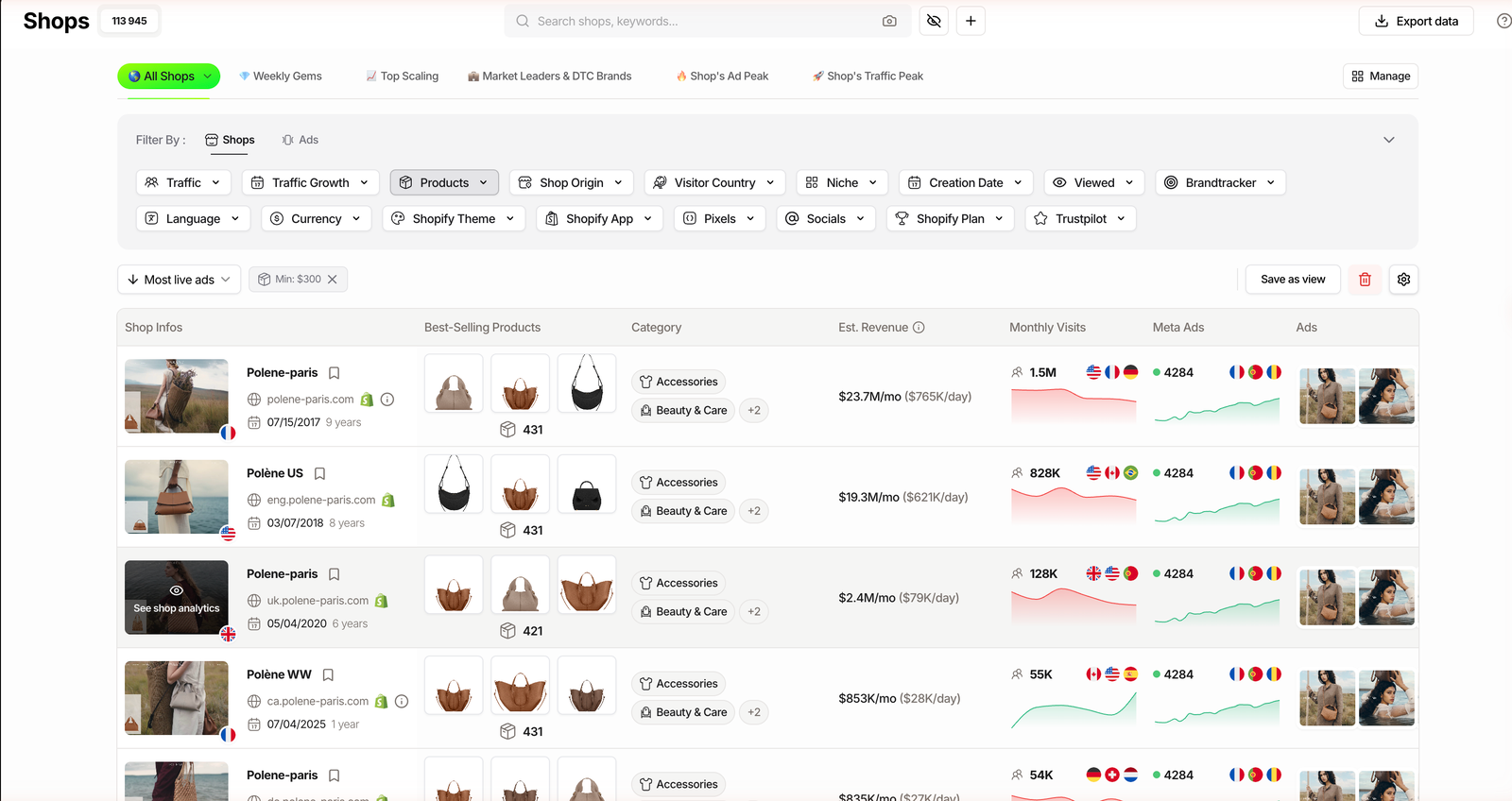
Plan check: screening stores by price and niche works on Starter ($59/mo). Cross-checking a product against the full Ads library at scale starts on Pro ($89/mo). Keep in mind estimated revenue is an estimate, not audited revenue.
Two stores growing on the same product, both running ads for a month, is a far stronger buy signal than any list, including this one. That is the workflow that keeps paying off after the trends here go stale. You can screen the store index yourself on the free Chrome extension or a trial.
FAQ
Is high-ticket dropshipping worth it?
Yes for some sellers. One sale at $600 with a 25% margin beats six sales at $30, and it is fewer orders to manage.
But the ad budget per sale is heavier and support matters more. It fits you if you have cash to test paid traffic and a reliable supplier, less so if you are starting with no budget.
What is a high-ticket dropshipping product?
A product that usually retails for $300 and up, often $500 to $2,000, shipped directly from the supplier. Furniture, home gym gear, saunas and garage equipment are typical high ticket items to dropship.
What profit margin should a high-ticket product have?
Aim for the margin in absolute dollars, not just the percentage. A 20% to 30% margin on an $800 item leaves $160 to $240 per sale, enough to absorb a high cost per acquisition. Below roughly $100 of net margin per sale, high ticket gets hard to run profitably on paid ads.
Where do you find high-ticket dropshipping suppliers?
Favor domestic or brand suppliers with short lead times and manageable returns over ultra-slow marketplaces. Before you contact anyone, validate demand: find the stores already selling that product and running ads, using TrendTrack’s store index.
How do you find high-ticket products with TrendTrack?
In the Shops module, set the best-seller price filter to a high minimum such as $300, choose a high-ticket niche, then turn on the estimated revenue column and sort by growth or live ads. Stores that are growing with ads live for several weeks are your best signals.
The short version
High ticket trades volume for margin. The 24 ideas above are proven lanes, but they will age, and a static list cannot tell you what is scaling this week.
The durable move is to screen the store index by price and niche, then confirm demand with live ads before you commit a dollar.
Want the high-ticket store that is scaling right now?
Filter 1.87M stores by best-seller price and niche, then read estimated revenue and live ads. From $59/mo, or $42/mo billed annually. Store screening is on every plan.