Last verified July 15, 2026. Models compared on public 2026 platform economics; TrendTrack figures checked live on a paid account.
Both let you sell online without making a product or holding stock. That is where the similarity ends.
One turns you into a store owner. The other turns you into a recommender. They reward different skills, cost different amounts, and leave you with very different assets a year in.
This page maps the two side by side, criterion by criterion, so you can pick the one that fits how you actually like to work.
Neither model wins outright. Affiliate marketing is cheaper and simpler because you never touch a product, an order or a refund, but commissions cap your margin and you never own the customer. Dropshipping costs more and carries store and ad risk, yet it builds a real asset with a higher ceiling. Pick affiliate for content-first, low-risk income; pick dropshipping to own a brand.
How each model actually works
Dropshipping means you run your own store, usually on Shopify. You list products, a customer buys, and your supplier ships the order directly to them. You never hold inventory, but you own the storefront, the ads, the pricing and the customer relationship.
That ownership is the whole point. It is also why the work is heavier. If you are weighing whether to commit to it, our guide on how to start dropshipping walks the full setup before you spend anything.
Affiliate marketing flips the model. You do not sell anything yourself. You send traffic to someone else’s product through a tracked link, and you earn a commission when that traffic converts. No store, no ads budget required, no customer support.
Your job in affiliate is attention: a blog, a YouTube channel, a TikTok account, an email list. The merchant handles the product, the checkout and the fulfillment. You handle the audience.
| Criterion | Dropshipping | Affiliate marketing |
|---|---|---|
| Startup cost | A few hundred dollars (store, apps, ad tests) | Often under $100 (domain, hosting) |
| Profit margin | Typically 15% to 30% after product and ads | Commission, commonly 5% to 50% |
| Who owns the customer | You (email, data, repeat sales) | The merchant, not you |
| Main workload | Store, ads, suppliers, support | Content and traffic |
| First skill to learn | Paid ads and product research | Audience building and SEO |
| Income ceiling | Higher (a brand you can scale or sell) | Capped by traffic and rate |
| Speed to first sale | Days to weeks with paid ads | Weeks to months with organic reach |
| Main risk | Ad spend and refunds | Program changes and traffic loss |
Startup cost and risk
Affiliate marketing is the cheaper door. If your traffic is organic, you can start for the price of a domain and hosting, often under $100. Your main investment is time spent building content and an audience.
Dropshipping needs real cash to test. A Shopify plan and apps are small; the ad budget is not. Most sellers should expect to burn a few hundred dollars finding a product that converts before one sticks.
Reality check: the risk profiles are not equal. In affiliate you can lose time. In dropshipping you can lose ad money on products that never convert, which is why product research matters more than a clever store.
So the trade is simple. Affiliate protects your wallet and spends your patience. Dropshipping spends your budget faster but can return a sale within days instead of months.
Profit margins and income ceiling
On paper, affiliate commissions look generous. Rates commonly range from 5% to 50%, with digital products and software paying the most and physical goods paying the least. But you only earn on the sale, and then the customer belongs to the merchant.
Dropshipping margins are thinner per order, typically 15% to 30% once you subtract product cost and ad spend. The difference is what happens next: you keep the buyer, so email, repeat orders and upsells stack on top of that first margin.
That is why the ceiling favors dropshipping. A content creator is capped by traffic and commission rate. A store owner can add products, raise average order value, and eventually sell the whole business.
Neither is passive, and neither is guaranteed. High affiliate volume can beat a small store, and a scaled store beats casual affiliate income. Effort and margin decide the winner, not the label.
Workload, skills and time to first sale
This is where most people actually choose. The two models ask for different work on different timelines.
Affiliate is front-loaded on content and slow to pay. You build traffic for weeks or months before commissions arrive, then it can compound quietly. Dropshipping is operational from day one: product, store, ads, suppliers, refunds, all at once, with a faster shot at the first sale.
Dropshipping
- Faster first sale with paid ads
- You own the customer and the data
- Higher ceiling, a sellable asset
- Heavier daily operations
- Real ad budget at risk
Affiliate marketing
- Cheap and simple to start
- No product, orders or support
- Income can compound over time
- Slow to reach the first payout
- You never own the customer
Ask yourself which failure you would rather face: months of content with no traffic, or a week of ad tests with no winner. Your honest answer points at the right model.
Control, ownership and the asset you build
A year in, the two paths leave you holding very different things. This gap is easy to ignore at the start and expensive to ignore later.
With dropshipping you build a store, an email list and a brand. Those are assets you control and can sell. With affiliate you build an audience on a platform, which is valuable but rented: an algorithm change or a program cut can shrink your income overnight.
The core difference: affiliate builds a rented audience, dropshipping builds an owned customer base. One can vanish with a policy change; the other stays yours.
Affiliate gives you freedom from operations. Dropshipping gives you ownership of the relationship. Which one matters more depends on whether you want a business or a side income.
Which one should you pick?
Stop looking for the universally better model. Look for the one that matches your budget, your temperament and the asset you want in twelve months.
Pick dropshipping if
- You have a few hundred dollars to test
- You want to own a brand and customer list
- You are comfortable running paid ads
- You want a faster first sale
Pick affiliate if
- Your budget is tight
- You enjoy making content
- You want low operational risk
- You are patient about the first payout
For most beginners with a small budget, affiliate is the gentler place to learn traffic and audience. For anyone who wants a real store with a higher ceiling and can fund ad tests, dropshipping is the stronger long game.
Related guide
Is Dropshipping Worth It in 2026?
The honest margin-and-effort math before you commit.
If you choose dropshipping, your first real job
Disclosure: some links on this page are affiliate links. If you subscribe through them we may earn a commission at no extra cost to you. We tested every TrendTrack feature mentioned here on a paid account.
Here is the part nobody warns beginners about. The store is the easy half. The hard half is knowing what to sell, because a great storefront around a dead product still loses money.
Guessing is the default, and guessing is what burns the ad budget. The alternative is to study what is already selling: which stores are scaling, which products they lead with, and roughly how much revenue they pull.
Source: TrendTrack index counters, checked in-app July 2026.
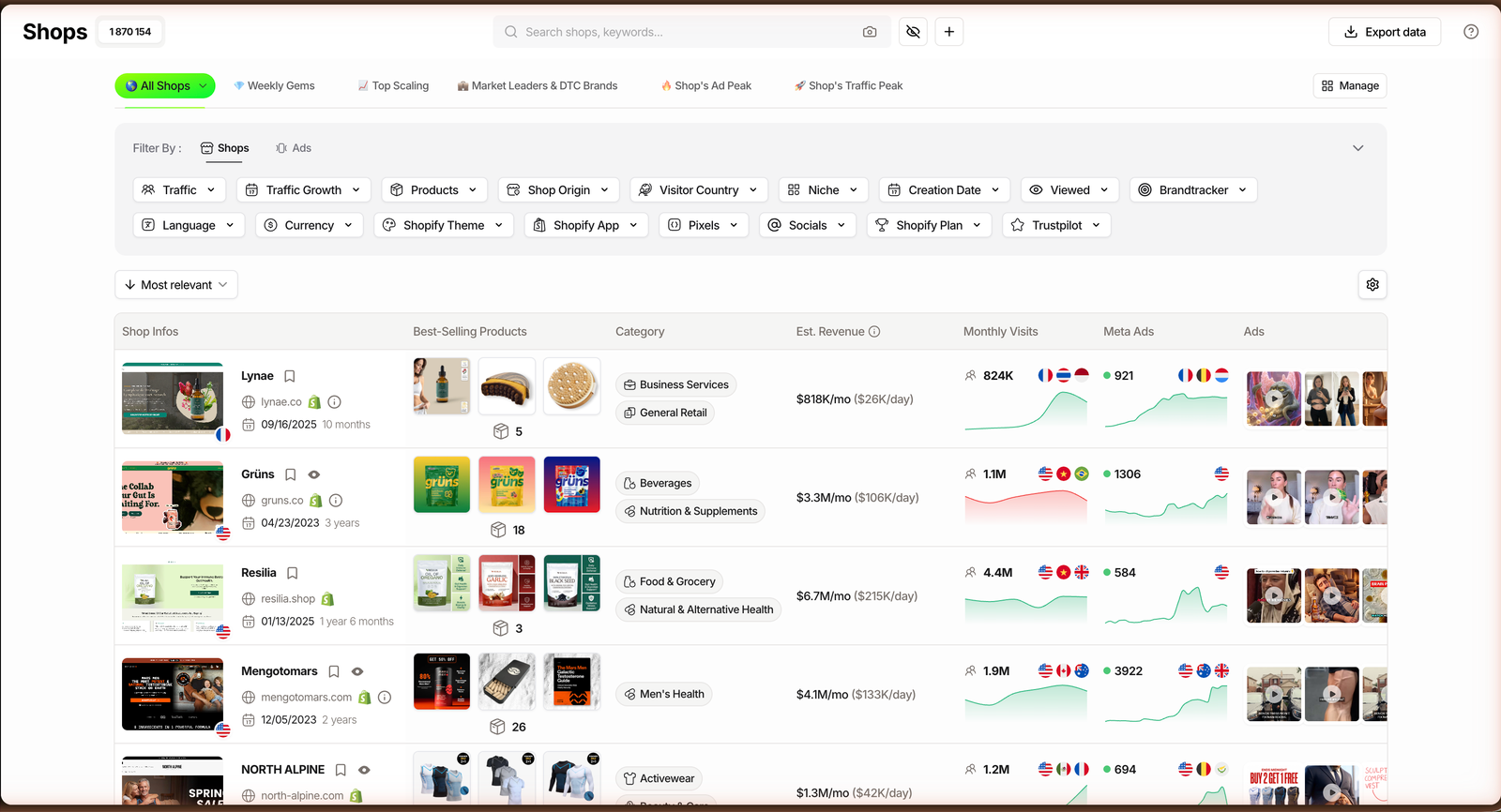
That is exactly what an ad-spy and store database does. Tools like TrendTrack let you screen live Shopify stores by estimated revenue and filter nearly two million of them by niche, country and growth, so your product shortlist comes from data instead of a hunch.
Keep the estimates in perspective. Est. Revenue is a modeled figure, not audited sales, so treat it as directional. It is still a far better starting point than picking a product because it looked good in a TikTok.
One plan note if you go further: the store database and two Brandtrackers sit on the $59/mo Starter plan (or $42/mo billed annually), while the deeper Ads and Advertisers modules start on Pro ($89/mo).
Related guide
Dropshipping Product Research: The Full Method
How to find products that already sell, not guess.
FAQ
Which is better, dropshipping or affiliate marketing?
Neither wins outright. Affiliate marketing is simpler and cheaper to start because you never touch a product, orders or refunds, but commissions cap your margin and you never own the customer. Dropshipping costs more to run and carries store, ad and fulfillment risk, yet it builds a real asset with a higher ceiling. Pick affiliate for content-first, low-risk income; pick dropshipping if you want to own a brand and customer list.
Is dropshipping or affiliate marketing more profitable?
It depends on volume and margin, not the model alone. Affiliate commissions commonly range from 5% to 50% depending on niche, with digital products paying most. Dropshipping margins typically sit around 15% to 30% after product cost and ads, but you keep repeat customers and can upsell. High affiliate volume can beat a small store; a scaled store usually beats casual affiliate income. Both are effort-driven, not guaranteed.
Which is easier for beginners?
Affiliate marketing has the gentler start. You need a channel like a blog, YouTube or TikTok, an audience and honest recommendations, with no store, ads budget, suppliers or customer support. Dropshipping asks you to build a store, pick products, run paid ads and handle fulfillment and refunds from day one. Affiliate is easier to start; dropshipping teaches more transferable e-commerce skills.
Can you do both dropshipping and affiliate marketing?
Yes, and many operators do. A common path is to start affiliate to learn traffic and audience-building with low risk, then reinvest into a dropshipping store once you understand what sells. You can also add affiliate links to a content site that supports your store. The main limit is time: both reward focus, so split only once one is stable.
How much money do you need to start each one?
Affiliate marketing can start for the price of a domain and hosting, often under $100, since traffic can be organic. Dropshipping needs a Shopify plan, apps and, realistically, an ad-testing budget, so a fair starting range is a few hundred dollars. Affiliate is cheaper to begin; dropshipping needs cash to test products.
Do you need product research for affiliate marketing too?
Yes, though it looks different. Dropshipping research finds products that already sell and competitors already scaling. Affiliate research finds high-intent keywords and programs that pay well and convert. If you lean toward dropshipping, tools that show which stores and products are actually growing shorten the guesswork.