Last verified July 2026. Market figures come from TrendTrack’s in-app index; margin and cost ranges are typical, not audited.
It is 11pm and you are staring at a Meta dashboard: $600 spent, two sales, and a product you were sure would fly. The question stops being whether dropshipping works for anyone. It becomes whether it works for you.
That is the honest version of the question, and it deserves an honest answer, not a hype reel.
Dropshipping is still worth it in 2026, but only under conditions. It rewards operators who validate real demand and test small, and quietly drains anyone who picks products blind and pours ad budget on hope. Typical net margins land near 10% to 30%, so discipline, not luck, decides the outcome.
Disclosure: some links on this page are affiliate links. If you subscribe through them we may earn a commission at no extra cost to you. We tested every TrendTrack feature mentioned here on a paid account.
The short answer: worth it, but not the way it’s sold
Dropshipping in 2026 is neither dead nor magic. The gurus selling a laptop-on-a-beach fantasy are wrong, and so are the people declaring the model finished.
What changed is the difficulty curve. The easy money left when everyone piled in, ad costs rose, and customers grew wary of two-week shipping. Search interest for dropshipping is still huge, which cuts both ways: more opportunity, more competition.
Sources: TrendTrack in-app counters, checked July 2026. Margin band is typical, not audited.
Here is the real shift. The old edge was being early. The new edge is being informed, because the market data that used to be invisible now sits in public ad libraries and store indexes, which is why sellers still deciding by gut lose to the ones deciding by data.
So is dropshipping dead? No, it just stopped forgiving lazy product picks. That single change is why the same model makes one seller money and bankrupts the next.
The case for yes: why it still works in 2026
The core appeal has not moved. You sell before you buy, so you carry no inventory and almost no upfront stock risk, and a store plus a product test can start for the price of a few dinners out. It is also a testing machine: float five products in a week, kill four, and put budget behind the one that moves.
The biggest change works in your favor. Demand is now measurable before you spend a cent, because you can see which stores are scaling and which products already have live ads behind them. That is the difference between guessing and validating.
Related guide
How to find winning products
Find a product with real demand instead of copying a saturated one.
There is a quieter payoff too. Even a store that never scales teaches you paid ads, copywriting, offer building and customer psychology, and those skills carry into any online business you touch next. The store can fail while the operator still comes out ahead.
So how much can you make dropshipping? Honestly, it ranges from nothing to a real income, and most stores make nothing. The winners reinvest early profit into ads for months before the number looks like a salary, so treat any specific income claim you see online as marketing, not a forecast.
The case against: where people lose money
Now the part the sales pages skip. Dropshipping has thin, leaky margins, and the leaks are predictable once you know where to look.
Product cost and shipping eat the biggest slice. Ad costs eat the next, because you pay to acquire every visitor and most never buy. Refunds, chargebacks and slow-shipping complaints quietly chip at what’s left, and each one costs you the product too.
| Cost line | Typical range | Why it eats margin |
|---|---|---|
| Product + shipping | 40-60% of sale price | Supplier cost plus fast shipping erases the easy markup |
| Ad spend | Often 20-40% of revenue | You pay for every click; most visitors do not convert |
| Refunds + chargebacks | A few % of revenue | Long delivery times drive disputes and lost stock |
| Shopify + apps | About $39/mo + apps | Fixed cost that runs before your first sale |
| Your time | N/A | Research, support and testing are unpaid until you win |
The ranges above are typical, not your exact numbers, but the shape holds: a $30 product can leave single-digit dollars after everything. That is why dropshipping profit margin math sinks most beginners who price on vibes. Saturation makes it worse, because when a product blows up, hundreds of stores pile on within weeks, ad auctions heat up, and last month’s margin evaporates.
The most expensive mistake is scaling a loser. If you spend before you know a product has real demand, you are funding a test the market already failed, so you can screen live demand first and check who is already advertising it, far cheaper than learning it from your own ad account. To read a rival’s creatives properly, our guide on how to spy on competitors’ ads shows what the free libraries miss.
So, is it worth it for you? It depends on 4 things
This is where the honest answer lives. “Worth it” is not a property of dropshipping, it is a match between the model and your situation. Four things decide it.
1. A test budget you can lose. Plan for $500+ before you get a clear signal, and if losing that would hurt your rent, wait.
2. A repeatable way to find demand. Random AliExpress scrolling is not research, you need a method to spot products already selling.
3. Willingness to learn ads. Paid traffic or organic content is the engine, and nobody visits a new store by accident.
4. Patience measured in months. First profit usually takes several product tests, not one lucky launch.
Notice what all four have in common: they are about you, not the model. Get them right and dropshipping is a fair bet. Skip any one and the odds turn against you fast, because the model cannot rescue a plan that is missing a budget, a method, a skill or the patience to iterate.
The second lever, finding demand, is the one you can shortcut with data. Instead of guessing, you can look at a live index of stores and ads and see what is actually moving before you commit a budget.
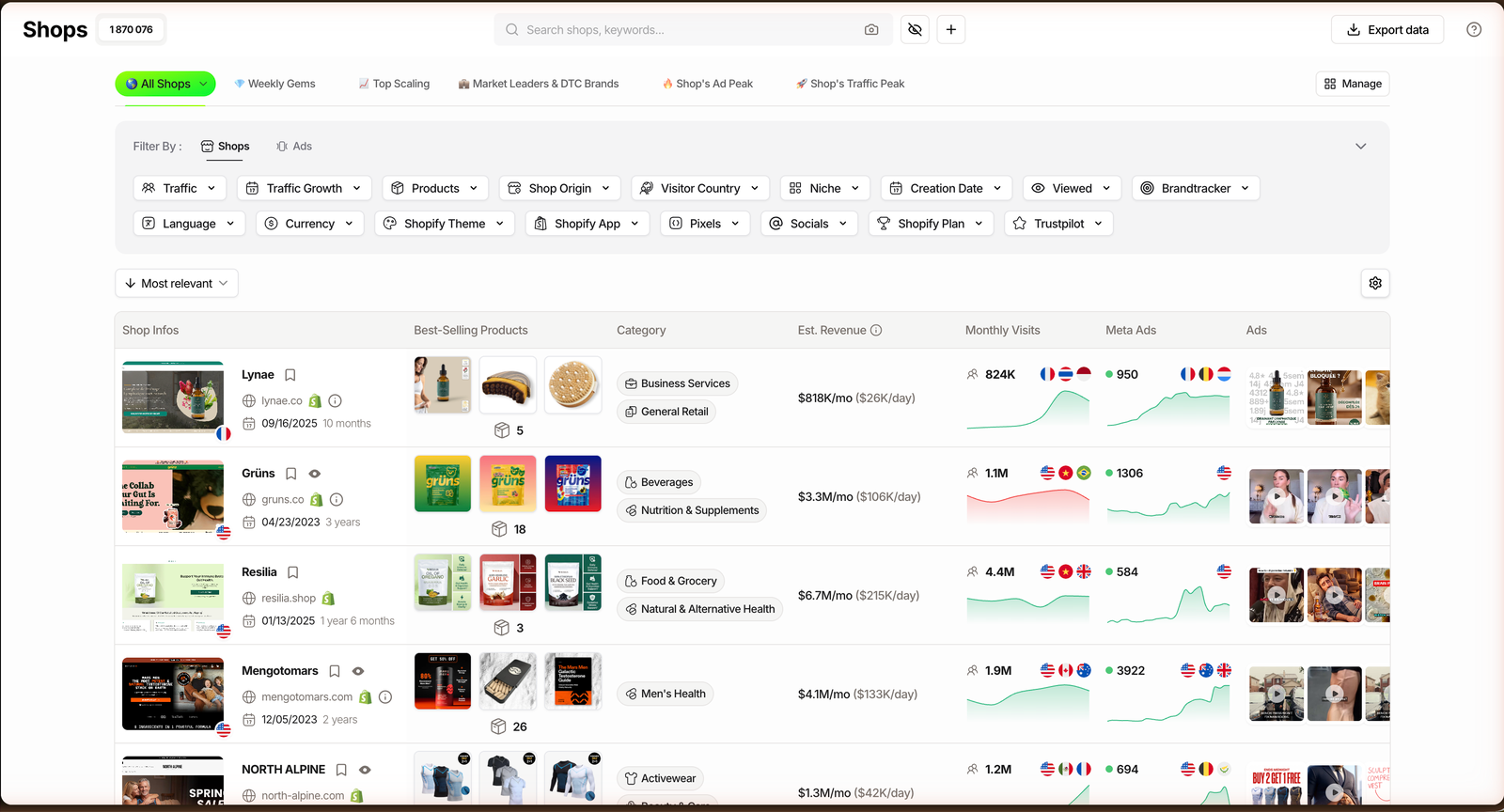
That view is the difference between an educated bet and a coin flip. You still have to test, but you test products the market has already voted for.
It also reframes competition. A niche with dozens of scaling stores is not automatically closed; it is proof the demand is real, and your job shifts to a sharper angle or a better offer. An empty niche is more often a dead one than an untapped goldmine.
See what is already selling before you spend
Product research sits on the Starter plan ($59/mo, or $42/mo billed annually), so demand validation is the cheap part. Full competitor ad spy starts on Pro ($89/mo), which matters once you are actively scaling. Before you scale a single product, our walkthrough on how to test products the right way keeps that first budget honest.
Worth-it checklist: score yourself before you spend
Run this before you buy a domain, not after your first failed campaign. Count your honest yes answers.
- I have a test budget I can afford to lose, separate from bills.
- I can name a repeatable way to find products with real demand.
- I am ready to learn paid ads or organic content, not just open a store.
- I have done the margin math on a real product, cost plus shipping plus ads.
- I can give it a few months and several product tests before judging.
- I will validate demand with data before scaling spend.
Five or six yes answers and dropshipping is genuinely worth a real attempt. Three or fewer and you are not ready to spend yet, you are ready to learn first. That is a cheaper place to be.
Worth it when
- You validate demand before spending
- You have a real, losable test budget
- You treat it as a skill to learn
- You reinvest early profit into ads
Not worth it when
- You need income this month
- You pick products by gut alone
- You cannot afford to lose the test spend
- You expect one launch to work
The verdict, by who you are
There is no single yes or no, so here is the answer split by the person asking it.
| Profile | Starting budget | Worth it? |
|---|---|---|
| Complete beginner, no test budget | Under $100 | No learn first |
| Beginner, serious, can lose a test budget | $500+ | Limited a real test |
| Existing store owner adding a product | Reinvest profit | Yes |
| Side hustle, very limited time | Any | Limited organic only |
The pattern is clear: the closer you are to real demand data and reinvested profit, the more worth it it becomes. The further you are from both, the more it looks like paid tuition. None of these verdicts are permanent either, since a beginner who builds a budget and a method simply moves up a row.
If you want the full breakdown of the tool we use to validate demand, read our TrendTrack review. Whatever you pick, make the decision on data, not on a dream, and dropshipping in 2026 is a defensible bet rather than a gamble.
FAQ
Is dropshipping still profitable in 2026?
Yes, for sellers who validate demand and test small before scaling. Typical net margins land around 10% to 30%, but they vary widely by niche and are not guaranteed. The profitable stores tend to research products with real, provable demand, price with the full cost stack in mind, and reinvest early profit into ads. The unprofitable ones scale on gut feeling. Profitability is a function of your process, not of the model itself.
How much money do you need to start dropshipping?
Enough to run a real test you can afford to lose, often $500 or more once you add a Shopify plan, apps and ad spend. The store itself is cheap to open; the budget goes into paid traffic to find out whether a product converts. Treat that money as tuition you might not get back, not a guaranteed investment. If losing it would put you under financial stress, build the skills first and start smaller.
Is dropshipping worth it for beginners?
It can be, as a way to learn e-commerce cheaply, but not as a shortcut to fast income. A serious beginner with a losable test budget and a real product-research method has a fair shot. A beginner expecting one launch to pay the bills usually loses money and quits. Learn to read demand and run ads on a small budget before you scale anything, and treat the first few product tests as practice. If you are starting cold, our step-by-step beginner roadmap lays out that method.
Why do most dropshippers fail?
Most fail for the same handful of reasons: they pick products by gut instead of data, they underfund their ad testing, they miscalculate margins and price too low, and they quit after one product instead of iterating. The common thread is spending before validating. When you can see which products already have live ads and scaling stores behind them, you skip the most expensive mistakes and put budget only behind demand that is already proven.
Is dropshipping dead?
No, it is just harder and more competitive than it was a few years ago. The easy-money window closed when everyone entered, ad costs climbed, and customers grew impatient with slow shipping. What replaced the old advantage of being early is the new advantage of being informed. Sellers who use public ad and store data to validate demand still build real businesses; the ones chasing a saturated product with no research are the ones who call it dead.
The bottom line
Is dropshipping worth it in 2026? Yes, if you validate demand, budget for real tests, and give it months; no, if you need quick income and pick products blind. The answer was never about the model, it was always about which of those two sellers you are.
The model did not get worse, it got more honest. The sellers who treat it like a data-driven skill make it worth it, and the ones who treat it like a lottery ticket fund everyone else’s education. Start on the free tools, prove the demand, and only scale the products the market has already picked for you.