Last verified July 17, 2026. Every rate and formula below was checked against TikTok Shop’s official US Seller Center pages.
Six percent sounds like a rounding error. Then you hand a creator 15%, pay for shipping out of your own pocket, and the product you priced at $39.99 turns into a number you never actually chose.
Most sellers price against a competitor’s tag and check the math later, which is a slow way to discover that a category is not viable. This TikTok Shop fee calculator does the arithmetic in front of you, with the referral rate, the creator commission, and the return cost in the same view.
TikTok Shop charges US sellers a 6% referral fee on most categories, calculated as rate x (customer payment + platform discount, minus tax). Jewelry and most pre-owned categories pay 5%, and anything a creator sells costs you the affiliate rate you set on top. Enter your numbers below to see your real payout and net margin.
Disclosure: some links on this page are affiliate links. If you subscribe through them we may earn a commission at no extra cost to you. We tested every TrendTrack feature mentioned here on a paid account.
Run your numbers
Fill in what you know and read the bottom line. The tool works per order, because that is the level at which every one of these fees actually lands.
If you are still deciding whether the channel is worth the setup at all, the wider guide to selling on TikTok Shop covers the account side. This page only does money.
What to enter: the selling price is what the buyer pays excluding sales tax. Enter a TikTok funded voucher in its own field rather than deducting it from the price, because that subsidy stays inside the fee base.
How the math works
There is one formula to know, and TikTok publishes it. On TikTok’s referral fee page it reads: Referral Fee = Rate % x (Customer Payment + Platform Discount minus Tax).
The standard rate has been 6% per qualified order since April 1, 2024. Two things sit outside that number: sales tax, which is subtracted from the base, and the creator commission, which is a separate charge you set yourself.
| Category | Rate | Notes |
|---|---|---|
| Most categories: beauty, womenswear, phones, pet supplies, sports, food and the rest of the card | 6% | Standard rate since April 1, 2024 |
| Five jewelry subcategories: Diamond, Gold, Jade, Platinum/Carat Gold, Ruby/Sapphire/Emerald | 5% | Effective October 31, 2024 |
| Most pre-owned categories | 5% | Bags, watches, footwear, womenswear and similar |
| Collectibles and pre-owned, portion of the sale above $10,000 | 3% | Tiered: 5% up to $10,000, 3% on the rest |
Source: TikTok Shop’s category rate card, checked July 17, 2026.
The creator commission runs on a different base. You set the rate, and TikTok bills it on the item price the buyer actually paid, before tax and shipping, and without the platform funded discount added back.
The $39.99 example, line by line
Take a $39.99 product with a landed cost of $9.00, $5.50 of shipping you absorb, and a 15% creator rate. The referral fee takes $2.40 and the creator takes $6.00, so TikTok pays out $31.59.
Subtract the goods and the shipping and you keep $17.09, a 42.7% net margin. That is a healthy product, and it is healthy because the creator rate is modest and the shipping is cheap. Move either one and the picture changes fast.
Worked example, arithmetic only. Your inputs will differ.
Now the part that catches people. Put a $5.00 TikTok funded voucher on that item and the buyer pays $34.99, but the fee base stays at $39.99 because the platform discount is added back.
Your referral fee is still $2.40, not the $2.10 you would expect from 6% of $34.99. It is thirty cents, and it is thirty cents on every single unit of a promo you did not price for.
Reading your result
A net margin is not a score, it is a budget. Whatever the calculator leaves you has to cover returns, the discounting you have not planned yet, and any paid traffic you want to layer on top.
| Net margin | Read | What it funds |
|---|---|---|
| Under 15% | No | One return wave or one discount cycle erases the product |
| 15% to 30% | Limited | Workable on creator and organic volume, thin for paid tests |
| Above 30% | Yes | Room to raise the creator rate or buy traffic and still keep a spread |
Those thresholds are arithmetic, not market data: they are simply what is left to spend. If you want the reasoning behind the numbers rather than the numbers themselves, our breakdown of what a healthy margin looks like goes further.
What a return actually costs you
When an order is refunded, TikTok hands the referral fee back and keeps a Refund Administration Fee of 20% of that fee, capped at $5 per SKU since May 15, 2025. Creator sample refunds and pre-shipment auto-cancellations carry no administration fee at all.
So the fee is rarely the problem. The calculator assumes the goods come back into sellable stock and that the shipping you already paid does not: enter a return rate and watch the shipping line, not the admin line, do the damage.
What the calculator can’t tell you
Every input here starts as an assumption. The price you type is a guess about what the market bears, and the creator rate is a guess about what it takes to get picked up.
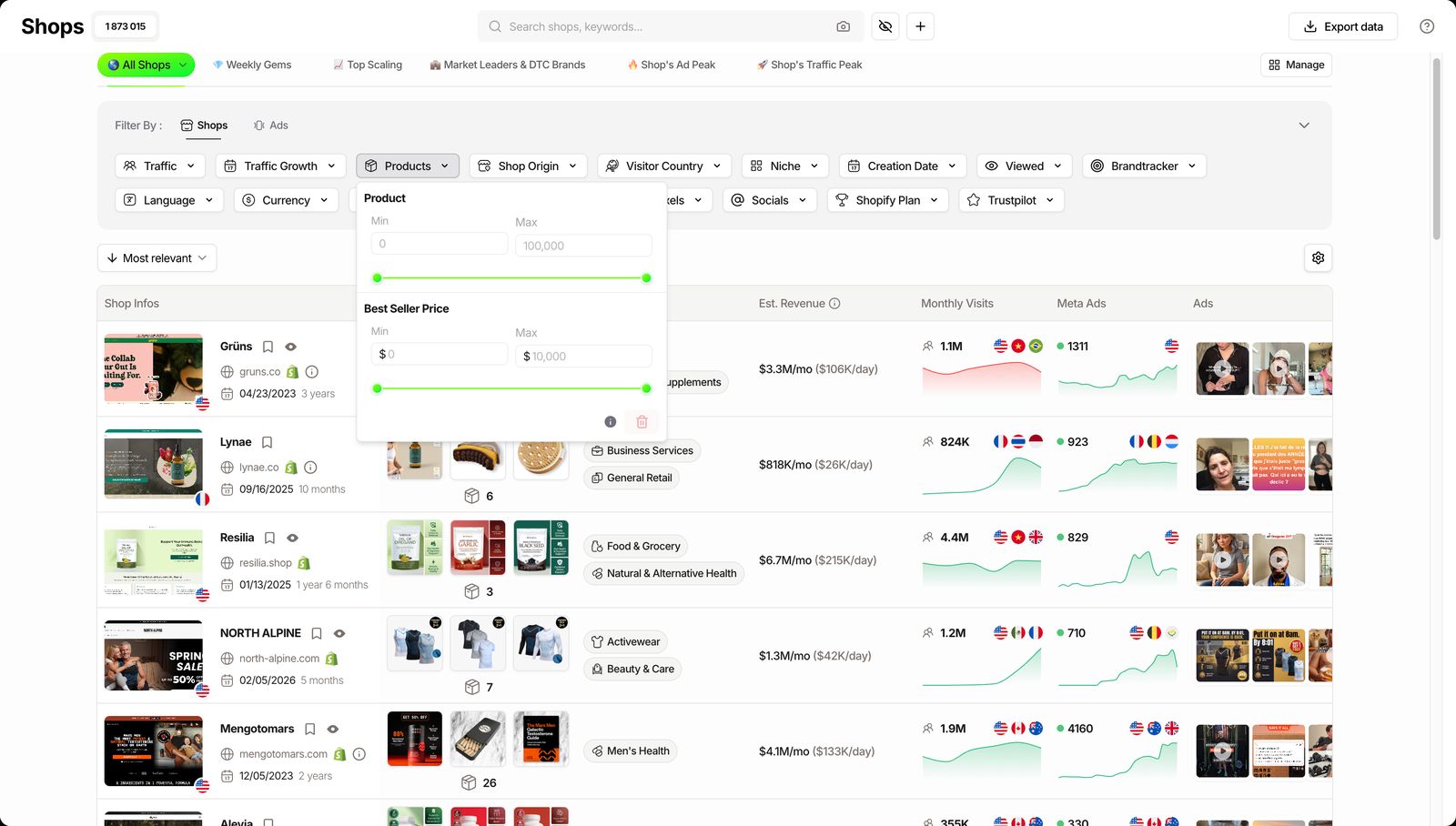
That is where a store database beats a spreadsheet. TrendTrack indexes 1 873 015 Shopify stores, checked July 17, 2026, with a best-seller price filter, so you can see the price band a niche actually sells at.
Its Est. Revenue column then puts a figure on the stores clearing that band. Treat that figure as estimated, never as audited revenue.
The second blind spot is how a competitor gets volume. A brand that sells on organic clips can live with a fee load that would sink a brand buying every click, and TrendTrack shipped TikTok tracking on June 8, 2026 precisely to separate the two.

Plan check: the TikTok tab of the Ads library sits in the Ads module, which starts on Pro ($89/mo, or $62/mo billed annually). Starter ($59) covers Shops and two Brandtrackers, not the Ads module.
If your margin says you can only win on organic, that split is the number to check before you commit a season of inventory. You can look at it yourself inside TrendTrack’s TikTok tracking.
FAQ
How much does TikTok Shop take per sale?
For most US categories the referral fee is 6% of the fee base, and TikTok’s official formula is Referral Fee = Rate x (Customer Payment + Platform Discount minus Tax). That is the platform charge.
If the sale came through a creator, add the affiliate commission you set yourself, which TikTok bills on the item price the buyer actually paid. So a $39.99 sale with a 15% creator rate loses $2.40 to the referral fee and $6.00 to the creator before your product cost.
Does TikTok Shop charge a separate transaction fee?
TikTok’s US referral fee page lists the referral fee as the platform charge on a qualified order, and it does not publish a separate US payment processing line. Budget from what is documented: the referral fee, the creator commission you set, your fulfillment cost, and any ad spend. If your own statements show a charge that is not on the rate card, put it in the custom rate field of the calculator rather than assuming a fixed number.
Is the referral fee charged on sales tax and shipping?
Tax is excluded. The official formula subtracts it from the base.
The part that surprises sellers is the other direction: a platform discount funded by TikTok is added back into the base, so a voucher does not lower your fee. Sell a $39.99 item with a $5.00 TikTok funded voucher and the buyer pays $34.99, but the referral fee is still calculated on $39.99, so $2.40 rather than $2.10.
What happens to the fee when an order is refunded?
TikTok returns the referral fee and keeps a Refund Administration Fee worth 20% of that referral fee, capped at $5 per SKU since May 15, 2025. Creator sample refunds and pre-shipment auto-cancellations carry no administration fee. The real cost of a return is usually not the fee itself but the fulfillment you already paid, which is why the calculator lets you enter a return rate.
Which categories pay less than 6%?
Five jewelry subcategories pay 5%: Diamond, Gold, Jade, Platinum/Carat Gold, and Ruby/Sapphire/Emerald, effective October 31, 2024. Most Pre-Owned categories also sit at 5%.
For collectibles and pre-owned items, the portion of a sale above $10,000 drops to 3%. Everything else on the card, from beauty to womenswear to phones and pet supplies, is 6%.
The bottom line
TikTok Shop’s platform cut is one of the cleaner ones in ecommerce: 6%, published, with a formula you can audit. The costs that actually decide a product are the ones you set yourself, the creator rate and the shipping you swallow.
Run the calculator before you list, not after your first payout. Then go find out what the stores already winning that category charge.
Priced it. Now who else is selling it?
TrendTrack screens 1.87M Shopify stores by best-seller price and niche, estimates their revenue, and splits a brand’s TikTok between ads and organic. Shops starts on Starter ($59/mo). Ad spy starts on Pro ($89/mo, or $62/mo billed annually).