Last verified July 2026. Store and ad counts checked live in TrendTrack; cost ranges are planning estimates you should adjust to your own setup.
You opened a fresh doc, typed “Business Plan” across the top, and then just sat there. The cursor blinked. Somewhere between “executive summary” and “financial projections,” the whole thing started to feel like homework instead of a business.
Here is the good news. A dropshipping business plan does not need to look like something a loan officer asked for. It needs to be short, honest, and useful enough that you stop guessing before you spend a dollar on ads.
A dropshipping business plan is a short document, one page is usually enough, covering 8 sections: executive summary, business model, market and competitor research, product selection, marketing strategy, financial plan, operations, and a 90-day roadmap. The point is clarity before spend, not paperwork. Copy the template below and fill it in one sitting.
Disclosure: some links on this page are affiliate links. If you subscribe through them we may earn a commission at no extra cost to you. We tested every TrendTrack feature mentioned here on a paid account.
Do you actually need a business plan to dropship?
No one is going to check. You can launch a Shopify store tonight without writing a single line of strategy, and plenty of people do.
But “plenty of people” is also who quits in month two, out of budget and unsure what went wrong. The plan is not for a lender. It is the thing that keeps you from spending your entire test budget on a product you never validated.
If you are brand new to the model, start with the full guide to starting a dropshipping business, then come back and build the plan around it.
Keep it one page if
- You are self-funding with your own savings.
- You want to launch in weeks, not months.
- You will revise it as real numbers come in.
Write the long version if
- You are pitching a partner or applying for funding.
- You are registering a formal company with co-founders.
- You need it for a visa or grant application.
For most first stores, the one-page version wins. It gets written, and a plan you actually finish beats a polished one that lives in your drafts.
What a lean dropshipping business plan includes
The classic business-plan format was built for brick-and-mortar shops and investor pitches. You can borrow its bones and drop most of the fat.
Strip it down and a dropshipping plan holds three jobs: prove there is demand, prove you can reach it profitably, and set a timeline that forces action. Everything below serves one of those three.
Store count: TrendTrack index, checked July 2026. Cost and inventory figures are planning estimates.
In this plan
- Executive summary and business model
- Market and competitor research
- Product selection
- Marketing and sales strategy
- Financial plan: costs, margins, break-even
- Operations, suppliers and tools
- The 90-day roadmap
Section 1: Executive summary and business model
Write this part last, but put it first. In four or five lines it answers: what do you sell, to whom, on which channel, and why now.
The business model line is short because dropshipping is simple by design. You list products on a store built on Shopify, a supplier ships each order after a customer buys, and you never hold inventory. Your money goes into ads and margin, not a garage full of stock.
Name your edge here too. Faster shipping through a private agent, a tighter niche, better creative, a brand angle competitors ignore. If you cannot name an edge yet, that is a signal to keep researching, not to skip the line.
Section 2: Market and competitor research
This is the section that decides whether the rest of the plan is worth writing. You are answering two questions: is there real demand, and who already serves it.
Start with the market. Define the niche narrowly, estimate the audience, note the seasonality, and write down where these buyers already spend time. “Pet owners” is a hobby. “Anxiety relief products for large-breed dogs” is a market.
Then look at competitors. You want to know who is already scaling, roughly how much they appear to spend, and what their offers look like. Treat every third-party number as an estimate, not a fact, because that is what it is.
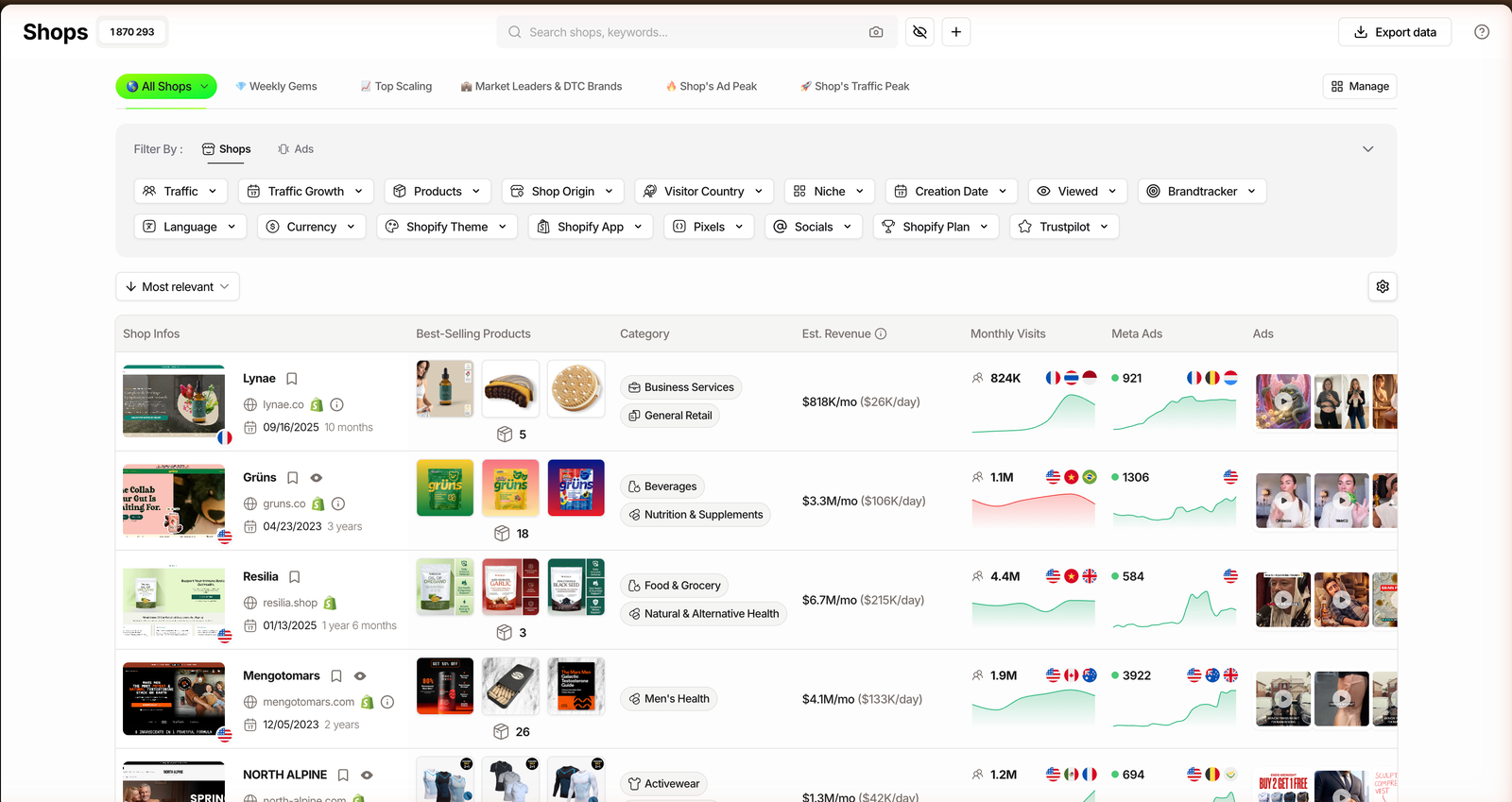
This is where a research tool earns its place in the plan. Screening a large index of live stores by niche, price band, and estimated revenue turns “competitor analysis” from a vibe into a shortlist you can point at.
Related guide
How to Spy on Competitors’ Ads
Turn the competitor line in your plan from a guess into live ad data.
A quick note on cost before you reach for a tool. The Shops index and two Brandtrackers sit on Starter at $59/mo (or $42/mo billed annually). Live ad spy in the Ads and Advertisers modules starts on Pro ($89/mo), so match the plan to what your research actually needs.
Screen the market in TrendTrack
Section 3: Product selection
The market tells you where to fish. The product is the hook. A plan should name one hero product and two or three backups, with the reason each one earns a spot.
Good candidates share a shortlist of traits: a healthy margin after product and shipping cost, a visible wow factor for video, and a supplier who can actually fulfill at volume. Weak candidates usually fail the margin test first.
Do not pick from a “trending products” listicle alone. Cross-check demand against live ad data, so you can scout products against what is already running instead of what a blog published six months ago.
Related guide
How to Find Winning Products
The research method behind the product line in your plan.
Section 4: Marketing and sales strategy
This section says how a stranger becomes a customer. For most dropshipping stores in 2026, the answer starts with paid social: Meta and TikTok carry the volume, and creative is the real lever.
Write down the channel you will lead with, the creative format you can produce consistently, and the offer that makes the first click worth it. One channel done well beats four done badly.
Then sketch the funnel past the ad: the product page, the upsell, and the email flows that recover abandoned carts. The ad buys the click, but the funnel is where thin margins turn into a profit.
Section 5: Financial plan: costs, margins, break-even
Here is where most first plans lie to themselves. The fix is to write real ranges and mark them as estimates you will replace with your own numbers.
Start with the cost of getting live. Dropshipping keeps inventory at zero, but a launch still has a bill.
| Item | Typical range | Notes |
|---|---|---|
| Shopify plan | ~$39/mo | Cheaper billed yearly; free trial to start |
| Domain | ~$12 to $20/yr | Optional; a subdomain works at first |
| Theme | $0 to $400 once | Free themes are fine to launch |
| Core apps | $0 to $50/mo | Reviews, upsells, email |
| Product samples | $20 to $100 | Order it before you sell it |
| Ad testing budget | $300 to $1,000 | The number you set to validate demand |
| Research tool | from $59/mo | Optional; market and competitor data |
Then model the unit. Selling price minus product cost minus shipping minus the ad cost to acquire one sale equals your contribution per order. If that number is not clearly positive, no volume will save it, so read up on how dropshipping profit margins really work before you commit.
Finish with break-even. Add up your fixed monthly costs, divide by the profit per order, and you have the number of sales that keep the lights on. Everything above that line is progress. None of it is a guarantee, and your plan should say so out loud.
Section 6: Operations, suppliers and tools
Operations is the boring section that quietly decides your refund rate. Write down who ships your orders, how long it takes, and what happens when a package is late or a customer wants a return.
Name a primary supplier and a backup. A single agent or marketplace listing going dark should never take your store down with it.
List the small stack you will run: the store, an email tool, a review app, and whatever handles order routing. Keep it lean at launch and add tools only when a real bottleneck asks for one.
Fill the template in three passes
Do not try to write all eight sections perfectly in order. Fill the template in three passes, each one adding a layer.
Here is the template itself. Copy it, drop it in a doc, and answer the prompts under each heading in a sentence or two.
Copy-paste template
1. Executive summary. What you sell, to whom, on which channel, and your one-line edge.
2. Business model. Store platform, how orders are fulfilled, where money comes from and goes.
3. Market and competitor research. Niche, audience size, seasonality, and three competitors already scaling.
4. Product selection. Hero product plus two backups, with margin and wow factor for each.
5. Marketing and sales strategy. Lead channel, creative format, offer, and the funnel after the click.
6. Financial plan. Launch costs, contribution per order, monthly break-even in units.
7. Operations and suppliers. Primary and backup supplier, shipping time, returns policy, tool stack.
8. 90-day roadmap. One goal and one metric for month 1, month 2 and month 3.
Treat the finished plan as a living document, not a monument. Revisit it at 30, 60 and 90 days, and rewrite the parts your real numbers proved wrong.
FAQ
Do you need a business plan to start dropshipping?
Not legally, and no platform requires one. But a one-page plan keeps you from burning your test budget on an unvalidated product. It forces you to name your niche, your target margin, and your test budget before money leaves your account, which is exactly where most first stores go wrong.
What should a dropshipping business plan include?
Eight sections cover it: an executive summary, your business model, market and competitor research, product selection, a marketing and sales strategy, a financial plan with costs and break-even, an operations and supplier plan, and a 90-day roadmap. On one page, each section is a few honest sentences, not a chapter.
How do you write a one-page dropshipping business plan?
Fill the template in three passes. First draft the model, market and product in bullets. Second, plug in real costs, margins and break-even from your research. Third, set a 90-day roadmap with one goal and one metric per month. The whole thing fits on a single page and can be done in one sitting.
How much does it cost to start a dropshipping business?
Inventory is $0 because you pay suppliers after each sale. The real launch bill is a Shopify plan around $39/mo, an optional domain, apps, a product sample, and an ad testing budget usually between $300 and $1,000. These are planning estimates, so adjust them to your own niche and channel before you commit.
Do you need an LLC to start dropshipping?
Many people start as a sole proprietor and register a formal company later, once the store shows traction. Rules vary widely by country and state, and structure affects taxes and liability. This is not legal advice, so check your local requirements or talk to an accountant before you decide.
How do you research the market for a dropshipping plan?
Estimate demand and competition together. Define the niche, note seasonality, and look at stores already serving it: which products they run, roughly what they appear to spend, and how their offers read. Tools that screen a large index of live Shopify stores by niche and estimated revenue speed this up, as long as you treat those figures as estimates.
Start with the plan, then go build
A dropshipping business plan is not paperwork. It is the cheapest test you will ever run, one that costs an afternoon instead of an ad budget.
Copy the template, fill it in three passes, and let your real numbers rewrite it as you go. When you are ready to turn the plan into a live store, walk through the full guide to starting a dropshipping business next.