Last verified July 15, 2026. Trend and search data pulled from US Google data (DataForSEO); TrendTrack prices, gating and database counts checked on a paid account.
Dropshipping is not dead. The 2020 version of it is.
The shortcut everyone still sells you, post one viral clip, watch the orders roll in, stopped working years ago. US search interest in dropshipping for beginners is down 52% year over year, the market is more crowded, and buyers are harder to impress.
None of that means you cannot start. It means you need a real plan instead of a lucky guess. This roadmap walks the whole path, phase by phase, with no hype and no promise that you will get rich.
Dropshipping for beginners in 2026 comes down to five phases: pick a niche and market, find a product with proven demand, build a lean store, run one clean paid test, then read what competitors are scaling before you spend more. Expect a real ad budget, not a free ride.
Disclosure: some links on this page are affiliate links. If you subscribe through them we may earn a commission at no extra cost to you. We tested every TrendTrack feature mentioned here on a paid account.
In this guide
The 2026 reality check
Before the steps, set your expectations straight. Dropshipping is a real retail model, you sell first and your supplier ships after, so you carry no inventory and low upfront cost.
What changed is the difficulty curve. The falling search trend below is not a death signal, it is a filter: the tourists left, the operators stayed. Fewer beginners are trying, and the ones who win treat it like a business, not a lottery ticket.
Search trend: DataForSEO, US, July 2026. Store count and pricing: TrendTrack, checked July 15, 2026.
So who is this for? A beginner who will treat the first months as tuition, not profit. If you need money next week, this is the wrong model.
Get your head right before your store:
- Budget for a paid test, not just a Shopify plan.
- Expect to kill more products than you launch.
- Measure everything; opinions do not pay for ads.
The roadmap at a glance
Five phases, in order. Skipping ahead is the fastest way to waste money, most beginners jump straight to running ads on a product nobody validated.
Phase 1: pick a niche and a market
A niche is not a product, it is the audience you will keep selling to. Pick one where people already spend, where you can speak their language, and where shipping a physical item makes sense.
Do you actually need a niche, or just one product? You need both, but start with the audience. A single product can flop while the audience behind it stays profitable for the next three tests.
Avoid the two beginner traps: markets that are pure fashion gambles, and products that break, spoil, or need sizing support you cannot give.
- Choose a market with clear buyers and repeat interest.
- Confirm the price point supports paid ads (usually $25 to $60 retail for impulse items).
- Write down who the customer is in one sentence.
Phase 2: find a product with proven demand
This is where most beginners lose. Scrolling TikTok until something looks viral is discovery, not validation.
Discovery is free: browse TikTok, watch what your niche shares, and check the trend on Google Trends to confirm interest is rising, not fading. But a rising graph does not prove anyone is profiting.
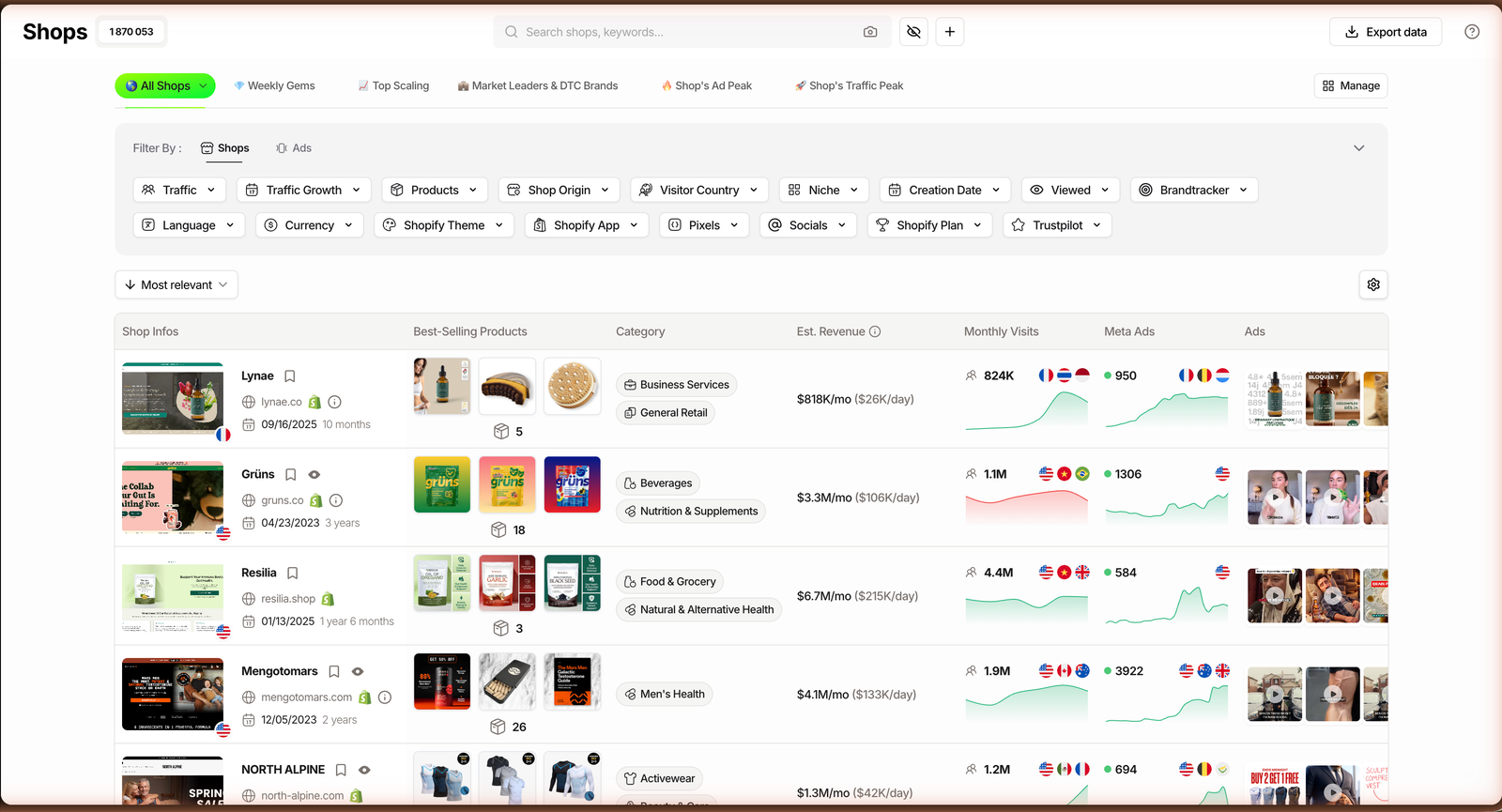
Validation answers a harder question: is a real store already scaling this product right now? That is what store-intelligence data is for. Across a database of 1.87M+ Shopify stores, you can filter by niche, product, price and traffic to see who is actually selling, then read their estimated revenue as a directional signal.
Related guide
How to Find Winning Products in 2026
The full signal checklist for spotting a product that scales.
Want the deeper version? We wrote a full product-research method that runs discovery and validation in three passes. You can also x-ray any store yourself with the free TrendTrack Chrome extension before you commit a cent.
Keep in mind estimated revenue is an estimate read from the outside, not audited sales. Treat it as a direction, not a receipt.
- Find 3 to 5 candidates with rising interest.
- Confirm at least one store is already scaling each one.
- Check the margin: retail price minus product and shipping cost must leave room for ads.
Phase 3: build a store that converts
You do not need a beautiful store. You need a trustworthy one that loads fast and makes checkout obvious.
Most beginners open a Shopify store, pick a clean free theme, and build a single strong product page rather than a cluttered catalog. Speed and clarity beat design flourishes every time.
The essentials are boring on purpose: clear photos, honest shipping times, a visible refund policy, and reviews. Trust signals are what turn a cold ad click into a first order.
- Launch on a fast, simple theme.
- Build one focused product page with real trust elements.
- Set up payments, shipping rules and a basic email flow.
Phase 4: validate with one paid test
Now you spend, carefully. The goal of a first test is not profit, it is a clear yes or no on demand.
Related guide
How to Test Products (Before You Scale)
The clean-test framework, from fixed budget to kill criteria.
Run one product, one platform, a fixed budget, and change one variable at a time. If you test five things at once, you learn nothing when it fails.
Judge the test on cost per purchase against your break-even number, the margin you calculated in Phase 2. If ads cost more than your margin and the gap will not close, kill it and move to the next candidate.
This is the emotional part. Killing a product you like is the skill that separates operators from hobbyists.
- Set a fixed test budget you can lose without stress.
- Track cost per purchase against break-even daily.
- Decide the kill or keep rule before you launch, then follow it.
Phase 5: read the competition and scale
A product that passes its test is not the finish line, it is permission to study the market seriously. Before you pour budget in, look at who is already winning and how long they have been running.
This is where you spy on competitors’ ads: which creatives keep running, how long they last, and which angles keep coming back. Ads that have run for weeks are ads that make money; that is your template.
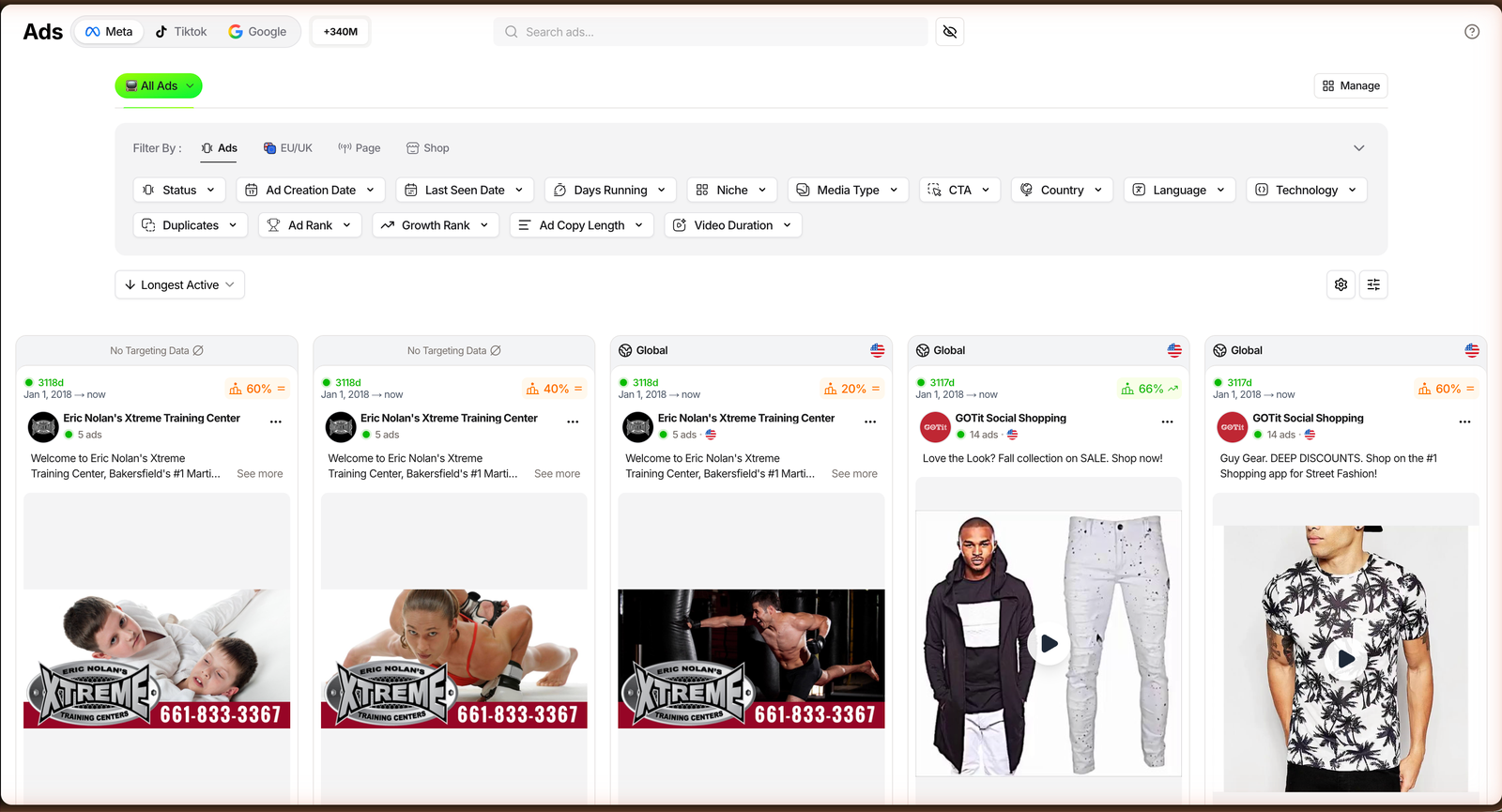
Plan check: TrendTrack’s ad spy (the Ads and Advertisers modules) starts on Pro ($89/mo). Starter ($59) covers the Shops database, 2 Brandtrackers and the free extension, but not ad spy.
What you read there is simple: an ad’s rank signals how well it is performing, and its run time signals whether the money behind it is staying. Copy the structure of the survivors, not the losers.
When product research and ad spy become a weekly habit, one paid tool that does both starts to pay for itself.
- Shortlist the competitors already scaling your product.
- Note the creatives running longest and copy their structure.
- Scale budget only on winners with proof behind them.
Beginner mistakes that burn budget
Most first-year budgets do not die on bad products. They die on avoidable process errors.
- Scaling an unvalidated product. The single most expensive mistake, spending big before one clean test says yes.
- Ignoring margin. A $20 product with $18 of cost and ads has nothing left to grow on.
- Testing five variables at once. You cannot read a result when everything changed.
- Copying an ad without checking it scales. A pretty creative that ran three days taught its owner nothing either.
Fix these four and you are already ahead of most people who quit in month one.
Your first 30 days
Here is the whole roadmap as a checklist. Each phase has a clear finish line, do not move on until you hit it.
| Phase | What you do | Done when |
|---|---|---|
| 1. Niche | Pick a market and a customer. | You can name the buyer in one sentence. |
| 2. Product | Validate proven demand and margin. | A store is already scaling it. |
| 3. Store | Build one fast product page. | Checkout works and trust is visible. |
| 4. Test | Run one clean paid test. | Cost per purchase judged vs break-even. |
| 5. Scale | Study rivals, push winners only. | Budget grows on proven creatives. |
FAQ
Is dropshipping still worth it for beginners in 2026?
Yes, with a caveat. The model still works, but the easy version does not. US search interest is down 52% year over year, competition is better armed, and you need a real test budget and real product research. Beginners who treat it like a business still find room; those who expect a lottery ticket lose money fast.
How much money do you need to start dropshipping?
Less than a store, more than nothing. Real costs are a Shopify subscription, a paid test budget (your biggest line), and optionally a research tool. TrendTrack starts at $59/mo for the store database, and ad spy starts at $89/mo on Pro. Budget for ads, not a free ride, and only spend what you can lose during testing.
How do beginners find a winning product?
In two steps. Discovery is free: browse TikTok and check Google Trends to confirm rising interest. Validation is the hard part: confirm a real store is already scaling the product and that the margin leaves room for ads. Estimated revenue and competitor data point you in the right direction, but treat them as estimates, not audited numbers.
What are the most common beginner mistakes?
Four repeat offenders: scaling a product before one clean test validates it, ignoring margin until ads eat all the profit, testing five variables at once so no result is readable, and copying a competitor’s ad without checking it actually ran long enough to be a winner.
How long before dropshipping makes money?
There is no guaranteed timeline, and anyone promising one is selling something. Most beginners spend weeks testing products before one works, and many never reach profit at all. Treat it as an iterative process: each failed test is information, and the goal early on is learning, not income.