Last verified July 16, 2026. Prices and TrendTrack counters checked live in-app; market figures are directional estimates.
This guide maps the whole landscape of Shopify dropshipping in 2026: what the model is, why Shopify, what it really costs, how to pick and source a product, and how to read the numbers before you spend.
Dropshipping did not die when the easy-money crowd left. It matured into a business that rewards operators who validate demand instead of chasing a viral clip.
Shopify is where most of that business runs. So this is the platform-first version of the guide, tested against a real toolset, with no income promises attached.
Shopify dropshipping means listing products on a Shopify store and having a supplier ship each order after it sells, so you hold no stock. Shopify handles checkout, hosting and apps. The store can be near free; the real cost is a $300 to $500 budget to validate a product with ads.
In this guide
Disclosure: some links on this page are affiliate links. If you subscribe through them we may earn a commission at no extra cost to you. We tested every TrendTrack feature mentioned here on a paid account.
What Shopify dropshipping actually is in 2026
The mechanic is simple. You list a product, a customer buys it, and your supplier ships it directly to them. You never hold inventory and you only pay for a unit after it sells.
Shopify is the storefront that wraps around that mechanic. It gives you a checkout, secure hosting, payment processing and an app store, so you are not stitching together a website from scratch.
One distinction matters before you start. This guide is platform-first: it focuses on Shopify itself. For the end-to-end launch sequence, from mindset to first sale, follow the full startup process step by step.
Product
The one thing that decides everything. Pick before the niche.
Supplier
Who fulfills the order and how fast they ship it.
Shopify store
Checkout, hosting and payments handled for you.
Theme
The look and speed of the store. Free options work.
Apps
Reviews, upsells and email that add conversions.
Traffic
Paid ads on Meta and TikTok are how most stores start.
What changed since the boom years is the cost of getting attention. Ad prices matured, buyers grew skeptical, and the stores that survive now compete on product and offer, not on a lucky video.
Get those six blocks right in order and you have a real store. Skip the first one and no amount of polish on the rest will save it.
Is Shopify the right platform for dropshipping?
For most sellers, yes. Shopify is the default direct-to-consumer platform because it removes the technical work and lets you launch in a weekend.
It is not the only option. WooCommerce on WordPress is cheaper at the margins but heavier to maintain. For a first store where speed matters, the tradeoff usually favors Shopify.
Pros
- Checkout, hosting and security handled for you
- Huge app ecosystem for reviews, upsells and email
- Fast, mobile-ready themes like Dawn
- Shopify Payments built in
Cons
- A recurring monthly subscription
- Extra transaction fees if you skip Shopify Payments
- Platform dependence: rules and pricing can change
- Popular themes are visually saturated
The real monthly cost
The store itself is cheap. The line that actually moves your budget is the ad test, not the software.
| Item | Typical range | Notes |
|---|---|---|
| Shopify plan | ~$39/mo | Basic, publicly listed; billed monthly |
| Theme | $0 to ~$350 | Free like Dawn, or a premium one-time buy |
| Core apps | $0 to ~$50/mo | Reviews, upsell, email; many free tiers |
| Product samples | Varies | Order before you sell to check quality |
| Ad test budget | $300 to $500 | To validate one product; estimated |
Ranges are typical, not audited. Your real number depends on the product price and how aggressively you test. Model the full picture in a Shopify profit calculator before you launch.
Choosing what to sell: the make-or-break step
Pick the product before the niche. A great store built around a weak product loses money; an average store around a proven product can still win.
A product worth testing usually shows three things: live demand other sellers are already funding, room for a healthy markup, and a clear reason to buy now. The fastest way to check the first one is to screen live competitor demand instead of guessing from a trends chart.
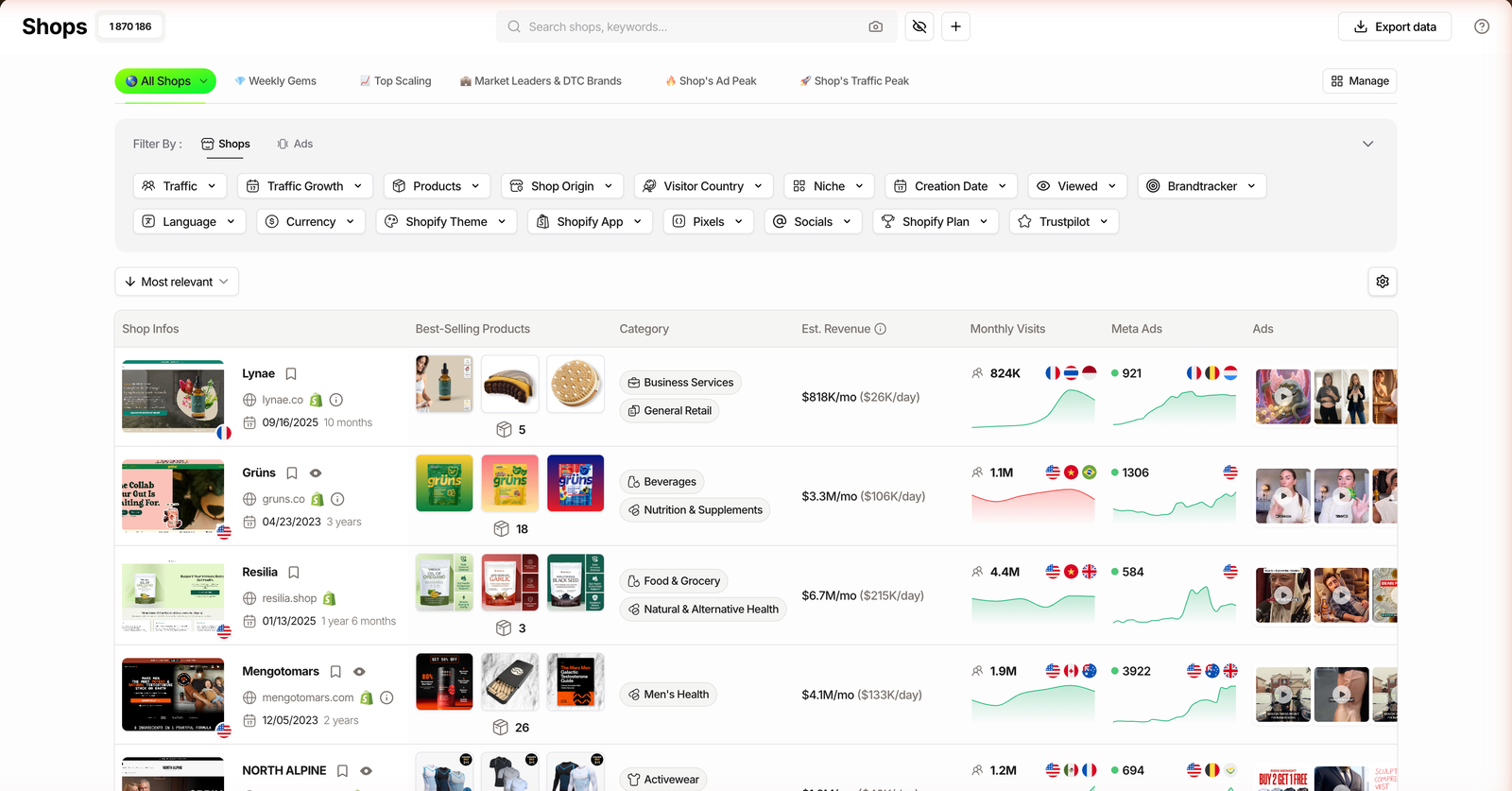
That is where a research tool earns its place. Filtering an index of live Shopify stores by niche, traffic growth and best-seller price surfaces the stores that are scaling right now, not last year.
Plan check: TrendTrack starts at $59/mo (or $41/mo billed annually). The Shops module and the free Chrome extension are on every plan, but the Ads and Advertisers modules start on Pro ($89/mo).
You do not need a paid tool to start. But knowing what already sells is the single biggest time-saver in the whole process, and it is where most beginners guess.
What a testable product looks like
Not every trending item is worth a test. Before you commit a budget, check that the product clears a few practical bars.
- Live demand: competitors are running ads for it right now, not just last season.
- Markup room: you can sell for at least three times your landed cost and still convert.
- A reason to buy now: it solves a visible problem or has a clear wow factor on video.
- Ship-ability: light, sturdy, and not fragile enough to rack up returns.
Related guide
How to Find Winning Products
The data-driven way to spot a product with live demand.
Sourcing your products: suppliers and models
Once a product looks promising, you need someone to ship it. Your sourcing model sets your shipping times, your margins and your risk.
| Model | Speed | Margin | Best for |
|---|---|---|---|
| AliExpress | Slow (1 to 3 wks) | Wide | Testing many products cheaply |
| Print on demand | Medium | Tighter | Custom designs, no inventory |
| Sourcing agent | Faster | Wide | Scaling a proven winner |
| Domestic supplier | Fast | Varies | Speed and returns for local markets |
Most beginners start on AliExpress dropshipping because it is cheap to test, then move to a sourcing agent once a product proves it can scale. Print on demand is the exception: it suits custom apparel and accessories where holding stock makes no sense.
Whatever you choose, order a sample first. A supplier that looks great in a catalog can still ship slow or send the wrong variant.
Building the store on Shopify
You do not need a designer. You need a clean, fast store that makes one product easy to understand and easy to buy.
Start with the theme. Shopify’s free Dawn theme is fast and mobile-ready, and it converts fine for a first store. Paid themes built for dropshipping add prebuilt sections, but they will not fix a weak product.
Then add only the apps that earn their keep. Three categories do most of the work, and each one maps to a specific conversion problem.
Reviews
Social proof on the product page. Fixes trust for an unknown store.
Upsell
Bundles and post-purchase offers. Lifts average order value.
Abandoned-cart and flow automation. Recovers lost checkouts.
Resist the urge to install twenty apps. Each one adds load time, and a slow store leaks sales on mobile where most of your ad traffic lands.
The pages that actually convert
Get the essentials right before anything decorative. A focused product page with real photos, honest shipping times, and a benefit-led description does the heavy lifting.
Around it, add the pages buyers look for: clear shipping and return policies, a simple contact page, and a checkout you have tested end to end on your own phone. Those basics convert far more than a flashy homepage.
Getting traffic and validating demand
A store with no traffic is a parked car. For most dropshippers, paid ads on Meta and TikTok are the fastest way to get real buying signals.
Before you spend, validate. The smartest move is to watch which competitor ads are actually running and for how long, because an ad that has been live for weeks is usually paying for itself.
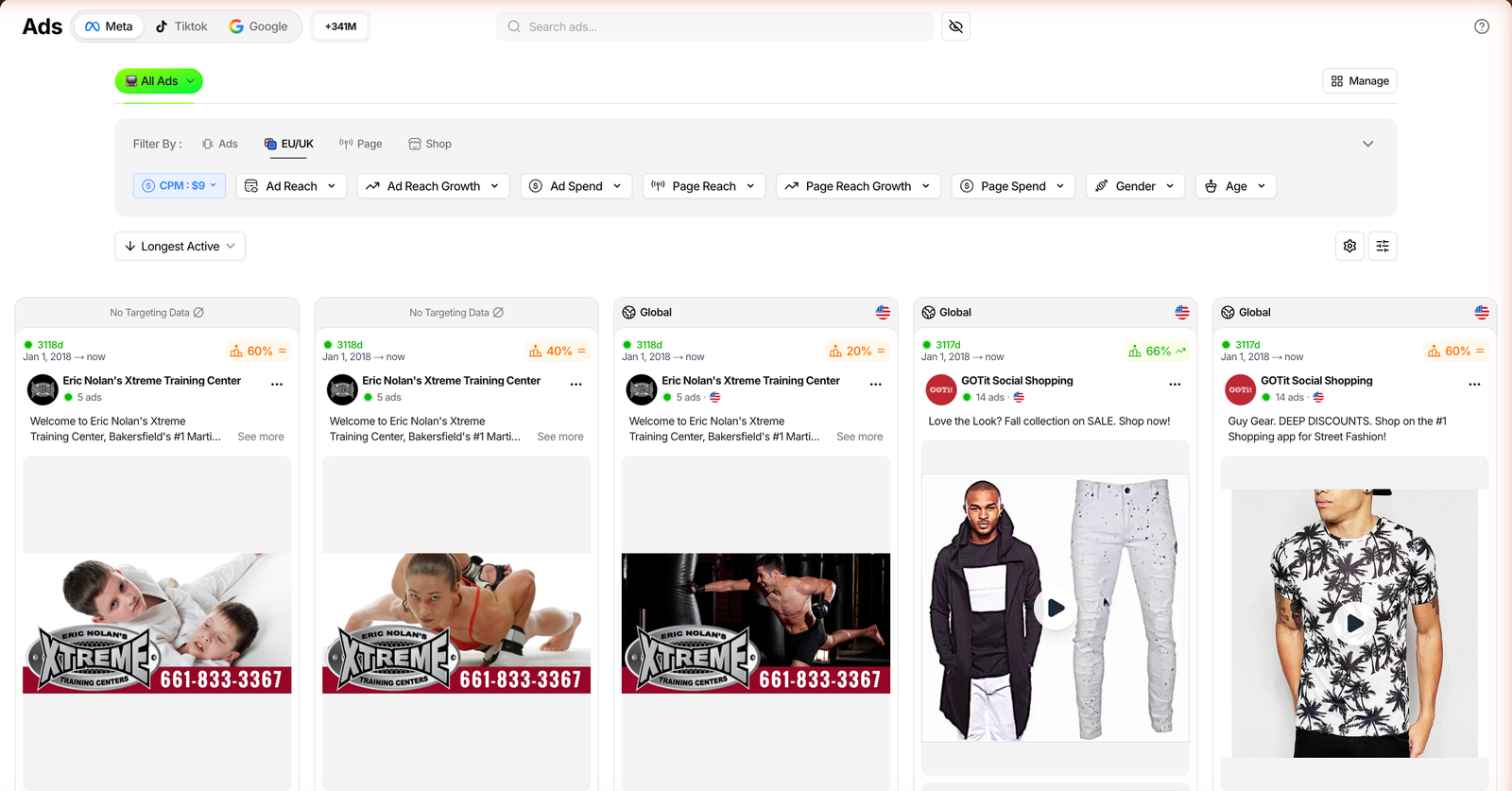
That is the difference between guessing and reading the market. Instead of betting your $300 test on a hunch, you can see the creatives, hooks and landing pages already scaling in your niche, then model your test on what works.
Related guide
How to Spy on Competitors’ Ads
See which competitor ads are actually scaling before you spend.
Paid ads are not the only channel. Organic TikTok content and short-form video can pull real traffic for close to nothing, and they pair well with a paid test once a product shows promise.
Keep your first test small and honest. One product, two or three creatives, a fixed budget, and a clear rule for when you cut it. Data beats hope every time.
The launch checklist by phase
Run the build in phases, not all at once. Each phase has one job, and you do not move on until it is done.
The order is the point. Most failed stores skip phase one, build something beautiful, and only find out at the ad stage that nobody wanted the product.
What the numbers really look like
Here is the honest math. Dropshipping margins are thinner than the hype suggests, and profit comes from discipline, not from a single viral product.
Ranges are typical for new stores, not audited results. Your outcome will vary.
Those figures are directional, not a promise. A 10% to 30% net margin means a store doing $10,000 in sales keeps roughly $1,000 to $3,000 before your own time.
Whether that math works for you depends on your goals and patience. If you want the full breakdown, read whether the model still pays off in 2026.
Frequently asked questions
Is Shopify good for dropshipping in 2026?
Yes, it is the default DTC platform: checkout, hosting and an app ecosystem are handled for you. The real cost is the monthly subscription (Shopify Basic is publicly listed around $39/mo) plus a theme and apps. The store can be near free; what costs money is the ad budget to validate a product.
How much does it cost to start dropshipping on Shopify?
The store itself is cheap: Shopify Basic (publicly listed around $39/mo), a free theme like Dawn, and a few free or low-cost apps. The real line item is validation: a $300 to $500 ad budget to test a product before you judge it. These are estimates, not audited figures.
Do I need product research tools for Shopify dropshipping?
Not required, but product research is the step that decides everything. Seeing which products already scale through competitor ads and rising stores saves weeks. A platform like TrendTrack indexes 1.87M+ Shopify stores and 340M+ ads you can filter for real demand. Estimated revenue figures stay estimates.
AliExpress or print on demand for dropshipping?
AliExpress dropshipping offers the widest product choice and the best margins, but long shipping times and variable quality. Print on demand removes inventory and lets you customize, though margins are tighter and delivery depends on the supplier. To scale, many sellers move to a sourcing agent to shorten shipping.
Is Shopify dropshipping still worth it in 2026?
Yes, under conditions. The model rewards operators who validate demand and test small, and drains those who pick products blind. Typical net margins land between 10% and 30%, so discipline, not luck, decides the outcome. See the dedicated guide for the full analysis.
The bottom line
Shopify dropshipping in 2026 is a real business for operators who treat it like one. The platform is the easy part; the product and the validation are where it is won or lost.
If you are willing to research before you build and test before you scale, Shopify gives you everything else out of the box. If you want passive income with no work, this is the wrong model.
When you reach the product research step, the logical next move is to stop guessing and read live demand from the stores and ads already scaling.