Last verified July 16, 2026. TrendTrack prices, gating and database counts checked on a paid account; market figures are directional estimates.
Can you name three competitors already selling your next product, and how long their ads have been running?
If not, that is the first mistake. Two more decide the rest: do you actually know your margin after shipping and ad costs, and do you have a rule for when to kill a test instead of hoping it turns around? Answer those three honestly and you have already dodged the errors that sink most new stores.
Most stores do not die from one dramatic error. They bleed out from a stack of small ones, each paid for in Meta ad spend. Here are the eight that quietly kill new stores, and the exact fix for each.
The single biggest dropshipping mistake is launching a product with no proof of demand: most failed stores pick on gut feeling, then pay to discover nobody wants it. Thin margins, weak creative and no testing discipline all compound from there. Read live demand and do the margin math before you spend.
Disclosure: some links on this page are affiliate links. If you subscribe through them we may earn a commission at no extra cost to you. We tested every TrendTrack feature mentioned here on a paid account.
| Mistake | Why it kills stores | The fix |
|---|---|---|
| No proof of demand | You fund the market research with ad spend | Read live ad count and run time first |
| Saturated products | CPMs climb, you are late to the curve | Enter early or add a real angle |
| Thin margins | No room to absorb ad costs or refunds | Full margin math before launch |
| Slow shipping | Chargebacks and one-star reviews | Vet suppliers, set honest ETAs |
| Copied creative | Same hook, worse hook rate | Study winners, then make your own |
| No testing discipline | Kill winners early, feed losers cash | Fixed budget and kill rules |
| Generic store | No trust, no repeat buyers | Brand basics and social proof |
| Neglected support | Refund spikes, ad account risk | Fast replies, clear policies |
Launching products with no proof of demand
The classic move is to scroll a supplier catalog, feel a spark, and order a $20 sample. Then you build a page and hand Meta $300 to find out if anyone else feels the spark. That is not product research; it is paying for market research with your ad budget.
The fix costs nothing and takes minutes. Before you commit, look at whether the product is already selling elsewhere: how many active ads it has, how long the best ones have been running, and whether comparable stores show healthy traffic. A product with strong live ad count and long run times has demand you did not have to fund yourself.
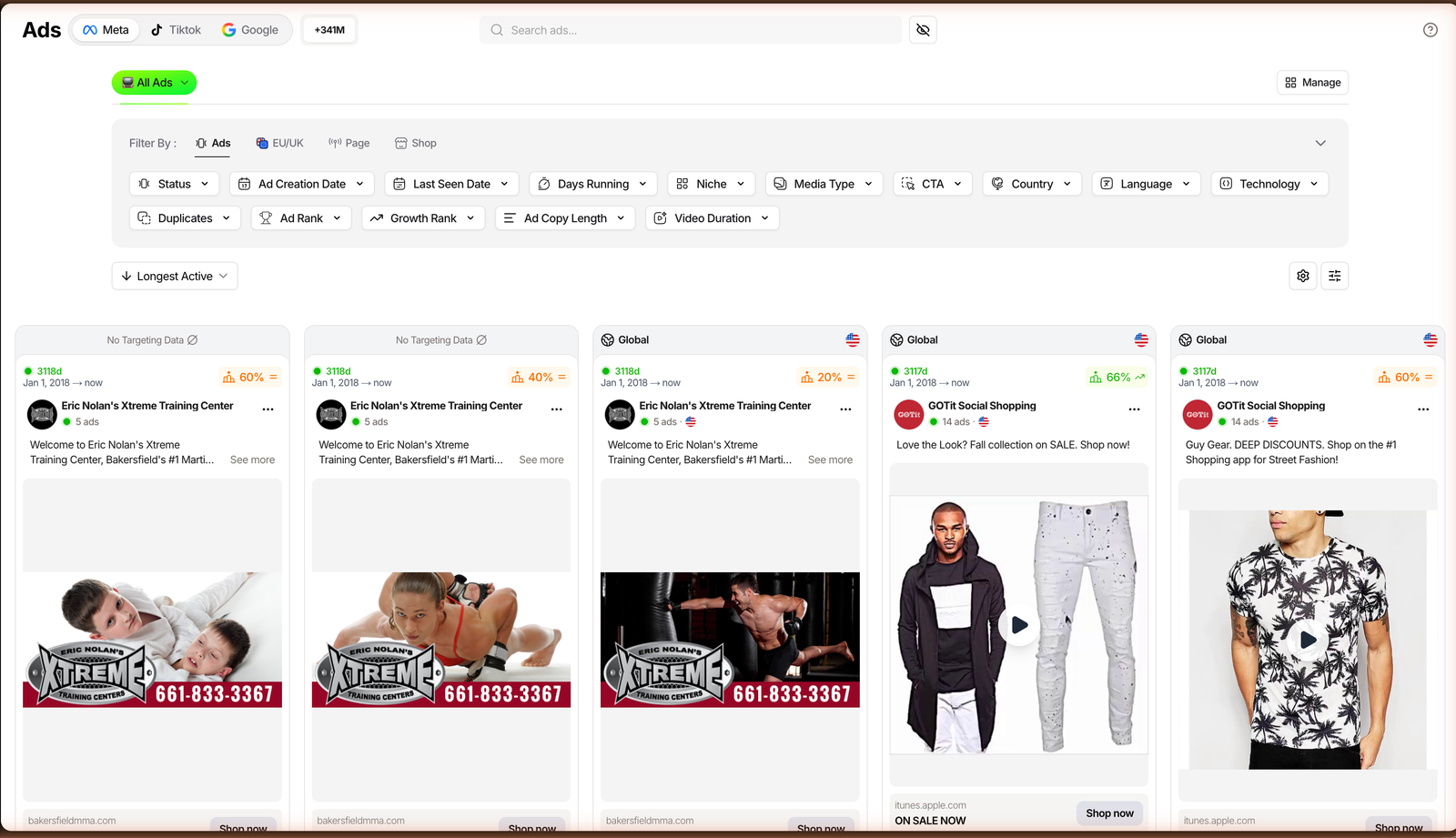
Run time is the tell people miss. An ad that has been live for weeks is not burning cash for fun; it is profitable enough to keep running. That single signal filters out most of the products that look exciting and sell nothing.
Related guide
How to Find Winning Products
The full workflow for spotting demand before you spend.
Chasing saturated products everyone already runs
The opposite mistake is jumping on a product at the top of every “trending” list. By the time a product is famous, thousands of stores run the same creative to the same audience, and CPMs punish everyone late to the curve. Popularity in a listicle is a lagging signal; it usually tells you the wave already broke.
Saturation is not automatically fatal, but it changes the job. If you enter a crowded product, you need a genuine angle: a better hook, a bundle, a fresh audience, or a landing page that outsells the copycats. Enter early or enter different, because entering late and identical is the version that loses money.
Competing on price and torching your margins
New sellers often assume the cheapest price wins. So they shave the product to a few dollars of margin, then hand most of that to Meta on the first click. One refund or one bad ad day, and the product is underwater.
Dropshipping is a paid-traffic business, not a discount store. Your price has to carry the landed cost, the shipping, the ad cost per sale, and still leave profit. If the math does not survive a realistic cost per acquisition, no amount of scaling saves it.
The amateur move
- Picks products on gut feeling
- Prices to be cheapest, ignores CPA
- Copies a competitor’s ad word for word
- Judges a test in a single day
The operator move
- Checks live ad count and run time
- Prices for margin after ad cost
- Studies winners, then builds new creative
- Tests to a fixed budget with kill rules
Ignoring shipping times and supplier reliability
A product can validate perfectly and still sink your store if it arrives in five weeks, cracked. Long transit times and flaky suppliers turn into chargebacks, one-star reviews, and payment processor flags that outlive the product. A great product with a three-week delivery window is a refund queue waiting to open.
Vet the supplier before you scale, not after the complaints roll in. Order the sample yourself, time the delivery, and set an honest ETA on the product page. Under-promising on shipping costs you a few conversions; over-promising costs you the customer and the dispute.
Running weak, copied ad creative
Because winning ads are easy to find, new sellers assume copying one is a shortcut. It is not. The same footage with a lazier hook gets a worse hook rate, and Meta charges you more to show a tired creative to a warm audience.
Study the winners for structure, not to clone. Look at how the first three seconds grab attention, what claim the copy leads with, and which format keeps people watching, then shoot your own version. The research is the input, not the output.
Scaling or killing ads too fast
No testing discipline is where budgets vanish. Sellers kill a promising ad after one slow morning, or pour money into a loser because they are attached to the product. Both are the same error: reacting to noise instead of a rule.
Related guide
How to Test Products in Dropshipping
Budgets, timelines and kill rules that keep tests honest.
Set the rules before you launch: a fixed test budget per product, a minimum window before you judge, and a clear metric that decides continue or kill. Discipline is boring, and it is the difference between a portfolio of small tests and one expensive tantrum. Write the kill rule down before emotion has a product to defend.
Running a generic, trust-free store
A store with a stock theme, no reviews, and a logo made in ten minutes converts cold traffic badly. Shoppers can smell a here-today page, and they bounce before they reach checkout. You paid for that click either way, so a thin store just means you paid to bounce them.
You do not need a full rebrand to fix this. A clean product page, real photos, visible reviews, clear policies and a consistent name buy enough trust to convert the traffic you already paid for. Branding is not vanity here; it is conversion rate.
Treating customer service and refunds as an afterthought
Support feels optional until the first wave of “where is my order” messages. Ignore them and refunds spike, disputes climb, and your payment processor starts watching your account. Processor holds and rising dispute rates can freeze the cash you need to buy your next round of ads.
Answer fast, set clear policies, and treat a refund as cheaper than a chargeback. Good service on a mediocre product still keeps the store alive; bad service on a great product still ends it.
How to stop guessing: validate before you launch
Here is the reframe that dissolves most of this list at once. Every mistake above is a decision made blind, yet the market is not actually hidden from you, because the winners advertise in public and the losers barely register.
TrendTrack index, checked in-app July 16, 2026.
Every mistake above shares one root: deciding without data. The reason we lean on a research tool is simple. Guessing is the expensive option, and the signals that end the guessing are already public if you know where to read them.
Before a product ever gets a dollar of ad budget, three checks catch most of the errors on this page.
Plan check: the ad spy modules (Ads and Advertisers) start on Pro ($89/mo, or $63/mo billed annually). Starter at $59/mo covers the Shops database, two Brandtrackers and the free Chrome extension.
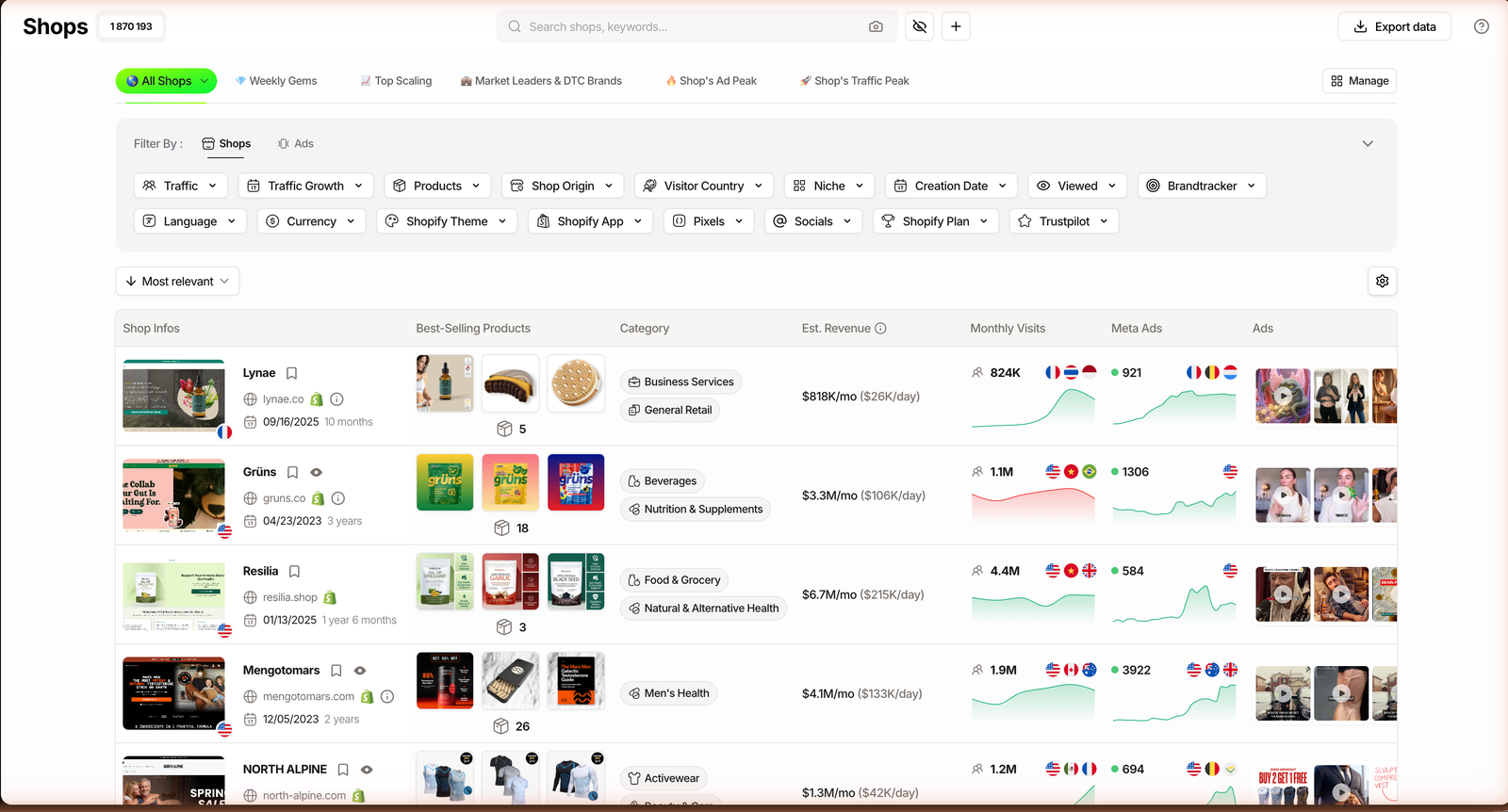
We ran these filters on a paid account, and the pattern is consistent. The products worth testing leave a trail of active ads and comparable stores, while the ones that feel clever and sell nothing leave almost no footprint. Estimated revenue is directional rather than audited, so treat it as a compass, not a bank statement.
None of this guarantees a winner, and no tool does. What it does is remove the mistakes that were never about luck: the unvalidated product, the saturated market, the margin that never worked.
Screen live demand in TrendTrack
Frequently asked questions
What is the single biggest mistake in dropshipping?
Launching a product with zero proof of demand. Most failed stores pick on gut feeling, then pay Meta to discover nobody wants it. The fix is to read live signals first, how many competitors already run the product and for how long, before you spend.
Why do most dropshipping stores fail?
Rarely one reason. It stacks: an unvalidated product, thin margins, weak creative, and no testing discipline, and each mistake compounds the ad-budget bleed. Fixing the demand and margin mistakes first removes most of the risk.
How do I validate a product before I sell it?
Check real demand and competition instead of guessing. Look at how many active ads a product has, how long the winners have been running, and whether comparable stores show healthy estimated revenue. Then do the full margin math, landed cost plus shipping plus ad cost.
Is dropshipping still profitable in 2026?
It can be, for operators who validate before they spend. Interest has cooled, and the dropshipping search trend is down year over year, but stores that avoid the mistakes here still ship profitably. If you are weighing the model itself, see whether dropshipping is still worth it.
How much money do I need to avoid these mistakes?
Less than you think for validation, more than you hope for ads. A research tool and a modest test budget beat a big spend on an unproven product. For reference, TrendTrack Shops starts at $59/mo and ad spy at Pro $89/mo, but the spending that matters is the disciplined test budget, not the software.
The bottom line
None of these mistakes need talent to avoid, only the patience to check before you spend. If you are just getting going, pair this with the basics on how to start dropshipping the right way, then validate every product against the three checks above.
Avoiding them takes no big budget and no background in ads. It takes resisting the urge to launch the product you already talked yourself into, and letting the data talk you out of the weak ones before Meta does it for you.
Beginners should obsess over the first three mistakes, demand, saturation and margin, because they cause the most damage for the least reason. Scalers already shipping should audit their testing discipline and supplier reliability, where the leaks are quieter but just as costly. Either way, the store that reads the market beats the store that guesses at it.