Last verified July 15, 2026. Prices and TrendTrack counters checked live in-app; market figures are directional estimates.
Search volume for “how to start dropshipping” is down 45% year over year. That is not the model dying. It is the tourists leaving.
The people who quit were here for a shortcut that never existed. What is left is a slower, more measurable business where execution beats hype. It is a worse fit for anyone chasing passive income, and a better one for anyone willing to run it like a real store. If passive income is the goal, weigh dropshipping versus affiliate marketing first.
This guide walks the whole path: what dropshipping actually is in 2026, how to pick a product, find a supplier, build the store, get your first sales, and read the real numbers. No income promises. Just the steps in the order they matter. It doubles as a beginner-friendly dropshipping roadmap.
To start dropshipping in 2026: pick a product with proven live demand, source it from a supplier you have vetted, build a clean Shopify store around one hero product, then test it with paid ads. Budget $300 to $500 to validate before you judge results. The store can be near free; the ad test cannot.
In this guide
What dropshipping really is in 2026
Dropshipping is simple to define. You list a product, a customer buys it, and your supplier ships it directly to them. You never hold stock and you only pay for a unit after it is sold.
That mechanic has not changed, but the market around it did. The easy-money crowd left, ad costs matured, and margins got tighter. So the winners now are operators who validate before they scale, not people chasing a viral clip.
Source: TrendTrack index counters, checked in-app July 2026.
Read those numbers the right way. The store and ad base is bigger and far more measurable than it was in 2020. If dropshipping were dead, the data you can spy on would be shrinking, not growing.
There are two ways to run this. The test-and-flip model chases a hot product for a few weeks, then moves on, while the brand model finds a proven product and builds a repeatable store around it. Both work, but 2026 rewards the second, because durable income comes from repeat buyers and a store people recognize.
Choose a product before a niche
Here is the contrarian part. You do not start from a “passion niche” and hunt for products inside it. You start from a product that already proves demand, then let the niche follow.
A niche is a bet on your taste. A product with live ads, a healthy best-seller price, and growing traffic is a bet on evidence. The second one is cheaper to be wrong about.
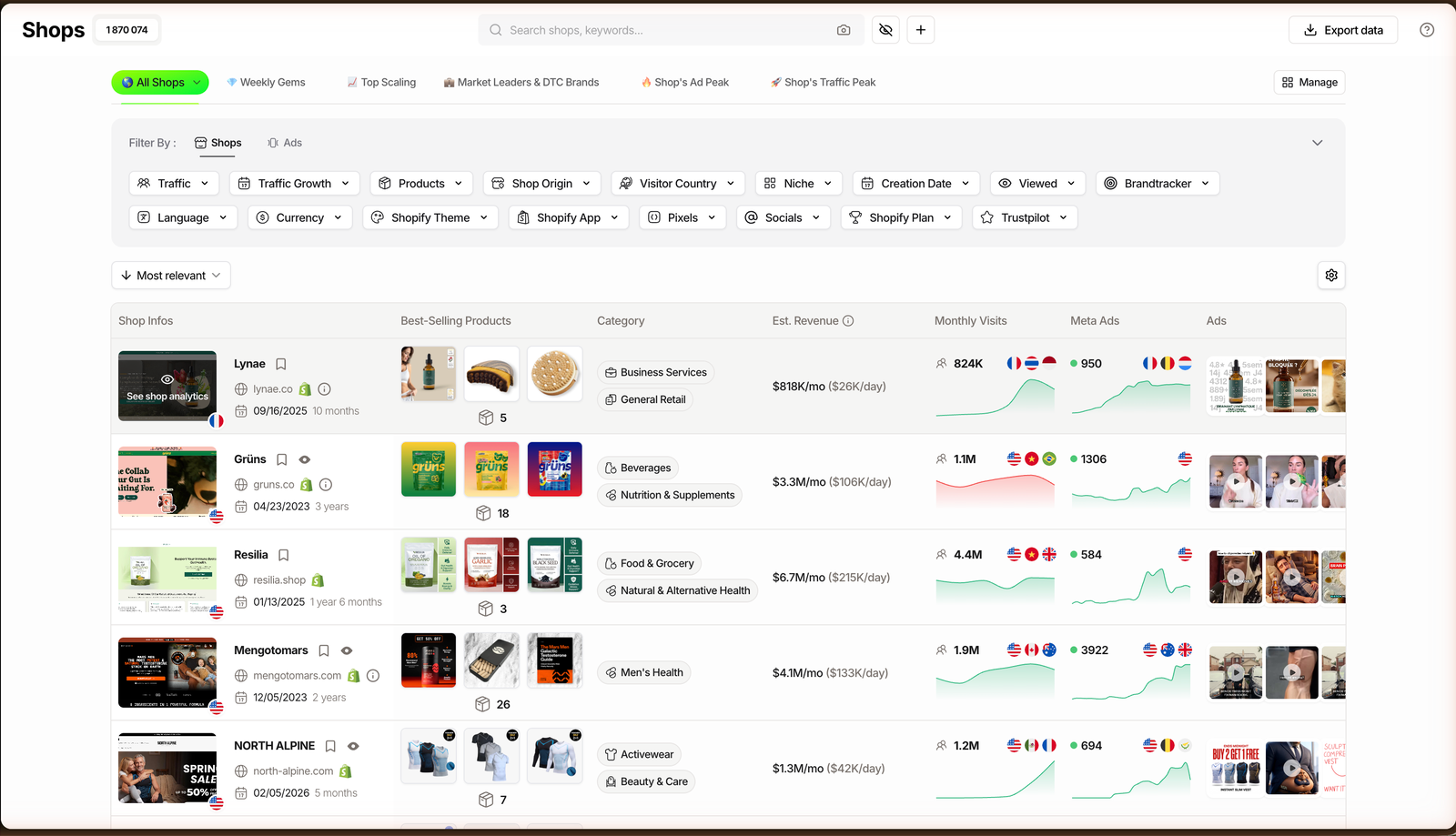
What to screen for: is the product being advertised right now, at what price does it sell, and is the store behind it growing? Those three signals separate a real opportunity from something that just looks good on a feed.
Live ads mean somebody is already spending money to sell it, which is the market voting with a budget. A best-seller price above roughly $30 gives you room for ad cost and still a margin. Rising traffic on the store behind it tells you the demand is fresh, not fading.
Related guide
How to find winning products
The exact signals that separate a scaling product from a viral fluke.
Do not skip demand validation. Before you commit, check demand on Google Trends to see if interest is rising or already cooling. Pair that with a repeatable product research routine so you are not restarting from scratch every week.
Find a supplier you can trust
Your supplier decides your delivery time, your defect rate, and half your margin. Pick badly and even a winning product turns into refund tickets.
You have three broad options. AliExpress or a sourcing agent gives the widest catalog and the thinnest margins, a domestic supplier costs more per unit but ships in days, and print-on-demand trades margin for zero inventory risk with full customization.
| Startup item | Typical range | Note |
|---|---|---|
| Shopify plan | $39/mo | Trial first, monthly after |
| Domain name | $10 to $15/yr | Buy a real .com |
| Core apps | $0 to $40/mo | Reviews, upsell, tracking |
| Product samples | $20 to $80 | Order before you sell |
| First ad test | $300 to $500 | The real cost of validation |
Whichever you pick, vet it the same way: order a sample yourself, time the real delivery, and message their support before you send them a single customer. If communication is slow now, it will be worse when something breaks.
Notice where the money is. The store is cheap; the ad test is not. Anyone telling you to start with zero budget is skipping the one step that tells you whether the product works.
Build the store on Shopify
You do not need a custom build. You need a hosted platform like Shopify, a clean theme, and a store that looks like a real brand instead of a template with a random product dropped in. The goal is not to impress other sellers, it is to look trustworthy to a stranger who just clicked your ad.
Keep the scope tight. One hero product, a focused product page, the trust and policy pages a buyer expects, and a checkout that works on mobile. That is enough to launch and test.
Spend your effort on the product page, since that is where the sale is won or lost. Real photos, a clear offer, honest shipping times, and a handful of reviews do more than any fancy homepage animation.
Before you spend a cent on ads, place a test order on your own store from your phone. If anything feels slow or sketchy in that flow, your customers will feel it too.
Handle the boring business setup
This is the part nobody makes a viral video about, and skipping it is how new stores get their payouts frozen. You do not need a lawyer to start, but you do need the basics in place before money moves.
Payments come first. Turn on a real processor such as Shopify Payments or PayPal, and make sure your store name, contact page, and refund policy match, since mismatches are the fastest way to a held payout.
Do at launch
- Enable a payment processor
- Write real shipping and refund policies
- Add a working contact email
- Start as a sole proprietor
Do once sales are steady
- Form an LLC if it fits your state
- Open a separate business bank account
- Track sales tax obligations
- Set up simple bookkeeping
The rule is simple: do the launch column before your first ad, and treat the second column as a reward for traction. None of this is legal advice, so confirm the rules for your own state before you formalize.
Get your first sales with ads
Paid traffic is not a growth lever yet. At the start, it is your validation test. Ads are how you learn whether real strangers will pay for your product at your price.
Most beginners start on Meta because the targeting and the ad library are mature, and the same playbook covers running Facebook ads for dropshipping. TikTok can be cheaper for the right product but rewards native, fast-paced creative over polished ads.
Start on Meta if
- Your product needs explaining or demoing
- You want stable, testable audiences
- You will reuse the same creative angle
- Buyers skew 30 and older
Start on TikTok if
- The product is visual and impulse-friendly
- You can shoot native, unpolished video
- You want lower entry CPMs to test fast
- Buyers skew under 30
Whichever you choose, run more than one creative. A single ad is not a test; it is a coin flip. Put a small daily budget behind three or four angles, cut the losers, and pour spend into the one that earns it.
Read the results by cost per purchase, not by likes. An ad with great engagement and no sales is a failed test, and a plain ad that quietly converts is the one you scale.
Margins and what you can actually make
Revenue is the number people brag about. Margin is the number that pays you. A store doing $50,000 a month can still lose money if the product, shipping, and ads eat everything.
A realistic net margin after product cost, fees, and paid traffic sits around 15% to 25% for most new dropshipping stores. Anything you see above that usually comes from strong repeat purchase or unusually cheap traffic, not the base sale.
| Where a $40 sale goes | Amount | Share |
|---|---|---|
| Product cost | $10 | 25% |
| Shipping | $5 | 12.5% |
| Ad cost per order | $14 | 35% |
| Payment and platform fees | $3 | 7.5% |
| Your net | $8 | 20% |
The lever most beginners ignore is repeat purchase. A first sale that barely breaks even becomes profitable when that customer buys again, which is why email and a real brand matter more than a one-time flip.
Tools that estimate a competitor’s revenue can help you size a market, but treat those figures as estimated, never as fact. Est. Revenue is a speedometer read from the outside, not the odometer inside the car.
Common mistakes that kill new stores
Most first stores do not fail because the idea was bad. They fail on the same handful of avoidable errors.
- Picking a product with no proof. If nobody is advertising it and no store is growing on it, you are the test subject.
- Running one creative. One ad cannot tell you if the product or the angle is the problem.
- Margins too thin to survive ads. A $15 product sold at $19 leaves nothing for paid traffic.
- Ignoring competitors. The stores already winning your product are telling you their angles for free.
- Scaling before validation. Ten times the budget on an unproven product is ten times the loss.
The fix for most of these is the same: validate with data and competitor evidence before you commit budget. Spend on the test, not on the guess.
None of these mistakes require a bigger budget to avoid, only a slower trigger finger. Do the homework on the product and the competition first, and most of them never happen to you.
The tools you actually need
You can start with fewer tools than most guides claim. You need a store, a way to research products and spy on live ads, and something to build creative. That is the core stack.
The research and ad-spy layer is where a tool earns its keep. Instead of guessing, you screen real stores by niche, price, and growth, then read which creatives competitors are actually running. We tested every module here on a paid account in July 2026.
Plan check: the Shops database and 2 Brandtrackers start on Starter ($59/mo). The Ads and Advertisers modules, the ad-spy core, begin on Pro ($89/mo, or $62/mo billed annually).
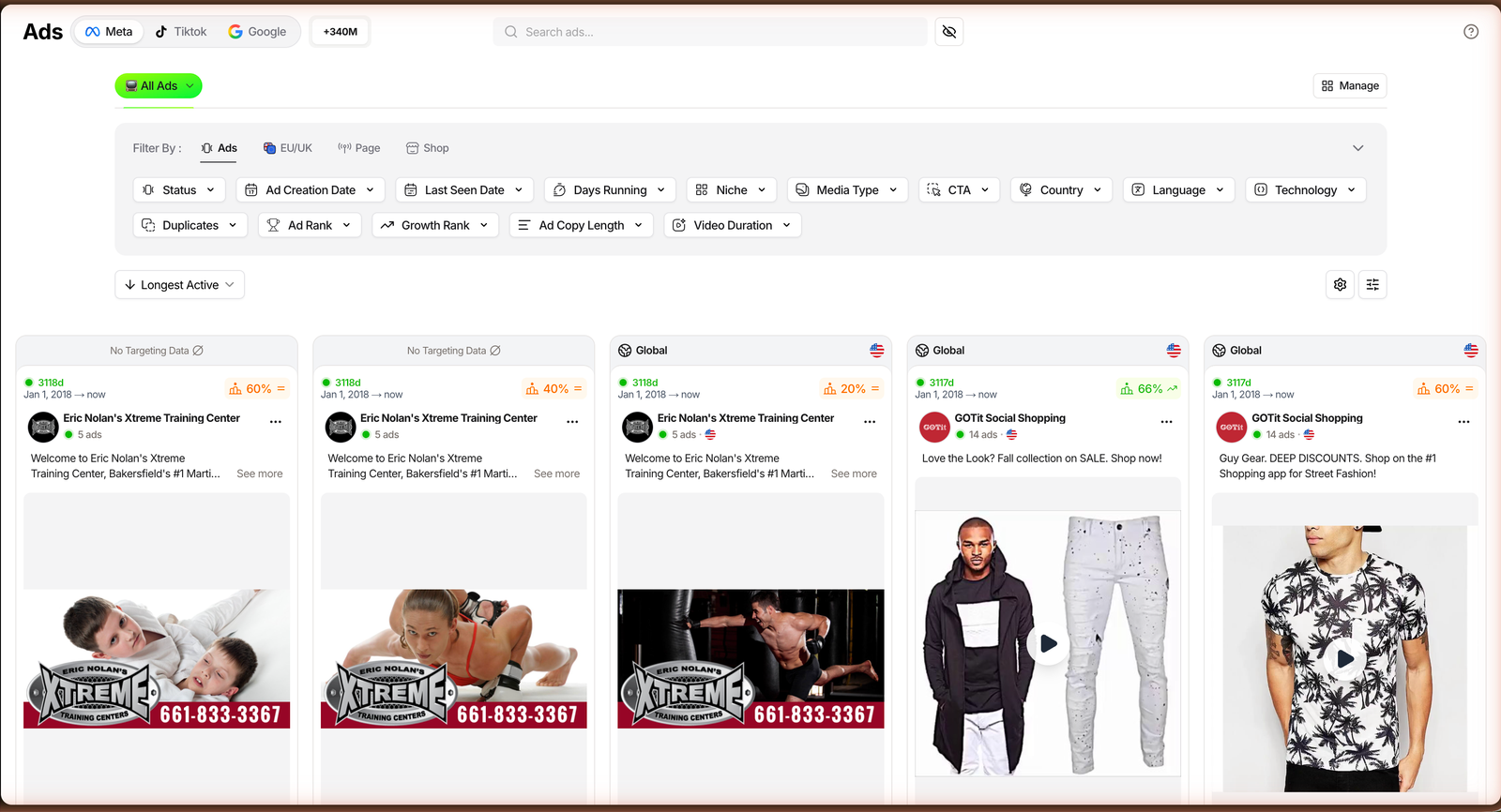
Inside the Ads module you filter by platform and by Ad Rank, TrendTrack’s ranking of which creatives are winning. Open any ad and you can see its landing page and how long it has been running, which tells you what to model before you spend.
Disclosure: some links on this page are affiliate links. If you subscribe through them we may earn a commission at no extra cost to you. We tested every TrendTrack feature mentioned here on a paid account.
See how TrendTrack scouts products
Want to see the full plan ladder before you commit? The gating matters most at the Starter to Pro jump, since that is where live competitor ad spying unlocks.
Related guide
TrendTrack pricing, plan by plan
Which plan unlocks what, monthly and annual, with no misleading math.
FAQ
How much money do you need to start dropshipping?
Plan for a Shopify plan around $39/mo (trial first), a domain near $15/yr, a couple of apps, and a real ad test budget of $300 to $500. You can technically launch for under $100, but without a test budget you cannot validate a product. Map those costs into a simple dropshipping business plan first. The store is the cheap part; the ad test is what actually teaches you.
Is dropshipping still worth it in 2026?
Yes for operators who treat it as a real business with product validation, healthy margins, and disciplined ad testing. No for anyone expecting passive income. Search interest is down 45% year over year, but the store and ad base is larger and more measurable than in 2020, so the opportunity is real for people who execute.
How long does it take to make your first sale?
Usually days to a few weeks once ads are running, not the same day. Your first sale is not the same as profit. Profit comes after you cut losing creatives and land on a product and angle that convert at a price that covers your ad cost.
Do you need an LLC to start dropshipping?
Not to launch and test. In most US states you can start as a sole proprietor and formalize into an LLC once you have consistent sales. This is general information, not legal advice, so confirm the rules for your own state.
What is the best product to dropship?
There is no single best product. The best product for you has proven live demand, a healthy margin at your selling price, and room to stand out from the stores already running it. Use data such as live ads, best-seller price, and traffic growth instead of guessing from your feed.
Can you start dropshipping with no money?
Not realistically. The store itself can be near free on a trial, but you need budget to test ads. With zero ad spend you are relying on organic reach, which is slow and unreliable for a brand-new store with no audience.
Start with the step in front of you
The path is not complicated: validate a product, vet a supplier, build a tight store, handle the business basics, test it with ads, and read your margins honestly. Do those in order and you skip the mistakes that sink most first stores.
If you spend money early on anything beyond the ad test, spend it on intelligence. Knowing which products already sell and which ads already convert is far cheaper than learning both by burning budget.
Dropshipping in 2026 rewards operators, not tourists. Pick the product that already has evidence behind it, and let the data decide what you scale.